




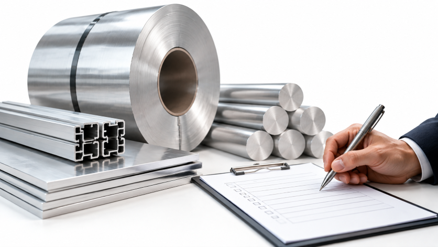
A delayed aluminium shipment can disrupt an entire manufacturing schedule. Production lines may be forced to slow down, customer commitments can be missed, and emergency purchases may come with higher prices and unfamiliar suppliers.
When your regular supplier cannot deliver aluminium on time, the priority is not simply to find any available material. You need to identify a reliable alternative supplier, quickly verify the material, confirm logistics and documentation, and make a commercially sound decision under pressure.
This guide explains how manufacturers, procurement heads and importers can manage urgent aluminium sourcing without compromising quality, compliance or delivery reliability.
Why urgent aluminium procurement is difficult
Aluminium procurement usually involves several technical and commercial requirements, including:
- Alloy and temper
- Product form and dimensions
- Quantity and packing
- Mechanical and chemical specifications
- Origin and compliance documents
- Delivery location
- Incoterms
- Payment terms
- Inspection requirements
During a normal procurement cycle, buyers have time to compare suppliers, request samples, complete technical approvals and negotiate commercial terms. In an urgent situation, these steps are compressed into a few days—or even a few hours.
The risk is that buyers may:
- Select an unverified supplier
- Accept material that does not meet specifications
- Overlook hidden freight or handling costs
- Pay for stock that is not actually available
- Miss important import or customs documentation
- Commit to a delivery date that the supplier cannot realistically meet
Urgency should accelerate the sourcing process, but it should not eliminate basic supplier checks.
Step 1: Define exactly what you need
Before contacting the market, prepare a clear emergency procurement brief. Suppliers can respond much faster when the requirement is specific.
Your brief should include:
- Aluminium product: sheet, plate, coil, extrusion, billet, ingot, rod, wire, foil or scrap
- Alloy and temper
- Dimensions, thickness and tolerance
- Required quantity
- Minimum acceptable quantity for an initial shipment
- Delivery destination
- Required delivery date
- Preferred Incoterm, such as EXW, FOB, CFR, CIF or DDP
- Required certificates and inspection documents
- Packaging requirements
- End-use or application, where relevant
- Acceptable substitutes, if any
For example, “aluminium sheet required urgently” is too vague for a supplier to quote accurately. A better requirement would specify the alloy, temper, thickness, width, length, quantity, destination and delivery deadline.
If the exact grade is unavailable, consult your technical team before accepting an alternative. A lower or different grade may affect forming, welding, strength, corrosion resistance, surface quality or product performance.
Step 2: Separate the requirement into critical and flexible specifications
Not every specification has the same level of importance. Dividing your requirements into fixed and negotiable points can help you secure supply faster.
Critical specifications
These usually cannot be changed without technical approval:
- Alloy
- Temper
- Minimum mechanical properties
- Thickness tolerance
- Chemical composition
- Product dimensions
- Safety or regulatory requirements
- Certification requirements
Potentially flexible specifications
These may be negotiable depending on the application:
- Coil or sheet width
- Coil weight
- Cut length
- Packaging format
- Delivery lot size
- Country of origin
- Partial shipment schedule
- Secondary finishing requirements
This approach helps suppliers identify workable stock instead of rejecting the enquiry because one non-critical preference cannot be met.
Step 3: Search for suppliers with available stock
When production is at risk, an aluminium stock supplier with ready material may be more suitable than a producer offering a lower price but a longer lead time.
You should search across several supplier categories:
- Stockists and distributors
- Service centres
- Aluminium mills
- Extruders and rolling mills
- Scrap processors and recyclers
- Traders with warehouse inventory
- Regional suppliers near the delivery destination
- Suppliers with cancelled or excess orders
For buyers in the United States, AL Circle’s directory of USA-onboarded aluminium suppliers can serve as an initial resource for identifying companies that may be able to respond to an urgent requirement.
However, a directory listing is only the starting point. It does not automatically confirm current inventory, technical suitability or delivery capability. Buyers should contact suppliers directly and verify the requirement against current stock and documentation.
Step 4: Ask the right questions immediately
An urgent enquiry should be short, clear and commercially complete. Avoid sending a long generic request that forces the supplier to ask several follow-up questions.
Ask the supplier:
- Do you have the exact material in stock?
- Where is the material physically located?
- What quantity is available for immediate shipment?
- Can you share recent photographs or warehouse evidence?
- What is the earliest dispatch date?
- What is the realistic transit time to the destination?
- Can you provide a mill test certificate or certificate of analysis?
- What are the exact alloy, temper and dimensions?
- What is the price and currency?
- Which Incoterm does the price cover?
- Are freight, insurance, duties and local charges included?
- Can you arrange third-party inspection?
- What payment terms are required?
- Can you ship a partial quantity first?
- What happens if the material does not match the agreed specification?
If the supplier cannot clearly answer basic questions about stock location, specifications and dispatch timing, treat that as a warning sign.
Step 5: Verify stock before making payment
One of the biggest risks in urgent aluminium sourcing is paying for unavailable material, already sold or materially different from the advertised product.
Before making an advance payment, request:
- Current stock photographs
- Images showing labels, heat numbers or batch details
- A packing list
- Warehouse location
- Mill test certificate or certificate of analysis
- Commercial invoice or pro forma invoice
- Supplier registration details
- References from previous buyers, where available
- Independent inspection, if the order value justifies it
Photographs alone are not sufficient proof of stock. They may be old, copied or unrelated to the actual consignment. Where the value or urgency of the purchase is high, appoint an independent inspection company to verify the material before loading.
Payment protection is also important. Buyers should avoid transferring the full amount to an unfamiliar supplier without completing basic due diligence. Depending on the transaction, safer options may include a letter of credit, escrow, staged payment, documentary collection or payment against verified shipping documents.
Step 6: Compare total landed cost, not just the material price
The cheapest offer may not be the cheapest solution. For urgent aluminium procurement, the relevant figure is the total landed cost.
Calculate:
- Material price
- Inland transport
- Export documentation
- Port handling
- Ocean or air freight
- Insurance
- Import duty
- Taxes
- Customs clearance
- Inspection charges
- Warehousing
- Demurrage and detention risk
- Currency conversion costs
- Financing or payment charges
Air freight may be justified for a small quantity of high-value aluminium, but it is usually uneconomical for bulk material. For larger shipments, buyers may consider a partial air or truck shipment to protect production while the balance moves by sea.
The correct decision depends on the cost of production downtime. If a delayed shipment could stop a factory for several days, paying more for a partial emergency delivery may be commercially rational.
Step 7: Use a two-track sourcing strategy
When the situation is critical, do not depend on one alternative supplier. Run two sourcing tracks at the same time:
Immediate supply
Focus on suppliers with ready stock, nearby warehouses or short delivery routes. The objective is to secure enough material to maintain production.
Replacement supply
At the same time, identify a supplier that can provide the remaining quantity under a more stable commercial arrangement. This may be a mill, distributor or long-term regional partner.
This strategy reduces the risk of replacing one supply disruption with another. It also gives your procurement team time to complete technical approvals and negotiate better terms for the larger order.
Step 8: Confirm quality before accepting substitutes
In an emergency, suppliers may offer similar alloys or alternative dimensions. These alternatives should never be accepted solely by the procurement team.
Technical, quality and production teams should confirm:
- Whether the alternative alloy is suitable
- Whether the temper provides the required strength and formability
- Whether the dimensions can be adjusted in production
- Whether the surface quality is acceptable
- Whether additional processing is required
- Whether customer approval is needed
- Whether the material remains compliant with applicable standards
A substitute may solve a short-term supply problem but create quality claims, rework or customer rejection later.
Step 9: Build a clear emergency approval process
Urgent buying often fails because responsibility is unclear. Establish a fast approval workflow covering:
- Technical approval
- Supplier verification
- Commercial approval
- Payment approval
- Logistics confirmation
- Import and compliance checks
- Final receiving inspection
Assign one person to coordinate the process and maintain a single record of supplier quotations, documents, approvals and delivery updates.
Do not allow multiple departments to contact the same supplier with different specifications. That creates confusion and can lead to incorrect material or duplicated orders.
Step 10: Protect future supply after the crisis
An emergency purchase should not be treated as a one-time solution. Once the immediate requirement is fulfilled, review why the regular supplier failed to deliver.
Possible causes include:
- Production breakdown
- Raw material shortage
- Port congestion
- Export restrictions
- Quality rejection
- Poor demand planning
- Financial distress
- Communication failure
- Inaccurate lead-time commitments
Based on the cause, consider:
- Qualifying a second supplier
- Maintaining safety stock
- Splitting orders between regions
- Signing framework agreements
- Reserving warehouse inventory
- Creating approved substitute grades
- Setting supplier performance indicators
- Using rolling forecasts
- Reviewing Incoterms and logistics routes
- Establishing an emergency supplier list
A dual-sourcing strategy may cost slightly more during normal periods, but it can prevent far greater losses when the main supplier fails.
How an aluminium sourcing service can help
An aluminium sourcing service can support buyers by helping them identify potential suppliers, compare offers, clarify technical specifications and coordinate communication.
This can be particularly useful when:
- The required grade is difficult to locate
- The buyer needs material from a new region
- The procurement team lacks local supplier contacts
- Several suppliers must be screened quickly
- The order involves technical or customised products
- The buyer needs support with documentation and logistics
- The transaction involves international trade
However, buyers should understand the scope of the service before proceeding. Ask whether the provider supports supplier verification, inspections, logistics coordination, documentation, payment protection and dispute resolution, or simply introduces suppliers.
Final checklist for urgent aluminium buying
Before confirming an emergency purchase, verify the following:
- The product specification is complete
- The supplier has confirmed physical stock
- The alloy and temper have been technically approved
- The quantity is available for the required shipment
- The delivery timeline is realistic
- The total landed cost has been calculated
- Certificates and export documents are available
- Payment terms are acceptable
- Inspection arrangements are clear
- The supplier’s legal and commercial details are verified
- A backup supplier or partial shipment plan is available
Conclusion
When a regular aluminium supplier cannot deliver, speed matters—but speed without verification creates additional risk. The best response is to define the requirement precisely, search for available stock, contact multiple suppliers, verify inventory and documentation, calculate the total landed cost, and involve technical and quality teams before accepting substitutes.
Manufacturers, procurement heads and importers can reduce disruption by maintaining an approved supplier network before a crisis occurs. When urgent sourcing becomes necessary, a structured process makes it possible to buy aluminium urgently while protecting production, quality and commercial interests.
For buyers seeking potential suppliers in the United States, the USA aluminium supplier directory can serve as a starting point for identifying companies to contact for current stock and delivery options.