








The choice between primary and secondary aluminium is often treated as a simple quality question.
Primary metal is seen as clean and reliable. Secondary metal is seen as cheap but less consistent.
That view is too basic.
The source of the metal matters. But the alloy grade, chemical limits, melt treatment, process control and test results matter more. A well-made secondary alloy can meet a strict specification. And primary aluminium can still fail if the wrong grade or temper is supplied.
So, when comparing primary vs secondary aluminium, buyers should start with the application. They should then check the required chemistry, mechanical properties, surface finish, conductivity and traceability.
What is primary aluminium?
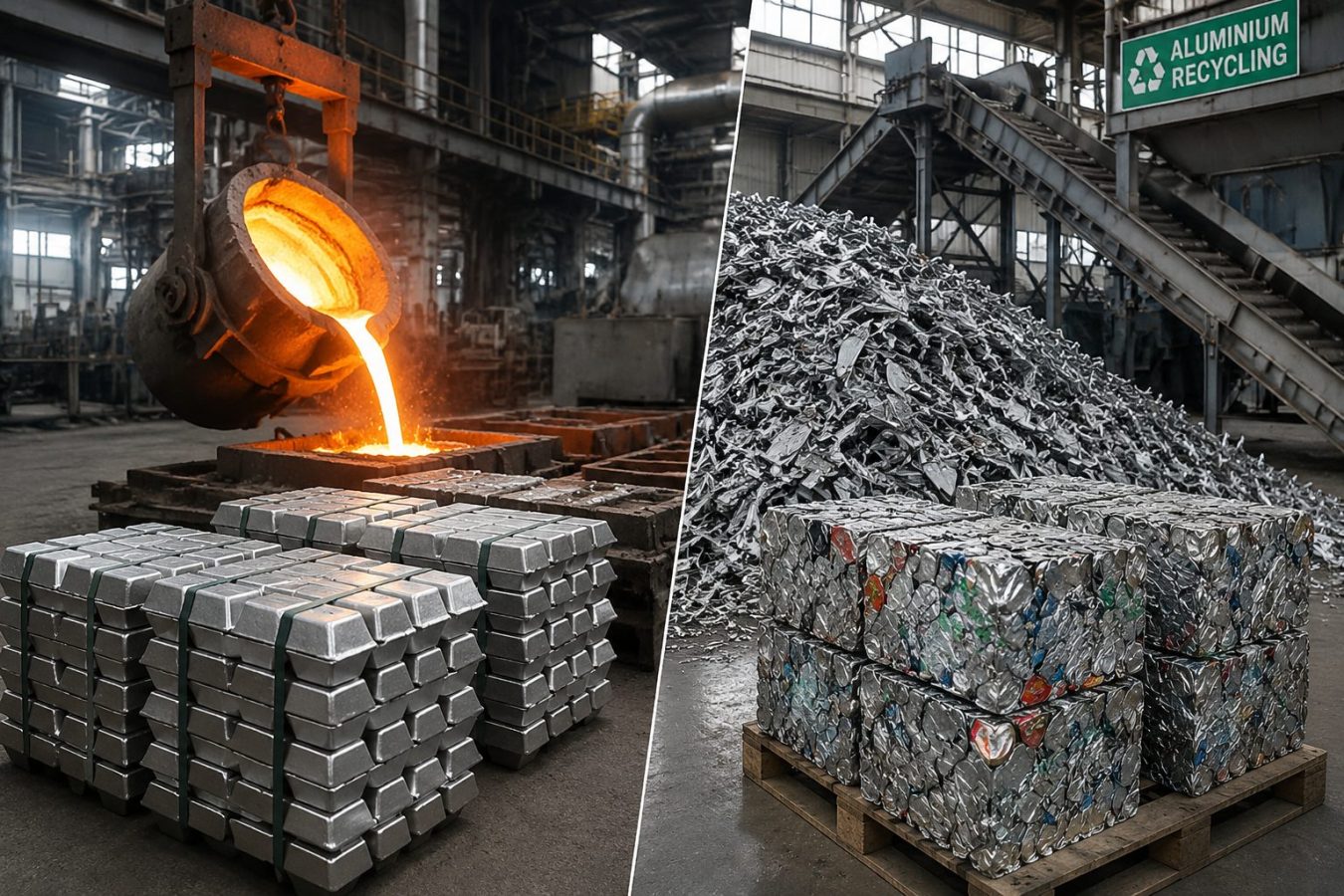
Primary aluminium is made from bauxite ore.
The bauxite is refined into alumina. The alumina is then reduced to liquid aluminium through electrolysis in a smelter. The International Aluminium Institute defines primary aluminium as metal tapped from electrolytic cells during the reduction of metallurgical alumina.
The liquid metal can be cast into ingots, billets, slabs, sows or T-bars. It may also be mixed with magnesium, silicon, copper, manganese or other elements to make a set alloy.
Primary aluminium is often chosen when a buyer needs:
- Low and tightly controlled residual elements
- High electrical or thermal conductivity
- Stable chemistry across large batches
- A clean surface for rolling, foil or special finishing
- Full traceability for a critical product
Note for procurement teams: Buyers can view primary aluminium products on AL Biz, including ingots, billets, slabs and wire rods. The category also includes common purity grades such as A7, A8 and A9.
What is secondary aluminium?
Secondary aluminium is made by remelting aluminium scrap.
The scrap may come from a factory or from a product that has reached the end of its life.
Pre-consumer scrap includes process offcuts, extrusion ends, rolling scrap and casting returns. It is often clean, and its alloy is easier to identify.
Post-consumer scrap includes used beverage cans, old window profiles, vehicle parts, cables, wheels and mixed scrap. This material needs more sorting and preparation.
Read more about types of aluminium scrap and their sources.
The secondary aluminium process usually includes:
- Collection and sorting
- Shredding, baling or cutting
- Removal of iron, plastic, oil, paint and dirt
- Melting and flux treatment where needed
- Degassing, filtration and chemistry correction
- Casting into ingots, billets, slabs or other forms
You can explore secondary aluminium products and aluminium scrap offers on our marketplace.
The marketplace covers alloy ingots, LM series ingots, deoxidisers, billets and several commercial scrap grades.
Primary vs secondary aluminium: Chemistry
The main difference between primary and secondary aluminium is the feedstock and production route. But the final performance comes from the finished alloy.
Strength does not come from the word “primary” or “secondary”. It comes from:
- Alloy composition
- Grain structure
- Heat treatment or temper
- Casting or forming method
- Porosity and inclusion control
- Surface and dimensional quality
This point is often missed in primary vs secondary aluminium discussions.
For example, a secondary ADC12 ingot made from sorted scrap can perform well in pressure die casting if its silicon, copper, iron, zinc and other elements remain within the agreed limits.
But a mixed ingot sold only as “98% aluminium” may not be suitable. Purity alone does not define an engineering alloy.
The same applies to primary metal. An A7 ingot may have a high aluminium content, but it is not a direct replacement for every 6xxx billet, 3xxx sheet alloy or foundry alloy.
Always buy to a full specification, not a broad label.
Primary vs secondary aluminium: Key differences
| Factor | Primary aluminium | Secondary aluminium |
| Main feedstock | Alumina made from bauxite | Pre-consumer or post-consumer scrap |
| Production route | Electrolytic reduction followed by casting | Sorting, remelting, refining and casting |
| Chemistry control | Usually easier at low residual levels | Depends heavily on scrap sorting and melt control |
| Energy use | High, mainly due to electrolysis | Much lower during remelting |
| Cost basis | Primary metal price, premium and conversion charges | Scrap price, recovery, processing and alloy demand |
| Common forms | Ingot, billet, slab, rod, sow and T-bar | Alloy ingot, billet, deoxidiser, slab, sow and T-bar |
| Typical fit | Low residuals, conductivity and strict traceability | Casting alloys, closed-loop scrap and industrial uses |
| Main buying risk | Paying for purity the product does not need | Variable chemistry, contamination or poor recovery |
Primary vs secondary aluminium: Which one costs less?
Secondary aluminium often costs less than primary metal. But this is not a fixed rule.
The final cost of secondary metal depends on:
- Scrap grade and availability
- Metal recovery and melt loss
- Iron, zinc, magnesium and copper content
- Sorting, shredding and cleaning costs
- Fuel, flux, salt and labour
- Dross generation and disposal
- Required alloying additions
- Freight and local demand
Clean and sorted scrap can carry a high price because it offers better recovery and easier chemistry control.
Mixed scrap may appear cheap. But it can create more dross, need more alloy correction and lead to rejected batches.
Primary aluminium also carries costs beyond the base metal price. These may include regional premiums, billet or slab conversion charges, alloying costs, freight and finance.
Note for procurement teams: Buyers should compare the total landed cost of usable metal. Comparing only the price per tonne gives an incomplete result.
Primary vs secondary aluminium: Which option has the lower carbon footprint?
Secondary aluminium has a clear energy advantage.
The International Aluminium Institute reports primary energy demand of 8.3 gigajoules per tonne for recycled aluminium. Global primary aluminium production from mine to cast house used 186 gigajoules per tonne.
That represents an energy saving of about 95.5 per cent.
But carbon claims still need to be checked.
A low-carbon aluminium purchase should consider:
- The source of electricity and fuel
- The method used to calculate recycled content
- The distance travelled by the scrap
- Metal yield and dross loss
- Whether both figures use the same system boundary
- Whether the supplier can provide an EPD or product carbon footprint
So, the answer to primary vs secondary aluminium is not simply that all secondary metal is green. Recycled aluminium normally needs far less process energy. But the environmental claim should still be supported by data.
Where primary aluminium is usually the safer choice
Primary metal is often preferred when low residual content is difficult to achieve from the available scrap stream.
1. Electrical conductors
Electrical conductivity can fall when iron, silicon and other elements rise.
Conductor rods and some busbar grades need close control of both chemistry and conductivity. Primary metal is often used, although clean production scrap may be added when the specification allows it.
2. High-purity foil and chemical uses
Thin foil, capacitor foil and some chemical applications need very low impurity levels and tight surface control.
Primary aluminium gives the producer a cleaner starting point.
3. Critical aerospace and defence parts
The main requirement is not simply virgin metal. It is strict alloy control, an approved production route and full traceability.
Recycled content may be possible, but only through a qualified and controlled process.
4. Alloy correction
Secondary producers may add primary aluminium to dilute unwanted elements or bring a melt within specification.
This is a normal and practical part of metal production.
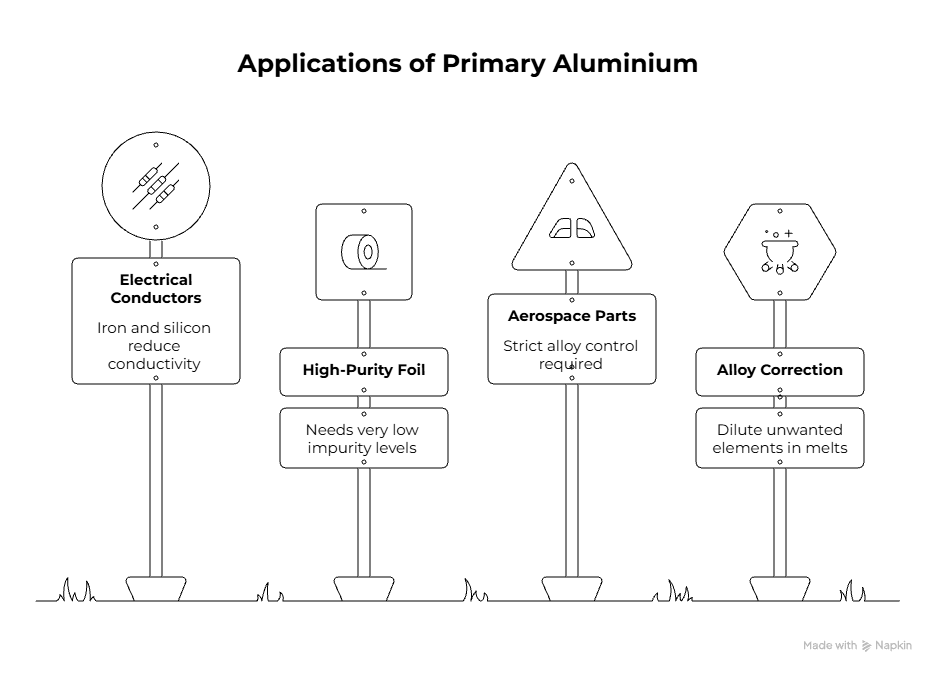
Image used for representational purpose
Where secondary aluminium works well
Secondary metal works well when the scrap stream and alloy limits match the final product.
1. Die casting
Many pressure die casting alloys can use a high share of secondary metal.
Grades such as ADC12, A380 and LM24 are common in automotive parts, appliances, hardware and industrial machinery.
Buyers often ask, “Is secondary aluminium suitable for die casting?”
Yes, it often is. But the supplier must control chemistry, hydrogen, inclusions and batch consistency.
2. Automotive castings
Engine housings, transmission cases, brackets, covers and many other cast parts use secondary foundry alloys.
The part design, loading conditions and alloy specification still decide whether the material is suitable.
3. Construction products
Old extrusion scrap can return to extrusion or casting routes after sorting.
Doors, windows, profiles and building systems can contain recycled aluminium. But visible surfaces and tight extrusion tolerances require sound billet quality and stable chemistry.
4. Steel deoxidation
Secondary aluminium is supplied as notch bars, shots, cubes, cones and granules for steelmaking.
Buyers should check aluminium recovery, size, moisture and unwanted elements.
5. Closed-loop manufacturing
Clean process scrap from a known alloy can often be remelted and returned to the same product family.
This gives better chemistry control than using mixed scrap. It also lowers waste and reduces the need for new metal.
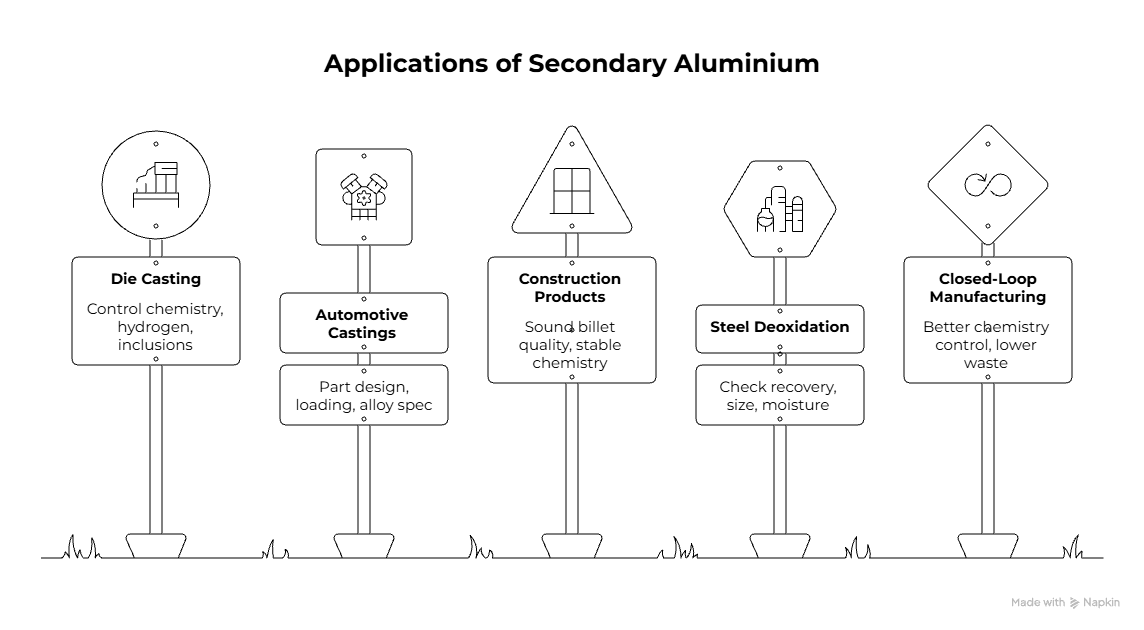
Image used for representational purpose
What should buyers check before placing an order?
A proper secondary aluminium buying guide must go beyond price and purity.
Ask the supplier for:
- Exact alloy grade and standard
- Full chemical composition range
- Certificate of analysis for each heat or batch
- Limits for iron, silicon, copper, zinc and magnesium
- Limits for lead, tin and other unwanted residuals
- Mechanical properties where required
- Conductivity data where required
- Hydrogen or inclusion data for sensitive castings
- Scrap source and recycled content method
- Batch size and consistency records
- Packaging and moisture controls
- A sample or trial order before a large purchase
And check the supplier’s process.
A furnace alone does not make good secondary metal. Sorting, melt temperature, skimming, degassing, filtration and spectrometer testing decide the final quality.
Note for procurement teams: Buyers can review current business leads or post an RFQ on our marketplace with the required alloy, quantity, certificate, destination and delivery terms. They can also upload technical specifications with their RFQ.
Final choice: Match the metal to the correct application
There is no single winner in primary vs secondary aluminium.
Choose primary metal when the product needs very low residuals, high conductivity, tight surface quality or strict approved traceability.
Choose secondary metal when the alloy can be made from a controlled scrap stream and the supplier can prove its batch quality. It is often a sound choice for die casting, steel deoxidation and many industrial parts.
And consider a blend when you need both recycled content and tighter chemistry.
The right purchase is not the cheapest tonne. It is the metal that meets the specification with a low total cost, stable supply and verified environmental data.


 Voyagerman Technology


