









A deposit return scheme (DRS) is a government programme that incentivises end consumers to return aluminium cans and plastic bottles for recycling by offering them a nominal monetary value for the same. Europe, Australia, and North America are some of the places that have successfully rolled out DRS over the years for aluminium recycling and gained results.
In Europe, DRS finds its roots in Sweden, where the programme started in 1984, using reverse vending machines to collect aluminium cans from consumers for a small monetary reward. Later on, several other European countries have implemented their own DRS programmes. Legislation around DRS seems more important, given that used beverage cans (UBCs) are a large source of revenue for state-owned material recovery facilities. Moreover, the International Aluminium Institute has often prescribed DRS as one of the pillars in its goal to reach an 80 per cent global UBC recycling rate by 2030 and a 100 per cent recycling rate by 2050.
The DRS programme is based on mutual benefit for both the producer of the container and the consumer. While upstream aluminium can producers get access to increased volumes of feedstock for their rolling mills (which produce can sheet for the aluminium cans), the consumer has a monetary incentive to bring the container back to the source. In many cases, consumers will store and stockpile cans so that they can return them in bulk and reap a larger reward for doing so. This behaviour is also seen in restaurants across Europe that return cans using local collection points at the end of each working day. These small efforts lead to several tonnes of material being collected each month across the country that uses a DRS programme. Hungary in Europe collected an average of 116.5 million cans each month in Q2 2026 through DRS programmes.
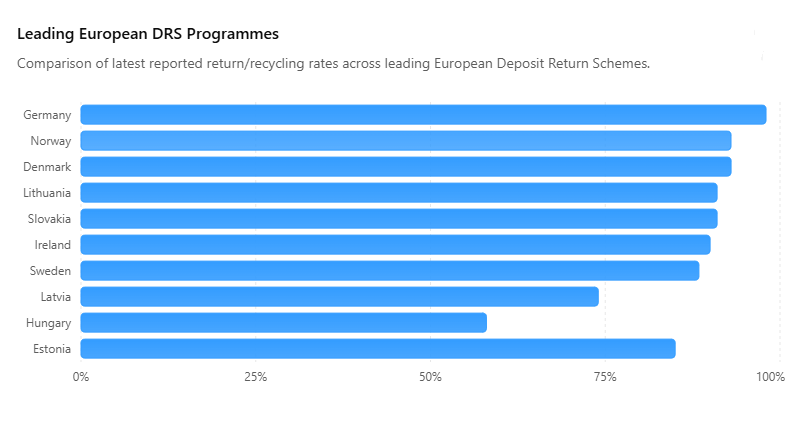
Development of DRS in Europe
Sweden’s original goal with the DRS programme was to reduce litter in the country, add metal back to the recycling stream and establish closed-loop recycling systems. In the first three years of implementation, the system logged a recycling rate of 70 per cent. Today, the Swedish DRS pays about $0.11 per can, with plans to raise it to $0.21 per can in the coming months. This monetary reward is now standard across DRS programmes in Europe. The programme is run by a private firm named Returpack AB under the brand Pantamera. The company is jointly owned by the Swedish Brewers Association and the Swedish Food Retailers Federation. According to the latest figures, Pantamera collected a record 3 billion containers (aluminium cans and plastic bottles) in 2025, which is an increase of 130 million units from 2024. The company indicated that the country’s container recycling rate has now reached 88.4 per cent, closing in on the national target of 90 per cent.
Other European countries that have adopted DRS programmes to increase UBC recycling rates include Norway in 1996, supported by a recycling company Infinitum; Denmark in 2002, managed by a circular firm Dansk Retursystem; and Germany in 2003, facilitated by Deutsche Pfandsystem GmbH. In addition, many Eastern European countries like Estonia, Croatia and Latvia adopted the scheme in the early 2000s. The most recent adopters include Ireland, Hungary, Poland and Austria in 2024-2025. Today, 18 of the 27 countries in the European Union have a functional DRS programme in place. The success of the scheme across Europe has led to advanced discussions in other member countries to consider adopting it. Legislation has been passed in the UK (still considered part of Europe but not part of the EU), Spain, Portugal, Cyprus and Greece, while policy makers discuss the programme in Belgium, Italy, Luxembourg and France.
Interestingly, Ireland has great evidence on how their DRS programme has worked. Branded as Re-turn, the Irish DRS programme has focused more on consumer awareness and labelling, apart from setting up efficient collection points in the form of reverse vending machines. As part of the implementation, the Irish government made it mandatory for all beverage containers, whether plastic or aluminium, to be labelled with a Re-turn logo to ensure that customers know that the item can be recycled using the DRS programme.
In 2025, Re-turn collected around 1.4 billion beverage containers, which was 300 million more than in 2024. In just two years of implementation, the Irish recycling rate climbed from 49 per cent to 90 per cent, with DRS responsible for 76 per cent of the collection. The country also saw a 60 per cent decrease in street litter after the programme was adopted. A similar story has been developing across Hungary, where the DRS operator Repont has collected over 1.58 billion containers over the first two years of implementation, of which 614 million units were aluminium cans. Cans formed around 42 per cent of the total collected units, with the most common items being beer and energy drink cans. The total volumes of cans put to market versus recycled (recycling rate) were around 58 per cent at the end of 2025, compared with an estimated 30 per cent in 2023, before the DRS programme was implemented.
What does the aluminium industry feel about DRS?
European Aluminium, the largest aluminium trade association in the region, is a strong believer in DRS and its capacity to increase recycling rates. As per the latest data, Europe’s recycling rate stood at 76.3 per cent at the end of 2023, with a 7 per cent increase in UBC recycling volumes over the prior year. The concerning factor is that while recycling volumes have risen, so has the amount of cans produced and brought to market. Hence, the gains in the real recycling rate have not been at the pace expected.
European Aluminium cited increases in countries that recently adopted DRS as evidence for success. Latvia introduced DRS in 2023 and saw its national UBC recycling rate rise from 60 to 74 per cent during the year, while the Slovak Republic saw its recycling rate climb from 58 to 91 per cent in the same period. Andy Doran, the director of packaging at European Aluminium, said that a well-designed DRS offers not only consumer incentives to return high-value aluminium cans but also a rather simple way to establish closed-loop cycles within a country’s economy. He also added that Europe’s Packaging and Packaging Waste Regulation (PPWR), which was recently introduced, makes it compulsory for all EU member states to implement DRS for single-use metal and plastic beverage containers by January 1, 2029.
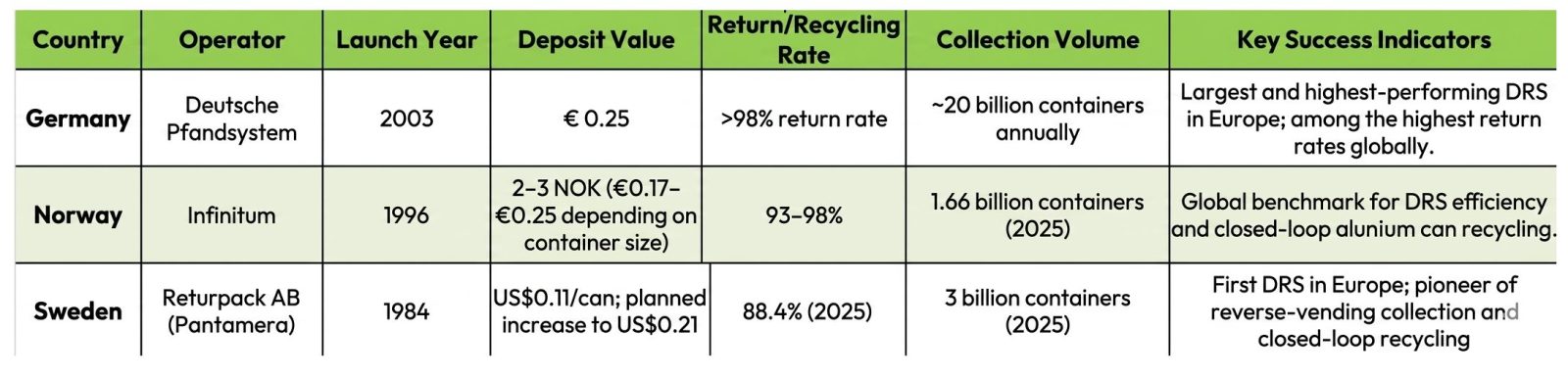
Top 3 European countries with most successful DRS implementation
Doran sees DRS a powerful tool for Europe to increase its aluminium and plastic recycling rate meaningfully as the region moves toward a 100 per cent recycling rate, in line with global standards set by the International Aluminium Institute (IAI). The IAI 2025 factsheet on aluminium can recycling shows us that while the collection of cans is important, the correct use of them is in can-to-can recycling. The data shows that more than 33 per cent of aluminium cans are melted into other forms of aluminium, like cast and sheet, which are then used to make other products. The IAI considers this to be a downcycling of UBCs, as their purity can be utilised to make new cans instead. It also reveals that new cans now contain about 41 per cent recycled content, which can be increased to 62 per cent by securing a reliable supply of UBC scrap for the can sheet producers in every region.
What makes a DRS programme successful?
A recent white paper by TOMRA on DRS programmes revealed several points to be considered while implementing and maintaining this scheme. The first metric highlighted was return rate targets. Most countries evaluate DRS based on improvements in UBC recycling rates. Countries that can reach 85 per cent or higher are usually considered to be running high-performance schemes. The importance of targets is that they allow for cooperation between producers, retailers and policy makers to work toward common goals while also delineating the amount of investment required in terms of deposit capital and infrastructure to make the programme efficient.
Another important point is to include a broader scope of beverage containers under the DRS programme. Producers must work with the government to establish the materials and sizes of containers they can recycle. In this sense, many countries adopt a size range of 100ml to 3 litres, with common materials being aluminium, plastics and often glass. Research has shown that these categories cover close to 99 per cent of the beverage containers being produced for consumers across Europe and the world.
Lastly, but definitely not the least important, is the monetary benefit the DRS scheme brings to the consumer. Several market participants in the UBC recycling industry agree that a singular base rate cannot be used for a sustained period of time, since inflation reduces the value of the benefit. Today, it is widely considered that a meaningful DRS programme cannot be run with a refund of less than $0.06 per container, with higher performance examples like Sweden, Norway and Germany paying above $0.20 per container. TOMRA’s data finds a direct correlation between the refund amount and the volume of UBC collected using the DRS scheme.
What lies ahead for DRS programmes in Europe?
Europe is considered to be a climate-conscious region in the world, with the Paris Climate Agreement and Conference of the Parties on Climate Change (COP) being widely recognised as the forefront of human efforts for the environment. It should come as no surprise that DRS, a great tool to increase resource utilisation and reduce material landfilling, works well in Europe. While several other regions in the world are also working to raise UBC recycling rates, the EU has gone a step further with the PPWR and made it mandatory in the near future. If you believe what the industry has to say about DRS, it can only be a great benefit for both consumers and recyclers. Moreover, the DRS compels the government and the aluminium industry to work together to improve how recycling works. The setting up of a truly closed-loop can-to-can recycling system is a critical step in ensuring future resource efficiency for the aluminium industry in Europe and across the globe.
Read all the latest developments in Europe’s aluminium recycling industry: Click here



 Voyagerman Technology


