







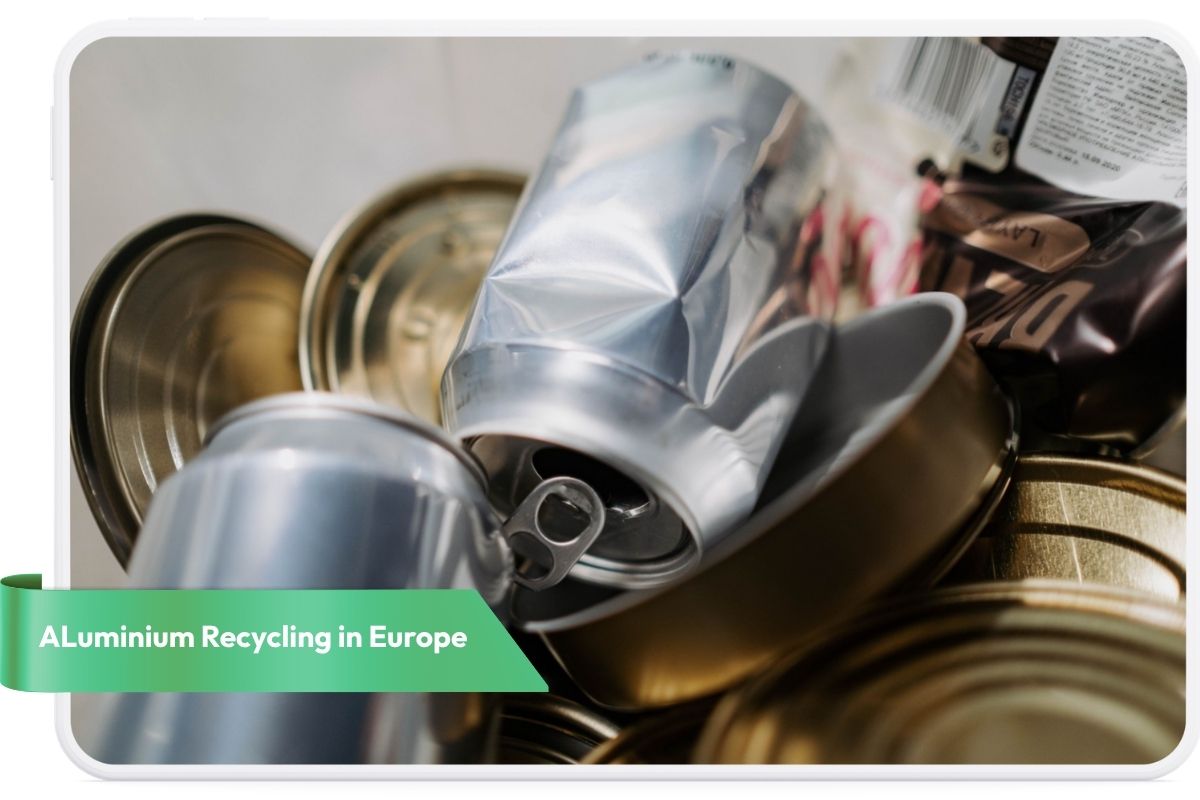
The global aluminium industry seems to be shifting to favour recycling over primary. In Europe, primary aluminium production has been curtailed by around 50 per cent since 2022 due to the energy crisis. Hence, aluminium recycling started to make much more sense as it consumes only 5 per cent of the energy needed to make the primary product. Moreover, the European region plans to reduce reliance on primary aluminium imports and reshore its aluminium scrap from exports to Asia. This can only be made possible through new investments in domestic recycling capacity in the region, which will enable supply to meet the 8 million tonnes of projected demand for 2025 and beyond. In the past two years, many plants have been approved for construction and will come online in the second half of 2026, while others are just getting started. The industry as a whole seems to be growing at a rapid pace owing to the increased acceptance of secondary aluminium as high-quality feedstock.
CLEANMAT (Smart Clean Aluminium Material Processing)
This is a project backed by the European government with a €7.3 million ($8.35 million) investment. The main aim of the project is to reduce the use of fluxing agents and chemical cleaning of aluminium scrap while also reducing emissions. It aims to deliver an end-to-end pathway that allows for low-quality scrap to be converted into high-grade aluminium alloys.
Cleanmat plans to study and optimise sorting, pre-treatment and melt refining processes by using AI-driven sensors to characterise alloys in scrap and detect residue to ensure purity of feedstock. It will use heat pre-treatment to rid the scrap of contaminants and coatings. Flux use will be reduced by 97 per cent by using two refining routes (induction and reverberatory furnaces) with vacuum distillation and high shear melt conditioning. Horizon Europe will work with automotive and recycling companies to validate the construction of an industrial-scale plant. It is expected to establish a strong circular supply chain and bolster Europe’s position in green metals like aluminium.
Norsk Hydro’s upcoming recycling plant in Torjia, Spain
Norway’s Norsk Hydro, a global leader in aluminium recycling and circular economy practices, is launching a recycling project in Torija, Spain. In March 2025, Hydro began its construction and expects to start production in 2026. The Torjia plant will have an installed capacity of 120,000 tonnes of extrusion ingots per year, complementing a nearby facility in Azuqueca, bringing their combined output to more than 200,000 tonnes per year.
Hydro will use its advanced sorting technology and production methods to process around 70,000 tonnes of post-consumer scrap at Torjia annually. The company plans to establish this unit as a flagship facility in the Iberian Peninsula region, serving the automotive market primarily. It will also meet demand in other European countries using fully local scrap sourcing. Hanne Simensen, executive vice president at Hydro Aluminium Metal, indicated that the plant is in line with Europe’s intention to process more aluminium scrap domestically and reduce exports where possible.
TRIMET Aluminium’s recycling expansion in Germany
Germany’s TRIMET is undertaking a broad-based expansion across its recycling facilities. Firstly, it will expand recycling capacity in Gelsenkirchen. It will install new furnaces that will bring the facility’s total capacity to 70,000 tonnes per year. TRIMET plans to use solar panels on the rooftop to decarbonise its energy supply and a hydrogen-rich reducing agent to lower carbon emissions further. Operations are expected to begin in August 2026.
Meanwhile, it has also started construction of an additional unit at its plant in Essen that will raise capacity by 16,000 tonnes per year. TRIMET says that this project will help it meet demand for higher recycled content in its products. This additional capacity will allow the company to introduce a new alloy – a recycled variant of Trimal 38 that will be used in battery housings, automotive structures and crash protection, all without the use of heat treatment. Finally, in Hamm, TRIMET is establishing a new plant that will handle sorting, processing and logistics of aluminium scrap using laser analysis and precise alloy separation. The facility will be operational by the end of 2026.
Speira’s modernisation across its recycling plants in Germany and Norway
In 2024, Speira decided to invest €11 million ($12.58 million) to install four new furnaces at its German aluminium recycling plants in Grevenbroich and Toging. The primary motive of this modernisation effort was to accommodate “low grades” like heavily contaminated aluminium scrap and dross. The company then set out to install the new tiltable rotary furnaces, two each at Grevenbroich and Toging. The new furnaces use the best burners and automated charging technology to reduce carbon emissions while also being hydrogen-ready, such that they can switch to using hydrogen instead of natural gas at any point.
Two of the new furnaces were commissioned in 2025, with one more at Grevenbroich in May 2026 and at Toging in October 2026. While Speira did not disclose specific capacities for these plants, its website says that it has a consolidated annual recycling capacity of 650,000 tonnes, of which 100,000 tonnes pertain specifically to packaging like used beverage cans.
Meanwhile, Speira has also undertaken an expansion at the Holmestrand, Norway, plant to raise recycling capacity by 22,000 tonnes per year. The company has invested NOK 400 million ($41.1 million) to install a new furnace at the plant, replacing a unit that is more than 50 years old. Speira indicates that this new increase in capacity will ensure that half of the aluminium produced by the company in Norway will come from secondary sources. It expects the project to be completed by the summer of 2026. Jon Gaasholt, plant manager at Speira Holmestrand, said that sustainability includes optimisation of production, processing and recycling as well. The new investment will keep Speira competitive in the future. It will also bolster the company’s position as a leader in the aluminium rolling and recycling segment in Europe.
EGA’s acquisition and expansions in Italy and Germany
EGA is a leading primary aluminium producer in the UAE and across the globe. The company has expanded beyond its reputation in primary aluminium to be more involved in the recycling industry recently. The company has made several acquisitions, both in Europe and the USA, during the past two years. In April this year, EGA acquired Italy’s Eco Green, which today collects and sorts 23,000 tonnes of aluminium scrap per year and produces 20,000 tonnes of secondary cast aluminium annually.
EGA plans to expand the company’s recycling capacity in Nogara di Verona, Italy, by around 15,000 tonnes per year, bringing total installed capacity to around 35,000 tonnes. EGA estimates that the project will be completed in the second half of 2026. Eco Green serves more than 60 customers across Europe and has a network of more than 350 suppliers of high-quality aluminium scrap.
On the other hand, EGA plans a much larger expansion in Lower Saxony, Germany. The company acquired Leichtmetall in May 2024 with the motive to grow its business considerably. EGA will invest around €145 million ($165.7 million) to expand aluminium recycling capacity at the plant to 150,000 tonnes per year while also raising its sorting capacity by 110,000 tonnes annually. The Leichtmetall plant is a combination of high-tech sorting, efficient furnaces and a closed-loop salt slag breakdown process, which allows it to be one of the only plants across the world to have net zero waste.
EGA will use X-Ray Technology, laser sensors and artificial intelligence to sort and separate different alloys from mixed aluminium scrap at the plant, allowing it to be more resource-efficient and reach markets for alloys that it has not previously tapped into. The company expects the new plant to be commissioned by 2028. These two expansions, along with EGA’s acquisition of Spectro Alloys in 2024 and its own recycling capacity at Al Taweelah, UAE, bring the company’s global recycling capacity to more than 400,000 tonnes per year.
In conclusion
European sustainability policies and their strong decarbonisation efforts point directly to higher aluminium recycling. Today, we see several private companies playing their part in this goal. The investments listed above represent more than 400,000 tonnes of new capacity, which is now online or soon to be commissioned in Europe. These will be the building blocks in the estimated 8 million tonnes of secondary aluminium demand that is being anticipated each year in the region. The future looks rather certain, primary aluminium producers (like Hydro and EGA) with large recycling capacities will have an edge over their competition in the days to come.
Also read: Recycling technologies driving Europe’s aluminium circularity and lowering primary metal dependence


 Voyagerman Technology


