







Commercial decision-making, especially when the global aluminium recycling industry is entering a volatile phase, is becoming as important as operational excellence. The main focus of the aluminium recyclers is now on optimising recovery rates, improving process efficiency and responding to the demand rise for recycled aluminium. However, one challenge that is consistent across the industry: Commodity price volatility.
Commodity price volatility is becoming a rising concern because even a modest movement in aluminium prices can affect inventory valuation, procurement costs, customer contracts and overall profitability. Moreover, in the current market situation, relying on market intuition alone is no longer enough. Businesses need structured risk management capabilities that help them make confident commercial decisions despite uncertain markets.
This is why “hedging” has become a skill of utmost importance, especially as it becomes an increasingly valuable business skill rather than a specialised financial function.
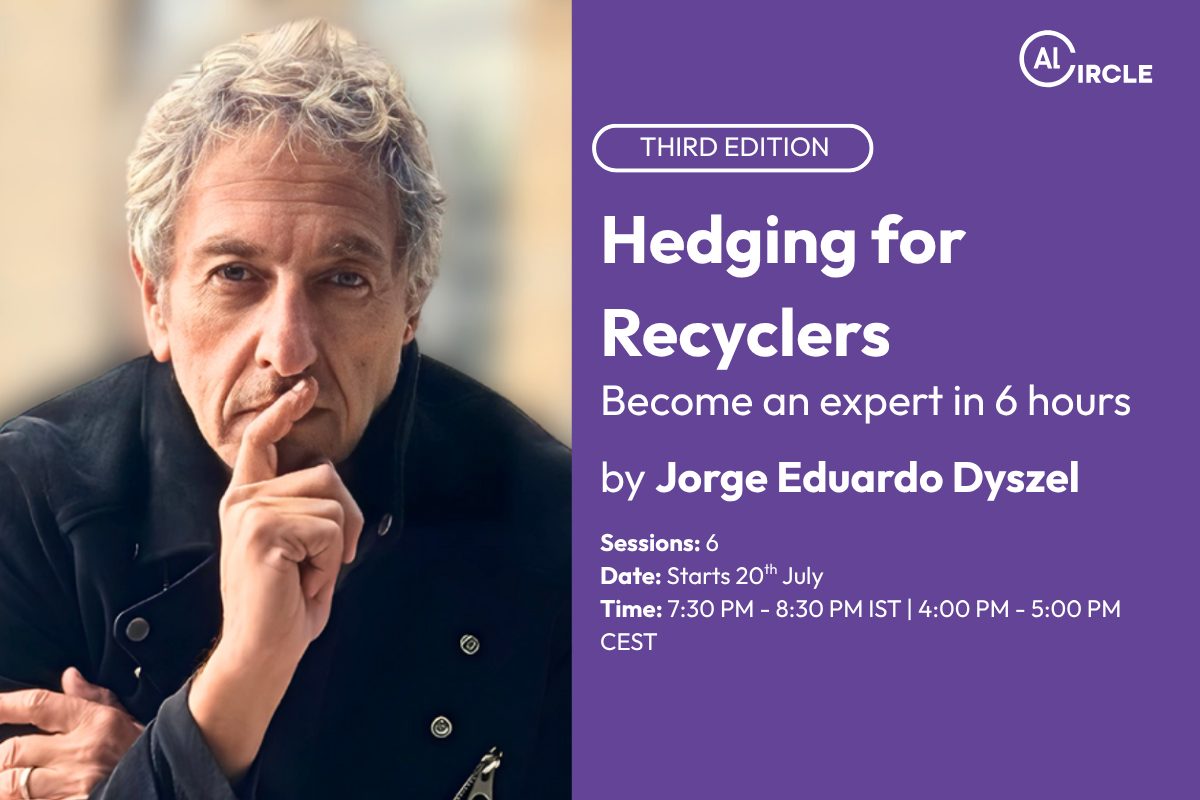
In order to enable all our readers, especially the ones from the aluminium recycling industry, AL Circle, with LME-certified Risk Management Consultant Jorge Eduardo Dyszel, is coming with a paid course, “Hedging for recyclers – Become an expert in 6 hours”. This six-session online course is designed specifically for recyclers, scrap traders, procurement professionals, finance teams and commercial managers working across aluminium and other base metals.
Why is volatility now a commercial challenge?
Before understanding the concept of hedging, we are required to understand the market where multiple factors are creating volatility, especially in today’s times. Currently, the global aluminium market is being influenced by multiple external forces. Factors like trade policies, geopolitical developments, energy costs, currency fluctuations, changing scrap availability, and evolving manufacturing demand are creating a shift in market prices within days or sometimes within hours.
For aluminium recyclers, these changing market movements are creating exposure throughout the business cycle. From procurement and inventory management to contract negotiations and sales, at every stage, a recycler’s commercial cycle is exposed to market fluctuations that can significantly impact profitability. Without a structured approach to managing this exposure, healthy operating performance can still result in shrinking margins.
The structured approach here is hedging, whose objective is not just to predict the market but also to reduce the uncertainty by understanding where price exposure exists and applying practical tools that help protect business performance.
How does the course fit in?
Recognising price risk is one thing; knowing how to respond to it is another. Many global aluminium recycling businesses understand that volatility affects profitability, yet lack a structured framework to evaluate exposure and make informed commercial decisions. AL Circle’s course, “Hedging for Recyclers – Become an Expert in 6 Hours“, bridges this gap by translating complex hedging concepts into practical business applications.
Via the six sessions, the speakers will explain how commodity prices are formed, where recyclers are exposed to risk and how hedging tools can be used to support procurement, pricing, inventory management and contract decisions. Moreover, rather than just focusing on financial theory alone, the course will equip all the participants with practical knowledge that can be applied to everyday commercial scenarios, helping businesses build greater confidence when operating in volatile aluminium markets.
Additionally, the discussion will also be around exploring price fixation, inventory exposure, procurement timing, commercial negotiations and the development of an internal risk management framework. These are the topics that are deemed to create a direct influence on day-to-day business performance within recycling companies. Practical exercises and real-world market scenarios ensure participants understand not only the concepts but also how to apply them in their own organisations.
Who should definitely attend this course?
This programme is particularly valuable for:
- Aluminium recyclers and scrap processors
- Scrap traders and metal merchants
- Procurement and purchasing professionals
- Commercial and sales managers
- Finance and risk management teams
- Base metal traders and executives responsible for pricing decisions
No previous hedging experience is required, making it suitable for both newcomers and professionals looking to strengthen existing risk management practices.
Build resilience before the next market swing
From the current situation taking place across the global aluminium industry, price volatility is something which is unlikely to disappear anytime soon. However, the companies that are able to identify, measure and manage price risks are now positioning themselves to have protected margins, negotiate contracts with greater confidence and make more informed commercial decisions.
For those who are unable to understand or are looking to expand their knowledge, the course “Hedging for Recyclers – Become an Expert in 6 Hours” offers practical, industry-focused training that helps recycling businesses move beyond reacting to market movements and towards managing them strategically. For professionals seeking to strengthen their commercial capabilities in an increasingly volatile metals market, this course provides knowledge that delivers value well beyond the classroom.
Avail of a discount of 25% for a group booking of 3 or more people. Secure your seat HERE, because the registration gate is closing soon.

 Voyagerman Technology


