









The global aluminium industry has entered a period of repeated disruption. In the past few years alone, the sector has faced the COVID supply shock, sanctions and trade disruptions following the Russia–Ukraine war, the European energy crisis that forced smelter shutdowns, and now geopolitical tensions in the Middle East. Each of these events has exposed one fundamental vulnerability of the aluminium value chain: primary aluminium production depends heavily on stable and affordable energy.
Primary aluminium smelting is one of the most electricity-intensive industrial processes globally. When energy prices rise sharply or supply becomes uncertain, smelters often respond by curtailing production. Europe already witnessed this during the energy crisis, when a significant portion of its smelting capacity was temporarily shut down. If geopolitical instability continues to affect energy markets, similar pressure on primary production cannot be ruled out.
Primary aluminium price-inventory dynamics on the LME: March-26
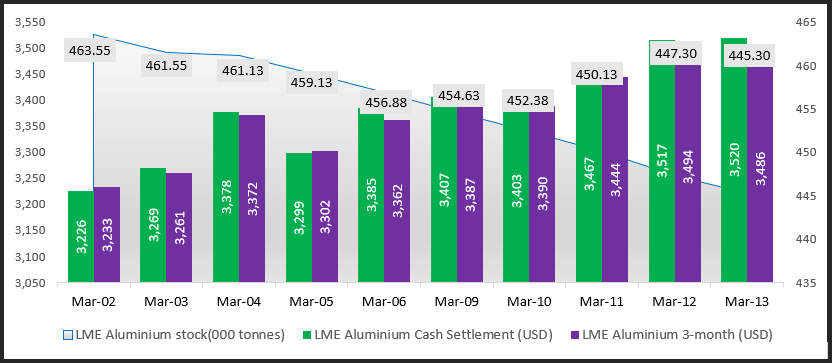
Source: LME
Whenever primary aluminium supply tightens, prices usually rise. This naturally raises an important question for the market: can secondary aluminium step in to fill the gap?
Secondary aluminium, produced from recycled scrap, has a major advantage. Recycling aluminium requires up to 95% less energy than producing primary metal. Because of this, secondary production is far less exposed to energy price volatility and geopolitical disruptions. As a result, during periods of primary supply stress, recycled aluminium often becomes an attractive alternative for manufacturers.
In many industries, the transition is already underway. Automotive manufacturers, packaging producers and construction material suppliers are increasingly using recycled aluminium in their products. These sectors can incorporate high levels of secondary metal because alloy adjustments can compensate for variations in scrap composition. In fact, recycled aluminium has become a critical pillar of supply in the global market, supporting both cost efficiency and sustainability goals.
However, the shift is not without limits. Some high-specification applications, such as aerospace components or certain flat-rolled products, still require extremely controlled metal purity. In these cases, primary aluminium remains difficult to replace completely. Moreover, secondary aluminium availability depends on scrap supply, which does not always expand quickly enough to meet sudden demand spikes.
Another important point is pricing dynamics. Secondary aluminium typically trades at a discount to primary metal, but it still follows the broader price trend. When primary aluminium prices rise, scrap prices also increase. This means the market may see higher recycled metal demand, but not necessarily cheaper material.
Despite these constraints, one structural trend is becoming increasingly clear: secondary aluminium is evolving from a complementary source of supply into a strategic stabiliser of the global aluminium market. As energy uncertainty, geopolitical risks and decarbonisation pressures grow, recycling will play an even larger role in balancing supply and demand.
In the end, the question may not be whether the market will accept more secondary aluminium. The more relevant question is how quickly the industry can expand scrap collection, recycling capacity and alloy innovation to support this transition.
Because in a world where primary aluminium production is repeatedly challenged by global crises, the future stability of the aluminium market may increasingly depend on the metal that has already been produced once before.

 Voyagerman Technology


