According to the latest data from the US Geological Survey, the United States’ aluminium crude metal and alloys imports increased over the year during January-May 2025, even as shipments from Canada - the country’s top supplier - declined. The data highlights two key trends: (1) Canada retained its position as the leading exporter despite a drop in volumes, and (2) the United Arab Emirates (UAE) stepped in to offset the shortfall, driving overall import growth.
Canada holds lead but volumes erode
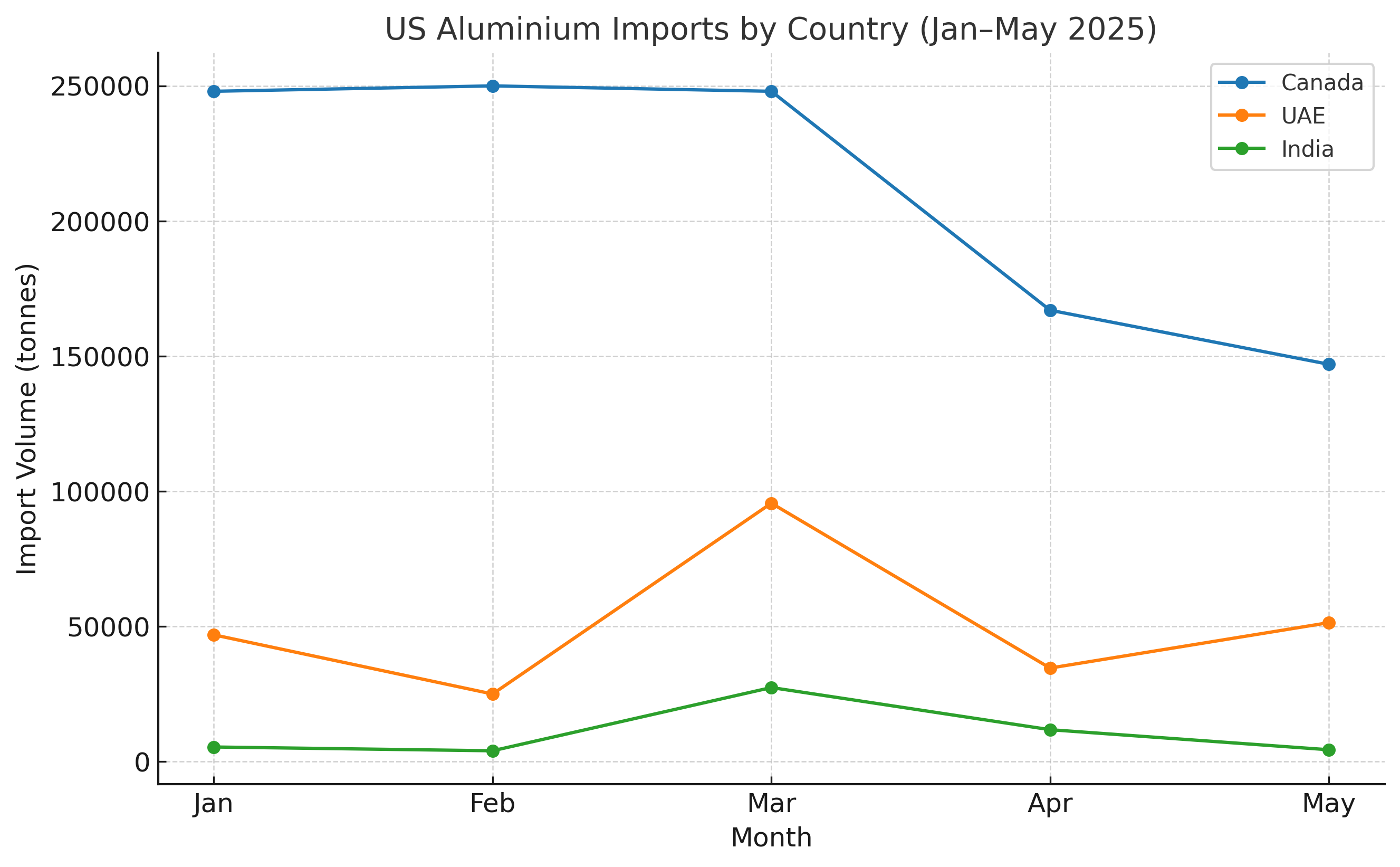
From January to May 2025, Canada exported 1.02 million tonnes of aluminium crude metal and alloys, compared to 1.17 million tonnes during the corresponding period of the previous year, reflecting a Y-o-Y decrease of 12.8 per cent. To be noted, Canada’s primary aluminium exports to the US remained steady through the first three months of 2025, ranging between 248,000 tonnes and 250,000 tonnes. The month-on-month drop in April and May to 167,000 tonnes and 147,000 tonnes, respectively, primarily affected the country’s export volumes.
Until March 2025, Canada’s aluminium exports to the US remained relatively steady, with limited immediate impact from tariffs. That changed after February 10, when President Donald Trump announced a 25 per cent tariff on Canadian and Mexican aluminium, effective March, replacing the 10 per cent duty in place since 2018. In response, Canadian federal government announced the launch of Export Development Canada (EDC)'s Trade Impact Program (TIP) as part of an initial CA$6.5 billion, as well as an additional CA$5 billion over two years in support of Canadian businesses negatively impacted by US tariffs. But the full blown effects set in when Donald Trump doubled the tariff on Canadian steel and aluminium to 50 per cent on March 12, allegedly in response to the province of Ontario's threat of a retaliatory 25 per cent tariff on electricity from Ontario exported to three American states.
However, despite the decline in Canada’s primary aluminium exports to the US, the latter still saw a rise in its total import volume during the first five months of 2025, standing at 1.54 million tonnes versus 1.51 million tonnes. That reflected a Y-o-Y increase 2 per cent. So, who compensated the loss that US faced from Canada?
In this context, the name that tops the list is the United Arab Emirates. In the first five months of 2025, the UAE exported 257,000 tonnes of aluminium crude metal and alloys, up by 73.64 per cent Y-o-Y from 148,000 tonnes. Not only until May 2024 but till December, the UAE’s primary aluminium exports to the United Arab Emirates ranged between 25,000 tonnes and 30,000 tonnes. In January 2025, the exports first surged to 46,900 tonnes, marking a month-on-month jump of 90 per cent and a year-on-year hike of 80 per cent. Again in March 2025, the imports from the UAE underwent another leap, amounting to 95,600 tonnes, following a subdued volume for the intermittent month in February.
In early March, the UAE’s aluminium exports to the US saw a sharp rise as buyers rushed to the former to source aluminium ahead of the 25 per cent tariff implementation. According to the US Department of Commerce, the UAE exported 68,560 tonnes of aluminium to the US in the first 11 days of March, significantly higher than the 16,124 tonnes exported during March 2024. This surge pushed UAE exports to a near two-year high on a monthly basis.
Industry analysts attribute the spike to US buyers hedging against uncertainty in Canadian supply. Yulia Buchneva, director at Fitch Ratings, highlighted that UAE producers, led by Emirates Global Aluminium (EGA), hold a global cost advantage, allowing exports to remain profitable even under tariffs.
However, in April again, it retreated from the jump and stood at 34,600 tonnes but advanced the next month (May) to 51,400 tonnes, albeit lesser than the volume of imports seen in March 2025. The March surge had already sparked questions about whether such momentum could be sustained, particularly amid ongoing discussions over a potential bilateral trade agreement. Negotiations launched in June 2025 failed to deliver any resolution on aluminium tariffs. Instead, Washington escalated measures further, doubling tariffs on UAE aluminium and steel imports to 50 per cent, casting doubt over the durability of the UAE’s export gains.
The jump in March primarily buoyed the United States’ primary aluminium imports during the first five months of 2025. For the next two months, the import volume stood lower but relatively stronger than the previous year’s.
India provides limited support
Besides the UAE, India also partly offset the year-to-date import decline from Canada by contributing 54,700 tonnes of primary aluminium as against 27,900 tonnes a year ago. The surge in total volume was primarily due to the stupendous monthly hike in March, with the volume standing at 27,400 tonnes, the highest in five months. In April and May, the imported volume decreased by 56.9 per cent and 62.88 per cent M-o-M, amounting to 11,800 tonnes and 4,380 tonnes, respectively.
The intermittent surge in March from India also coincided with the implementation of higher tariff, the effect of which started being visible in April and May 2025.
Outlook: shifting supply chains under tariff strain
The first five months of 2025 reveal two clear trends in US aluminium trade:
Canada remains the dominant supplier, but its position is under severe tariff pressure.
The UAE has emerged as a competitive alternative, leveraging low production costs to expand market share, though its longer-term viability depends on tariff negotiations.
India and other secondary suppliers have shown capacity to step in during volatility but lack the scale to sustain a material offset. With US tariffs on both Canada and the UAE now at 50 per cent, the coming months will likely see further reshuffling of supply chains, with American buyers forced to balance cost, availability, and geopolitical risk.













_md.webp)