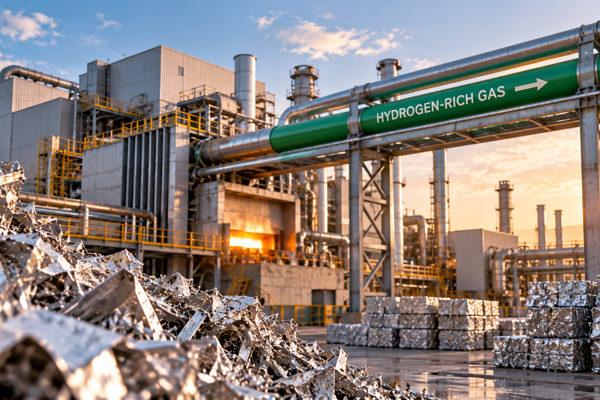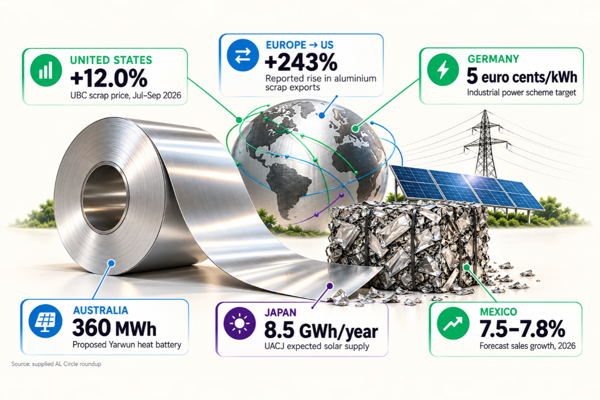
Aluminium’s trade map is no longer drawn by smelters alone. Scrap flows, power contracts, industrial policy and specialist grades now shape who secures metal, at what cost and under whose rules. Ten recent developments across Europe, the US, Australia, Japan and Mexico show how recycling, energy and regulation are becoming the new levers of aluminium competitiveness. They also show where traders, exporters and policymakers may need to adjust. Scrap tug-of-war: the US pull, Europe’s leak and the recycling base at stake The pull starts with price. The US UBC scrap benchmark averaged USD 2,322.89 a tonne in July, USD 2,491.22 in August and USD 2,602.51 in September. That is a 12 per cent climb, and it came after a July that opened at USD 2,464.98 and fell to USD 2,270.76 within two days....
Nespresso is expanding its aluminium coffee capsule recycling network across New Zealand, adding 25 JB Hi-Fi stores as collection points and bringing the total number of participating retail locations to 138. The move gives coffee drinkers more places to return used capsules, helping make recycling a little easier after that final, satisfying sip. The new collection points join existing locations at Briscoes and Noel Leeming stores. The expansion also complements other return options available through Nespresso, including its boutiques, public collection points, NZ Post drop-off locations and courier collections from customers’ homes. The aim is to make returning used capsules more convenient, recognising that a single collection method will not work for everyone. For those who enjoy...
Grow with
AL Circle

Select base metals rose at the non-ferrous metal market here today on good stockists buying amidst rising industrial demand despite bearish London Metal Exchange (LME) cues. Meanwhile, tin, aluminium and copper utensils scrap declined on subdued offtake from consumer as well as alloy industries. Copper utensils scrap and aluminium utensils scrap softened by a rupee per kg each to Rs 425 and Rs 107.
Hydro Aluminum’s Extrusion North America unit reports that it recycled more than 220 million pounds of scrap aluminum in 2010. Of this, some 60 percent was post-industrial waste. The remaining 40 percent was post-consumer waste, representing an increase of nearly 20 percent over the preceding year. This growth was made possible by investments in equipment during the past two years that allows the company to recycle more painted scrap. “Compared to 2009, our total 2010 recycling volume increased by 13 million pounds, this in a market that is still recovering from the recession,” said Lynn Brown, senior vice president for sales and marketing for Extrusion North America. “But we are particularly pleased that our efforts to increase our post-consumer recycling have yielded such good results....
Metal manufacturers are raiding the scrap heap to save money, pushing up demand–and prices–for recycled metal. Scrap prices are rising faster than primary metal, which is smelted for ore, in important markets like copper, aluminum and steel, as demand grows from U.S. manufacturers looking to save on energy costs and from Asian buyers that need raw materials of all kinds.
A proposed aluminum recycling waste landfill that received a permit Friday from state environmental regulators is opposed as unsafe by some Maury County residents, including a Mt. Pleasant city commissioner who expressed incredulity that the project was okayed.
Japan Metal Bulletin reported that Chinese secondary alloyed aluminum output will increase by 6.7% to 5.17 million tonnes in 2011 from 2010. According to Beijing Antaike Information Development, the growth slows due to slower domestic demand growth. Antaike expects Chinese government's fiscal and financial policy impacts on the demand under higher inflation and severe power availability.
Strong demand lifts scrap metal prices faster than prices of "virgin" or new metal --Price gap between Comex copper and high-grade scrap copper shrank to 31 cents a pound from 49 cents a pound at the start of 2011 --Asian demand strains U.S. scrap supply NEW YORK (Dow Jones)--Metal manufacturers are raiding the scrap heap to save money, pushing up demand--and prices--for recycled metal. Scrap prices are rising faster than prices for new metal in important markets like copper, aluminum and steel, as demand grows from U.S. manufacturers looking to save on energy costs, and from Asian buyers.
Global aluminum fundamentals, such as output costs, inventory trends, scrap and secondary demand and primary aluminum output challenges, are sending signals of “attractive value” at current prices, says Harbor Intelligence. Analysts see limited downward moves from current levels and “high odds not only of a new wave up in prices but of fresh highs in the next quarters.” Chinese demand is strong, resulting in a tight market despite record domestic production, with Chinese spot prices at a premium of $250 a metric ton to LME aluminum, Harbor says. Further, Harbor says, backwardation has emerged in the Chinese market, with spot prices higher than futures prices. “Total commercial aluminum-inventory levels in China have halved in the last three months by falling from 889k tons in late March...
Rolled aluminium giant, Novelis Inc., has made an investment of $15.8 million in the construction of a new line that will recycle painted scrap aluminium into the metal needed to produce rolled aluminium sheet. The new continuous casting line will be installed at the company's production facility in Pieve Emanuele, Italy, and follows a recent commitment from Novelis to increase the amount of recycled metal it uses in its rolling operations around the world from 34%% today to 80% by 2020. The Pieve Emanuele facility is an integrated continuous casting, rolling and finishing operation. The aluminium sheet and coil produced at the facility is sold to distributors and end users in a number of industrial and construction markets. The plant also supplies aluminium coil to the nearby Novelis...
Japan Metal Bulletin reported that Chinese secondary alloyed aluminum makers of Guangdong Longda Aluminum and Baoding Longda Aluminum Industry resumed full capacity operation after adjustment due to slow automobile demand since Japanese major earthquake. The joint owner of Tokyo based deoxidizing agent maker, Nippon Kinzoku recognized the automotive order increases since mid June to support the production.
Reportedly, Alcoa announced on July 1st 2011 to invest USD 21 million analysis of aluminum recycling, energy saving and emission reduction. The facility will occupy 35,000 square foot and will take new technology to melt the aluminum scrap to produce aluminum slab which will be used to produce new wheel. Also, the analysis will not only help to raise the aluminum usage rate but also to reinforce Alcoa’s sustainability of production progress to strengthen its leading position.
Most of base metals declined at the non-ferrous metal market here today due to stockist selling amidst lacklustre trade on the back bearish global sentiment. Meanwhile, aluminium utensils moved up on better demand from consumer industries. The industrial metals ended lower at the LME on worries over possible interest rate hike in China. Nickel prices dropped by Rs 10 per kg to Rs 1,200 from overnight closing level of Rs 1,210. Copper sheet cutting and brass sheet cutting fell by Rs 3 per kg each to Rs 441 and Rs 316 from Monday's closing level of Rs 444 and Rs 319. Copper cable scrap, copper wire bar and brass utensils scrap all edged down by Rs 2 per kg each to Rs 467, Rs 495 and Rs 305 respectively. Copper scrap heavy and copper utensils scrap also softened by a rupee per kg each to Rs...
Japan Metal Bulletin reported that secondary alloyed aluminum makers around Tokyo concluded price negotiation to decrease the selling price by JPY 4 per kilogram to JPY 6 per kilogram for June shipment at the after shipment negotiation. The makers had to reduce the price due to lower primary aluminum and scrap price. The alloy price could decrease more in July due to lower tender price by major users despite of the higher demand for automobile.
Novelis Inc., the world's largest producer of rolled aluminum and a global leader in aluminum recycling, today announced the investment of $15.8 million in the construction of a new continuous casting line at its production facility in Pieve Emanuele, Italy. The new line will recycle painted scrap aluminum into the metal needed to produce rolled aluminum sheet. Today's announcement follows the company's stated commitment in May to increase the amount of recycled metal it uses in its rolling operations around the world from 34 percent today to 80 percent by 2020. Novelis is leading the aluminum industry in sustainably reducing the embedded carbon footprint of its operations and of its customers' products through increased recycling. "This is one step towards Novelis reaching our ambitious...
Fluctuating fertiliser prices could become a thing of the past in the south if a dross recycling plant starting up at the Tiwai Point aluminium smelter is successful. Taha Asia Pacific expects to complete its $5 million dross recycling plant at New Zealand Aluminium Smelters' site by August. Taha has a long-term contract to recover usable metal from NZAS' dross, a waste by-product of the smelting process, and also the 40,000-odd tonne stored in landfills at Tiwai. However, in a world first, the firm is going to turn the remainder of the dross into a phosphate fertiliser to sell to southern farmers. Taha Asia Pacific director Hamish McCallum said the product was good news for the region because it would not be imported and therefore not affected by international prices through factors such...
Western world unwrought aluminium stocks rose to 1.573 million tonnes in May compared with a revised 1.537 million in April, industry data showed on Monday. Unwrought stocks stood at 1.303 million tonnes in May 2010, provisional data from International Aluminium Institute (IAI) figures showed. Total aluminium smelter stocks excluding finished endproducts rose to 2.656 million tonnes at the end of May 2011, versus a revised 2.591 million in April 2011 and 2.392 million tonnes in May 2010.
Can Manufacturers Institute reported that aluminum can recycling has reached its highest level in 10 years, at a rate of 58.1 percent, in its annual report from June 15. According to the report the energy savings is equivalent to 17 million barrels of crude oil or the amount of gasoline consumed in the United States in a two day period. Another advantage of recycling is that it cuts down on waste leading to less garbage in land fields. Heidi Logue, director of developmental training at CCAR industries, said a total of 127,264 pounds, an average of 42,421 pounds per month, in recyclables from Eastern was received between March and May. Ryan Siegle, campus energy and sustainability coordinator, said Eastern receives more than $20,000 a year from this effort and that it pays his student...
The Aluminum Association (www.aluminum.org), the Can Manufacturers Institute (CMI) and the Institute of Scrap Recycling Industries (ISRI) have announced the United States. recycling rate for aluminum beverage cans has reached 58.1 percent in 2010. In 2008, the Aluminum Association set a goal of recycling 75 percent of aluminum cans by 2015. The recycling rate in 2008 was 54.2 percent. The recycling rate increased by 3.2 percent in 2009 with 57.4 percent of all aluminum beverage cans being recycled. Steve Larkin, The Aluminum Association president, says, “We are pleased the recycling rate has increased from last year—this is a boost for our industry and further evidence that the aluminum beverage can is the best environmental and sustainability packaging option. Of course we must do more...
As the global economy rebounds and demand for aluminum rises, the need for recycling of scrap metal increases, and China must play a big role in that if the secondary market is to expand. David Wilson, director of metals research, at Societe Generale, said recycling needs to take off in China, where little recycling is done so far. “Brazil is the best at recycling. They have very high rates…. It’s an easy metal to recycle. We’ll see some increase in recycling in China as the amount of available scrap picks up. It’s clear the life span of buildings in China is shorter than in the West. There’s a 10-20 year life span as some weren’t built well and some are outdated. So I have a feeling that scrap supplies will increase. But it’s coming from a very low base,” he said. Wilson spoke to Kitco...