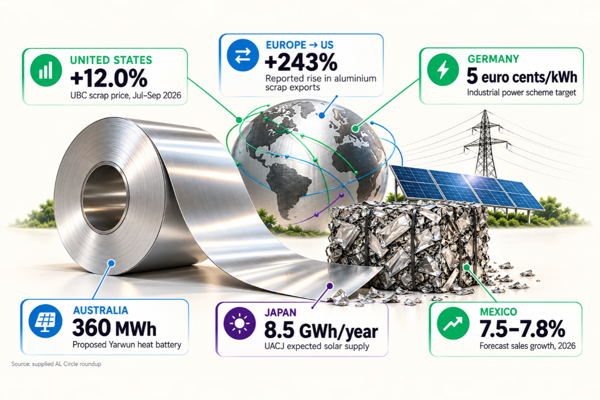
Aluminium’s trade map is no longer drawn by smelters alone. Scrap flows, power contracts, industrial policy and specialist grades now shape who secures metal, at what cost and under whose rules. Ten recent developments across Europe, the US, Australia, Japan and Mexico show how recycling, energy and regulation are becoming the new levers of aluminium competitiveness. They also show where traders, exporters and policymakers may need to adjust. Scrap tug-of-war: the US pull, Europe’s leak and the recycling base at stake The pull starts with price. The US UBC scrap benchmark averaged USD 2,322.89 a tonne in July, USD 2,491.22 in August and USD 2,602.51 in September. That is a 12 per cent climb, and it came after a July that opened at USD 2,464.98 and fell to USD 2,270.76 within two days....
Nespresso is expanding its aluminium coffee capsule recycling network across New Zealand, adding 25 JB Hi-Fi stores as collection points and bringing the total number of participating retail locations to 138. The move gives coffee drinkers more places to return used capsules, helping make recycling a little easier after that final, satisfying sip. The new collection points join existing locations at Briscoes and Noel Leeming stores. The expansion also complements other return options available through Nespresso, including its boutiques, public collection points, NZ Post drop-off locations and courier collections from customers’ homes. The aim is to make returning used capsules more convenient, recognising that a single collection method will not work for everyone. For those who enjoy...
Grow with
AL Circle

The Recycling Roundtable, and advocacy group comprised of The Institute of Scrap Recycling Industries (ISRI), the Steel Recycling Institute (SRI), the Aluminum Association, the Solid Waste Association of North America (SWANA), the National Solid Waste Management Association (NSWMA), the American Forest and Paper Association (AF&PA), and the Paper Recycling Coalition (PRC) has announced its strong endorsement of U.S. Senate Resolution 251, "expressing support for the improvement of collection, processing and consumption of recyclable materials throughout the United States."
Select base metals declined at the nonferrous metal market here due to sluggish demand from industrial users amid bearish trend in global markets. Meanwhile, copper armiture and aluminum utensils scrap inched up on better offtake from consumer industries. The industrial metals fell at the LME over weak US consumer spending data and speculation on Chile's miners strike.
Total aluminum recovered from scrap in the U.S. in March was 260,000 tons, 9% higher than 239,000 tons the previous month and 17% higher than the 222,000 tons recovered in March 2010. Of this, 138,000 tons of aluminum was recovered from new scrap, 5% higher than the 132,000 tons recovered the previous month and the same as in March 2010. Aluminum recovered from old scrap in the U.S. in March totaled 122,000 tons, which was 14% higher than 107,000 tons in February and 45% higher than 84,000 tons a year earlier.
The city of Oxnard issued the following news release:Join the City of Oxnard in celebration of the Del Norte Regional Recycling and Transfer Station's fifteenth anniversary as we reduce, reuse and recycle our way to a cleaner, more eco-friendly tomorrow. In honor of the event, the Del Norte recycling center will be offering a special aluminum can recycling rate of $1.75 per pound for the entire month of August.
An ounce of gold is going for $1,600 - silver for $40 - but there's a much more common metal that's become increasingly precious. Aluminum is bringing in 70 cents a pound, and more and more people are learning there's cash in those cans.
The Gangqiao industry park with a handling capacity of 880,000 tons of renewable resources would obtain 0.2 billion Yuan of central financial subsidy funds. Gangqiao industrial park demonstration base occupies 3,800 acre land with a 1.457 billion total investment. It will carry out items including the renewable resources terminal market, renewable resources’ sorting and processing, trade information service center and comprehensive exploitation of aluminum scrap, copper scrap, used motor vehicle etc. renewable resources ‘ recycling and transaction will cover Chongqing, Sichuan, Guizhou and Yunnan etc after the demonstration base being completed.
The overall recycling rate for aluminium beverage cans in the EU 27 increased by 1.2% to 64.3% in 2009. Despite the difficult economic situation the consumption of aluminium beverage cans in wider Europe remained at 34bn units - it was possible to collect and recycle a further 400M in addition to the 21bn cans already recycled.
HOUSEHOLDERS are now able to place aluminium foil products in their blue box for glass and cans as part of South Lakeland District Council’s kerbside collection service. As well as foil cartons, people will also be able to recycle other aluminium products including milk bottle tops, barbecue and freezing trays, cigarette and tobacco foil and screw top lids from wine bottles “We are working hard to ensure residents are able to recycle more products on their doorstep,” said Coun Clare Feeney-Johnson, portfolio holder for Environment and Sustainability. “The council is aiming to reduce the amount of waste going in the grey household waste bin and then onto landfill.
Inside Waste Weekly reported last week that the government’s announcement of a carbon price plan might well lead to a rise in recycling rates for high embodied energy materials such as aluminium and plastics, but could also bring challenges such as increased operating costs. While the industry awaits further details from the government, industry consultant Mike Ritchie said the carbon plan is the right reform but that waste and recycling remain the “poor cousins”. “People are not looking at the potential for recovering embodied energy from waste and it’s a real problem and a lost opportunity,” said Ritchie, “it could reduce Australia’s emissions by 7-8%”. He said regulators need to understand what recycling has to offer in terms of scale and establish national accounting which can measure...
Aluminum markets are improving. A lot of aluminum scrap is available on the market, and a scrap dealer based in the Midwest says sales are becoming a bit more challenging. “You can get all the material [you want] but you don’t want to sell it too early due to the potential of better pricing,” he says. The scrap dealer says several aluminum suppliers are sitting on loads of scrap expecting price increases. “Companies that have the space and capital are taking advantage of the situation to make an extra buck,” he adds. Despite this tactic, several aluminum scrap dealers say movement and supply are gradually improving.
Japan Metal Bulletin reported that Chinese largest secondary alloyed aluminum maker Shanghai Sigma Metals expands the group's Chinese production capacity to 4 times at annual 2.4 million tonnes in 5 years.
German aluminum output of 428,369 tonnes between January and May was up 5.3% from the same period a year earlier. Mr Christian Wellner MD of GDA said that "The outlook for aluminum remains optimistic because customer industries are also continuing to develop positively. Germany's aluminum industry is confident that production growth will continue in the H2 of 2011. Output of secondary aluminum smelters declined by 4.3%.
A new aluminum can recycling option, a can cottage, was set up July 20 at California Lanes by the River City Habitat for Humanity. Members of the California Area Chamber of Commerce were present for the ribbon cutting.
Hydro Aluminum, Linthicum, Md., has reported that its Extrusion North America unit recycled more than 220 million pounds of aluminum scrap in 2010. Of the total, about 60 percent was post-industrial scrap and 40 percent is described by the company as post-consumer scrap. The 220 million pound total represents a nearly 20 percent increase from the previous year’s total. The company attributes the increase to equipment investments made over the past two years that have allowed the company to recycle more painted scrap.
Output of secondary aluminium smelters declined by 4.3 percent, preliminary GDA data showed.
A new township initiative will see if potential tax savings are enough to inspire residents to go beyond mere compliance with recycling laws. By having residents sort and deliver their own aluminum to the recycling center, the township could see a 170,000-percent increase in revenue from recycled soda cans. With scrap aluminum bringing in roughly $850 a ton, minus transportation costs, the West Milford Department of Recycling and Solid Waste has been hoarding the precious metal in a dedicated Dumpster. However, until recently, the bin has mostly been reserved for larger scrap.
Recently, China’s Custom released the initial statistics of the country’s aluminum scrap imports in June. The country imported 240,000 tonnes of aluminum scrap in June increased by 6.7% from a month earlier. Also, it soared by 7.1% YoY. In addition, the data also showed that China’s totaled aluminum scrap imports in the H1 of this year were 1.26 million tonnes decreased by 9.3% YoY.
Epping Forest District Council has expanded its recycling service to include empty aerosol cans, such as those used for deodorants and air fresheners, plus aluminium foil trays, such as those used for take-away food, pie cases and oven-ready meals. The carbon-busting move, which was rolled out last year, is expected to prevent an estimated 1,435,752 aerosol cans and 9,678,032 foil containers from ending up in local landfill sites every year.