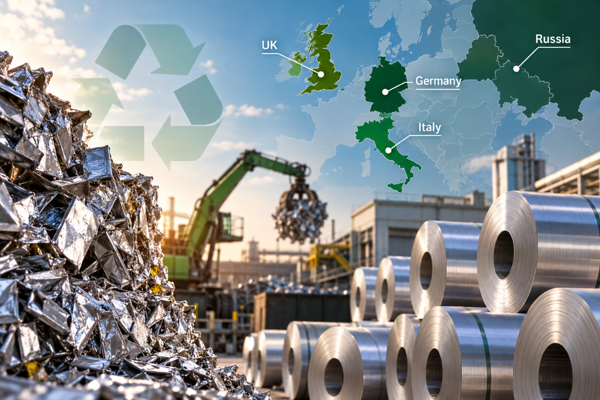
Europe’s recycled aluminium industry is an important component of the global secondary aluminium supply chain, with Germany, Italy and the United Kingdom (UK) representing key national markets. Production across the European region stood at nearly 6 million tonnes in 2023, supported by established scrap recovery systems, industrial recycling capacity and demand for recycled metal. Russia also contributes to the regional landscape through secondary aluminium production units concentrated in several industrial centres. According to AL Circle’s analysis in its report, “ World Recycled ALuminium Market Analysis Industry Forecast ”, the four countries present different market structures, from Germany’s substantial recycling capacity and Italy’s scrap-based production to the UK’s organised...
According to SMM survey statistics, the operating rate of the secondary aluminium alloy industry in September was 35.0 per cent, up 3.1 percentage points M-o-M but down 6.7 percentage points Y-o-Y. Industry production continued its recovery trend, but the overall operating level remained below the same period last year. On the demand side, September marked the traditional peak consumption season, with downstream orders recovering from August. End-use demand from automobiles and other sectors improved marginally, but the peak season effect has yet to fully materialise. According to CAAM data, automobile production in September was 2.99 million units, up 11.4 per cent M-o-M but down 8.7 per cent Y-o-Y. NEV production was 1.814 million units, up 12.2 per cent Y-o-Y. CAAM noted that China's...
Grow with
AL Circle

A New South Wales government plan to reduce litter volume by imposing a small deposit on drinks could dent sales of soft drinks, fruit juice and bottled water by almost 10 per cent, observed market watchers. Under the container deposit scheme, which comes into effect in July 2017, commercial drink containers- aluminium cans, glass bottles, tetra pack- between 150 millilitres and three litres will be redeemable for 10¢ each at depots and reverse vending machines. The scheme will be paid for by beverage manufacturers, including Coca-Cola Amatil, Asahi/Schweppes, Carlton & United Beverages and Lion Co, which owns juice maker Berri. They plan to pass the cost of the 10¢ deposit and the cost of administering the scheme onto consumers by raising prices by between 15¢ and 20¢ per container....

Ford recycles as much as 20 million pounds of aluminium stamping scrap per month using the closed-loop system at Dearborn Truck Plant which builds F-150. That is the equivalent of more than 30,000 F-150 bodies in the largest configuration – a SuperCrew body including doors, plus hood, tailgate and 6.5-foot cargo box. Opting for aluminium over steel in new automobile construction is the best way to reduce energy consumption and carbon emissions, according to Oak Ridge National Lab. Recycled aluminium avoids 95 per cent of the greenhouse gas emissions associated with primary aluminium production. It uses significantly less energy and water – another reason Ford F-150 leads the full-size truck pack in terms of lifetime carbon footprint. Weight savings from aluminium alloy helps F-150 reduce...
The aluminium company Hydro commissioned a EUR 45 million facility today aiming to recycle up to 50,000 tonnes of used beverage cans per year at its Neuss plant in Germany. The facility is located in the heart of a growing can market, as Europeans now are using more than 30 billion cans a year. That equals 450,000 tonnes of used beverage cans (UBC) to recycle. Waste for some, “silver” gold for others, Hydro turns this urban-mined resource into material for new can tabs, ends and bodies, closing the recycling loop. “Hydro’s facility in Neuss is the first to adopt a patented, advanced sorting technology for used beverage cans, able to process collected aluminium material with up to 20 percent impurities – making the new recycling line the best place to be for any used beverage can,” said...
A recent publication on the consumption of aluminium by auto industry showed that Ford produces about 20 million pounds (9 million kg) of aluminium stamping scrap per month, which is recycled as a part of the company's closed loop recycling system and goes on to provide parts for the F-150. Opting for aluminium over steel in new automobile construction is the best way to reduce energy consumption and carbon emissions, according to Oak Ridge National Lab. Recycled aluminium avoids 95 per cent of the greenhouse gas emissions associated with primary aluminium production. It uses significantly less energy and water – another reason Ford F-150 leads the full-size truck pack in terms of lifetime carbon footprint, according to Automotive Science Group. Ford recycling closed loop system: • First,...
As the Jaguar XE celebrates its first full-year of sales, ‘REALCAR’, the pioneering recycled aluminium project that contributes to the awarding winning saloon’s aluminium-intensive body has reached a significant milestone. Jaguar Land Rover has reclaimed over 50,000 tonnes of aluminium scrap, the weight of 200,000 XE body shells, back into the production process during 2015/16, preventing more than 500,000 tonnes of CO2 equivalent from entering the atmosphere by not using primary aluminium material. The figures are a result of project ‘REALCAR’ which involves 11 UK press shops implementing a closed-loop, segregating waste aluminium scrap so that it can be sent back into production to be re-melted into recycled aluminium sheet for use in Jaguar Land Rover vehicles. The Jaguar Land...
A simplified dry recycling process to recover the 5-10 per cent of aluminium which remains in the aluminium salt cake produced in the smelting process of secondary aluminium, has been developed by German recycling equipment manufacturer, BHS-Sonthofen. According to the company, to date the recovery of this aluminium has thus far proven difficult, costly and time consuming. However, it said that it has now developed a new process based on the selective impact crushing of the salt cake. By using its multi-functional Rotorshredder and VSI rotor centrifugal crusher, BHS-Sonthofen said that its process has a number of advantages over traditional methods including lower power consumption, lower wear and maintenance costs as well as lower noise pollution – as well as no danger of dust explosion...
AfrikaBurn festival 2016, which kicked off yesterday in Northern Cape Province of South Africa, is going to set new standards of excellence in terms of environmental sustainability. The organizers of the event this year have come up with a unique initiative which will see visitors making it to the festival with aluminium cans leaving with a piece of jewellery rather than a bulging plastic bag of trash. A team of "burners" from Johannesburg, formed separately to manage this programme, has set up a smelter at this year's festival which will be used to turn empty aluminium cans into recycled products of substantial user value. Spokesman Alexandra Hutchison said she and Helter Smelter leader Saul Abelson had been refining the idea since the middle of last year. Their smelter meant for...
Ford Motor Co says the toughest, smartest, most capable and safest F-150 ever is also the greenest F-150 – thanks to advanced materials like high-strength, military-grade aluminium alloy and EcoBoost engine technology. The American carmaker recycles as much as 20 million pounds of aluminium stamping scrap per month using the closed-loop system at Dearborn Truck Plant, which builds the F-150. That is the equivalent of more than 30,000 F-150 bodies in the largest configuration – a SuperCrew body including doors, plus hood, tailgate and 6.5-foot cargo box. Opting for aluminium over steel in new automobile construction is the best way to reduce energy consumption and carbon emissions, according to Oak Ridge National Lab. Recycled aluminium avoids 95 percent of the greenhouse gas emissions...
Shares of Gravita India rose 4.3 per cent intraday Monday as it has started commercial production of aluminium alloys. The company has made an entry into aluminium recycling at its new recycling plant at Phagi, Jaipur with an initial capacity of 6000 MTPA of aluminium alloy production. The company will be manufacturing aluminium automobile alloy by recycling aluminium scrap. "This entry into aluminium recycling will not only help in reducing India's carbon foot prints but will also enhance the recycling DNA of the group," company said in release. At 09:51 hrs Gravita India was quoting at INR 24.65, up INR 0.45, or 1.86 per cent on the BSE.
A study commissioned by the Aluminium Packaging Recycling Organisation (Alupro) into the UK’s ‘real’ recycling rate for aluminium packaging in 2015 has revealed that over 10,000 tonnes of material went unreported. According to official figures the UK’s recycling rate for all aluminium packaging hit 55 per cent in 2015, up from 48 per cent. However, Alupro added that the estimated recycling rate for aluminium drinks cans has reached 69 per cent, up from 60 per cent, but the figures could be even higher, according to a study commissioned by Alupro. It also noted that according to packaging waste recovery data recently released by the Environment Agency the “business” recycling rate for all aluminium packaging exceeded its 2015 target (49 per cent), reaching 76,027 tonnes. The research...
The recently concluded Institute of Scrap Recycling Industries (ISRI) Convention and Exposition held fruitful discussions on the increased usage of aluminium by automotive industry and its impact on recycling. The panelists highlighted on the various light weighting benefits and emphasized on the need to create more capacities to meet rising demand. According to speakers of the session titled “The Increased Use of Aluminium in the Automotive Industry and its Impact on Recycling”, the usage of aluminium has increased three-folds since mid-1980’s. The use of aluminium in vehicles offers lightweighting benefits and closed loop capabilities. The aluminium usage in vehicles is expected to grow further. Original Equipment Manufacturers (OEMs) must work closely with suppliers to ensure that...
The U.S. aluminium industry purchased an estimated 746 million pounds of aluminium scrap during January 2016, according to aluminium recycling statistics published by the U.S. Geological Survey, Department of Interior, down 9.2 per cent from the January 2015 total of 822 million. USGS estimates that recovery of aluminium and aluminium alloys totaled 653 million pounds, a decrease of 8.6 per cent year-over-year. Preliminary data indicate that recovery of aluminium from scrap totaled an estimated 8,244 million pounds in 2015, up 2.8 per cent over the 2014 total of 8,018 million. U.S. exports of scrap, not included in the government’s consumption statistics, totaled 215 million pounds in January, down 4.8 per cent from January 2015. Aluminium imports of ingot, scrap and mill products into...
Chandigarh-based start-up Trestor is building a machine that can provide clean drinking water to people, especially the urban poor. However, to get 300 ml of water, a person has to put an used plastic bottle or an aluminium beverage can or aerosol can into the machine. Developed in just 95 days by two final year students of IIT-Bombay — Anurag Meena and Satyendra Meena — the machine, built to capitalise on Government of India's Swachh Bharat campaign, is being marketed by Trestor. Trestor was founded by serial entrepreneur Kunal Dixit in the year 2014. Leveraging technology to help create healthy, responsible communities, Trestor has developed this machine to involve people in keeping public places clean and provide them with ready access to clean drinking water. “Through our ‘Swachh...
According to USGS Mineral Industry Survey for Aluminum in January 2016, total aluminum recovered from scrap in January 2016 was 296,000 t, 2% more than that recovered in December 2015 but 9% less than that in January 2015. Of this, 173,000 t of aluminum was recovered from new scrap, 6% more than the amount in the preceding month and slightly more than the amount recovered in January 2015. The amount of aluminum recovered from old scrap was 123,000 t, 4% less than the amount recovered in the preceding month and 21% less than that in January 2015. About 89,100 tons of aluminum alloys were produced at secondary smelters in the united States in January 2016. Average buying prices for UBC aluminum scrap was about 1212 dollars per ton.
Labour costs have increased ‘very rapidly’ in China and some lower-end projects have moved to other developing countries in the region with wage and logistics advantages as well as lower environmental standards, according to Ma Hongchang, BIR’s advisor on local policy and regulatory developments. ‘Some capacity has already been transferred there,’ he points out. In 2015, China imported 3.658 million tons of scrap copper, 2.087 million tons of scrap aluminium More recently, many Chinese scrap traders and processors have been encouraged by the commodity price rebound and copper imports soared 50% year on year in February to 420 000 tonnes. Dubbed ‘unexpected’ in some quarters, this improvement in LME aluminium values helped to trade some of the ‘frozen’ tonnages which had remained unsold...
Minister of State (Independent Charge) of Environment, Forest and Climate Change, India, Prakash Javadekar on April 3, released the Hazardous Waste Rules 2016 to distinguish hazardous waste from other wastes. Speaking on the occasion, Javadekar said, "The new rules will ensure resource recovery and disposal of hazardous waste in environmentally sound manner. The rules are environment and industry- friendly." "The provisions of the new rules are in line with this Government's priority for Ease of Doing Business and Make in India, but with responsible concerns for sustainable development," added Javadekar. The Hazardous and Other Wastes (Management and Transboundary Movement) Rules 2016 includes other waste as well; waste management hierarchy in the sequence of priority of prevention,...
Ever since start-up boom hit India, a large number of companies with novel ideas have mushroomed, some with substantial growth potential. However, there existed a vacuum in the waste recycling space, since nothing noteworthy has been coming up despite Central Government's endeavour to promote it's pet project- "Swachh Bharat Abhiyan." Recently, Pom Pom, a web-based recycling platform established in November last year, has taken a step forward in this domain. Pom Pom cleansed the mess left behind by the World Cultural Festival 2016 held in New Delhi as the recycling partner. Ensuring that it does not end up in a landfill and gets recycled, Pom Pom loaded trucks with recyclables such as plastic bottles, aluminium canisters, aluminium foils, empty packets of eatables, polythene sheets,...
Pepsi has demonstrated its commitment to drinks can (aluminium or tinplate) recycling by becoming the first brand to feature the marque of a major European recycling initiative on pack. Every Can Counts – or Jede Dose Zaehlt in German – has been encouraging consumers in Austria to reuse drinks cans properly since 2010. For the first time, the scheme’s emblem and call-to-action “please recycle” will appear on cans of Pepsi Cola, as well as Seven Up. The companies are hoping to motivate young people, especially at festivals and sports events, to collect their empty beverage cans for recycling so that the packaging material can remain in circulation. Jede Dose Zaehlt founder Dorothea Junk said: “Jede Dose Zaehlt has been engaged in motivating Austrians to recycle beverage cans properly...