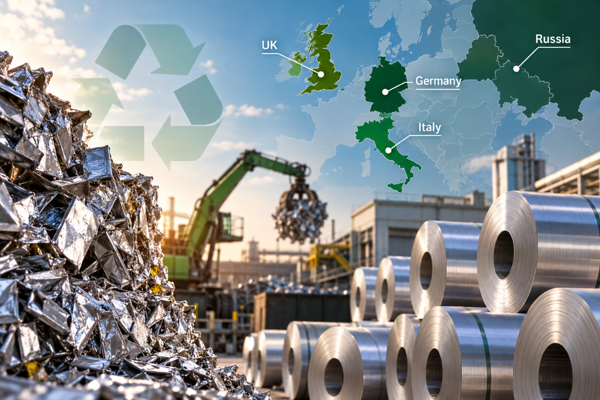
Europe’s recycled aluminium industry is an important component of the global secondary aluminium supply chain, with Germany, Italy and the United Kingdom (UK) representing key national markets. Production across the European region stood at nearly 6 million tonnes in 2023, supported by established scrap recovery systems, industrial recycling capacity and demand for recycled metal. Russia also contributes to the regional landscape through secondary aluminium production units concentrated in several industrial centres. According to AL Circle’s analysis in its report, “ World Recycled ALuminium Market Analysis Industry Forecast ”, the four countries present different market structures, from Germany’s substantial recycling capacity and Italy’s scrap-based production to the UK’s organised...
According to SMM survey statistics, the operating rate of the secondary aluminium alloy industry in September was 35.0 per cent, up 3.1 percentage points M-o-M but down 6.7 percentage points Y-o-Y. Industry production continued its recovery trend, but the overall operating level remained below the same period last year. On the demand side, September marked the traditional peak consumption season, with downstream orders recovering from August. End-use demand from automobiles and other sectors improved marginally, but the peak season effect has yet to fully materialise. According to CAAM data, automobile production in September was 2.99 million units, up 11.4 per cent M-o-M but down 8.7 per cent Y-o-Y. NEV production was 1.814 million units, up 12.2 per cent Y-o-Y. CAAM noted that China's...
Grow with
AL Circle

Apple Inc. said on Thursday, April 18, that it would expand its global recycling programmes and introduced "Daisy", its recycling robot that is capable of disassembling 200 iPhones per hour. Apple also announced that it will open a "Material Recovery" lab in Austin, Texas to investigate new techniques using robotics and machine learning to recycle iPhones. The lab will use robots to rip apart iPhones and recover recyclable materials like aluminium, cobalt and copper. The 9,000-square-foot lab is built at the same Austin facility. The Apple-built Daisy robot is a successor to Liam, another recycling robot made by Apple in 2016. Daisy was created with some of Liam’s old parts, making it a recycled robot that helps recycle iPhones. Lisa Jackson, Apple's vice president of environment, policy...

During the Spotlight on Aluminum session at ISRI 2019, the annual convention and exposition organized by the Institute of Scrap Recycling Industries (ISRI) at Washington, presenters predicted additional investment in secondary and primary aluminium production and discussed about the changing trends in the aluminium recycling sector. “When we look at the European aluminum market and we look at the primary side, we’ve seen billet prices under pressure,” Steve Deacon, nonferrous president for EMR USA said. “We see closed loop supply chain management that has reduced the need for external scrap. He said that demand for secondary aluminium from the automotive sector is slowing down in the US because of the closed loop recycling by automakers. The secondary aluminium products are now flooding...

Malaysia’s total imports of aluminium including scrap from the USA stood at 10,100 tonnes in January 2019, 46 per cent higher than the corresponding period of 2018, according to the latest Mineral Industry Survey report from US Geological Survey. Malaysia imported 9,870 tonnes of aluminium scrap from the USA in January 2019, up 3430 tonnes or 53 per cent from 6,440 tonnes imported in January, 2018. Imports dropped 38 per cent month-on-month from 15,800 tonnes in December 2018. For the full year of 2018, the country imported 172,000 tonnes of aluminium scrap from the USA, from 52,500 tonnes imported in 2017. This records an increase of 119,500 tonnes or 228 per cent year-on-year. Imports of aluminium semi-finished products (plates, sheets, bars, etc.) dropped to 196 tonnes in January....

The recycling branch of the China Nonferrous Metals Industry Association said Chinese authorities would start accepting applications for licenses to import soon-to-be-restricted types of metal scrap from May 2019. China has long been trying to restrict scrap imports as part of a campaign against foreign solid waste. Imports of low-grade copper scrap such as coiled cable and waste motors known as ‘Category 7’ are already banned since the beginning of 2019. The imports of eight further kinds of scrap, including high-grade scrap copper known as ‘Category 6’, as well as types of aluminium and steel scrap would be restricted from July 1. The recycling association said in a statement that provincial units of the Ministry of Ecology and Environment can start collecting applications for licenses...

The Denver Museum of Nature & Science has eliminated single-use plastic to enhance their commitment to environment and sustainability. The Museum will now offer 100% recyclable aluminium cans and compostable cups made of plant based material to its visitors for drinking. It is to be noted that the Denver Museum now composts all used utensils, straws, napkins, plates, condiment cups, containers, and food waste to limit dumping in the landfills. “It takes plastics hundreds of years to decompose, and we felt this was an immediate step we could take to continue our commitment to protecting the natural world,” said Patrick Hartnett, the Museum’s food and beverage director. The Museum has partnered with Ball Corporation for this sustainability initiative. As a goodwill gesture towards this...

Metal Exchange Corporation (MEC) has announced a new joint venture with Novellini Industries; located in Mantova, Italy. The newly formed company called novALmec will enhance its aluminium billet supply capability to the European market. Metal Exchange Corporation, a privately owned business at St. Louis, Missouri has a worldwide procurement network in aluminium scrap markets. They remelt aluminium scrap and cast into billets. The company has four decades of expertise in billet casting, sales and marketing in the US. Novellini, on the other hand is contributing its 22,000 tonne state-of-the art foundry for the production of secondary aluminium billets and its upstream scrap processing facility and its solid customer base towards the joint venture. The joint venture company will have a...

Gillespie & Powers Inc. has announced that they have signed an agreement with Matalco to supply one 115,000 lb. Tilting Melting Furnace, one (1) 115,000 lb. Tilting Holding Furnace, three (3) 120,000 lb. Batch Homogenizing Ovens and two (2) 120,000 lb. Batch Coolers with Charging Car and related equipment. The equipment will be supplied to support their business expansion in Wisconsin Rapids, Wisconsin. This equipment is likely to be operational by June 1, 2020. Matalco Inc. is an independent company engaged in the remelt and manufacturing of aluminum billets for the aluminum extrusion industry. Matalco’s US$80 million aluminium recycling plant in Wisconsin Rapids got preliminary approval from the city's Finance and Property Committee for the project. They expect to have a ground breaking...

According to a recent report, the European Union is likely to collaborate with Jawaharlal Nehru Aluminium Research Development and Design Centre (JNARDDC) in May for working together on the management of aluminium waste. JNARDDC, a Central Government Institution, has long been working in research and development of the aluminium sector, and its revolutionary work of aluminium recycling is tremendously appreciated world-wide. It has invented the process of recycling aluminium wastes like red mud, dross and Spent Pot Lining (SPL) to make their best use in construction and other sectors. The unique part is the institution is capable to recycle aluminium waste at an affordable cost. Impressed with this, the European Union has approached JNARDDC to share its work based on aluminium recycling....

According to the latest Mineral Industry Survey report from US Geological Survey, the U.S. aluminium industry recovered 290,000 tonnes from scrap in January 2019. The amount drops 6% YoY, indicating a drop in domestic recycling. Of this, 172,000 tonnes of aluminium was recovered from new scrap and 118,000 tonne was recovered from old scrap. The country imported 54,000 tonnes of aluminium scrap in January, up from 48,400 tonnes in December 2018. The US imported about 51,000 tonnes of aluminium scrap in January 2018. This shows a steady import flow of scraps to the US. On the other hand, the U.S. exported 140,000 tonnes of aluminium scrap in January 2019, down 16% from 167,000 tonnes exported in December 2018. However, the volume increased about 20% from 117,000 tonnes exported in January...

According to Shanghai Metals Market, operating rates across secondary aluminium producers in China have recorded a growth of 22.02 percentage points month-on-month and 0.3 percentage point year-on-year to average at 61.12 per cent in March. This hike in secondary aluminium operating rates is attributable to weak export prices that drove aluminium scrap producers to focus on the domestic market rather than sending the scrap overseas. Increasing demand is also a reason for the growth in secondary aluminium operating rates, particularly for the sharp month-on-month rise. Downstream buyers had brought forward their April orders to chase VAT invoices with a rate of 16 per cent before the tax cuts took effect and that resulted in demand increase. However, in April, the operating rates across...

A large number of countries are found actively participating in recycling aluminium to produce fresh metal. The infinite recycling properties of aluminium are of course, not unknown to us, neither the fact that it involves about 95 per cent less energy than the primary production process. As per the report released by London-based Technavio, the global aluminium recycling market will rise to 32.12 million metric tonnes by 2021, at a CAGR of nearly 8 per cent. Some of the major players in this sector are the United States, Germany, United Kingdom, France, and Saudi Arabia. {newsStudioGallery} The use of aluminium scrap in some of the Southeast Asian countries has also been found growing. For instance, Indonesia’s import of aluminium scrap has been rising year over year, according to the...

British company King of Shaves says it will ditch single-use plastic within four years to control environmental pollution and will switch to aluminium and cork for their recycling benefits. Aluminium, as a metal is infinitely recyclable and cork is a natural and biodegradable material made from the bark of Cork Oak Trees, which can be recycled into a range of products. King of Shaves said that the move will hit profits in the short term but the switch from single-use plastic will double annual revenues in the long term, from around £3million now to about £6million. The company has already spent £120,000 for shifting to refillable products, with its first range, Code Zero, to be launched in July. Founder and executive chairman Will King said: “This is a hit we will absorb due to the...

Williams Sonoma has introduced a branded line of coffee capsules that are blended from 100% Fair Trade Certified coffee and packed in 100% recyclable aluminium packaging. The coffee capsules are available in six flavours, including Intenso, Ristretto, Cremoso, Vanilla, Lungo and Decaf Intenso. The new capsules reflect the company’s commitment to exceptional quality, sustainability and long-term relationships with coffee farmers. The capsules are sold in sets of 10 capsules for $7.95 and suitable for OriginalLine Nespresso® drop through capsule machines. The coffee comes from leading coffee producing countries worldwide, including Brazil, Colombia, Costa Rica, Ethiopia, Honduras, India and Kenya. Williams Sonoma, a member of Williams-Sonoma, Inc. portfolio of brands, is a leading specialty...

Nespresso on Friday, March 29, reportedly issued an invitation urging portioned coffee manufacturers to join its recycling programme that aims to improve the accessibility and convenience of aluminium capsule recycling. This move was endorsed by the Nespresso Sustainability Advisory Board (NSAB) during its annual meeting at Geneva. Jean-Marc Duvoisin, CEO of Nespresso, said, "Aluminium is a valuable material and is infinitely recyclable. We have built a global scheme for recycling our capsules, and by inviting other companies to join our system, we hope to offer a solution for the whole category. This decision is aligned with our global initiatives to shape a waste-free future and drive behaviour change towards a circular economy." The public recycling infrastructure in most countries...

Jaguar Land Rover has reportedly launched a new aluminium recycling scheme, in a bid to reduce material wastage that comes from scrapping cars and minimise CO2 emissions throughout its entire production process. The manufacture will recover aluminium from end-of-life vehicles and melt down to reform into high-grade metal suitable for new model production. Currently, it is obtaining the metal from a group of pre-production I-Pace electric SUVs for trialling the new scheme. Besides aluminium, Jaguar Land Rover also intends to recondition and reuse the batteries of the I-Pace electric SUVs. The British multinational automotive company claims that it has “already reduced its global vehicle manufacturing operating CO2 by 46% per vehicle and remains committed to an ongoing decarbonisation...

According to Shanghai Metals Market, China in the first two months of 2019 imported 206,000 tonnes of aluminium scrap in total, compared with 309,500 tonnes of import in the same period last year. Therefore, the country’s aluminium scrap import through January and February stood down 33.41 per cent or 103,500 tonnes year on year. {newsStudioGallery} China’s aluminium scrap import in the same period last year was also down from the previous year by 9 per cent, which means the scrap import volume during January-February 2017 was around 337,355 tonnes (approx.). The aluminium scrap import had been limited year over year because of the policies and restrictions that were imposed upon the import of aluminium scrap in China. Prerequisites on the level of impurity in imported scrap aluminium had...

According to a recent media report, crushing or flattening aluminium cans before throwing it for recycling makes the sorting and recycling tougher for the recycling facilities. As explained by Matt Meenan, the senior director of public affairs at the Aluminum Association, when a crushed can is put into the recycling loop it makes sorting difficult for the machines and it may contaminate other recyclable materials. A flattened aluminium can could be mistakenly sorted as paper and then it may end up contaminating paper recyclables. “Crushed aluminium cans may fall through the spaces of the sorting equipment and either be lost entirely or improperly sorted,” he said. However, this depends on the kind of recycling technology a plant has. The recycling facilities in the U.S. follow any of the...

According to the latest report from US Geological Survey, the US exports of aluminium scrap, which is not included in the government’s consumption statistics, came in at 1.76 million tonnes in 2018. The figure was up 190,000 tonnes or 12.1 per cent from 2017 total of 1.57 million tonnes. {newsStudioGallery} Total scrap exports increased from 148,000 tonnes to 167,000 tonnes in December, representing an increase of 19,000 tonnes or 12.84 per cent year-on-year. On month-on-month basis, exports dropped 5.11 per cent from the November export volume of 176,000 tonnes. The U.S. exports to China in 2018 stood at 505,000 tonnes, down 38.41 per cent from 2017 export volume of 820,000 tonnes. The export stood at 43,400 tonnes in December. This was down 42.29 per cent year-on-year, but up 13.32 per...