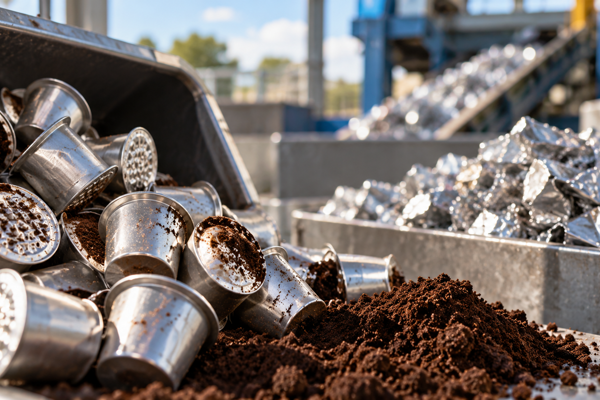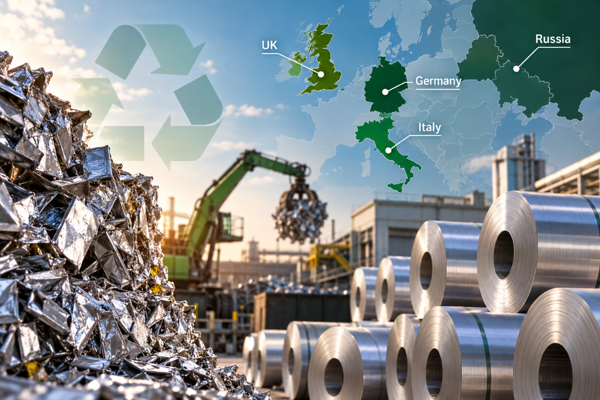
Europe’s recycled aluminium industry is an important component of the global secondary aluminium supply chain, with Germany, Italy and the United Kingdom (UK) representing key national markets. Production across the European region stood at nearly 6 million tonnes in 2023, supported by established scrap recovery systems, industrial recycling capacity and demand for recycled metal. Russia also contributes to the regional landscape through secondary aluminium production units concentrated in several industrial centres. According to AL Circle’s analysis in its report, “ World Recycled ALuminium Market Analysis Industry Forecast ”, the four countries present different market structures, from Germany’s substantial recycling capacity and Italy’s scrap-based production to the UK’s organised...
According to SMM survey statistics, the operating rate of the secondary aluminium alloy industry in September was 35.0 per cent, up 3.1 percentage points M-o-M but down 6.7 percentage points Y-o-Y. Industry production continued its recovery trend, but the overall operating level remained below the same period last year. On the demand side, September marked the traditional peak consumption season, with downstream orders recovering from August. End-use demand from automobiles and other sectors improved marginally, but the peak season effect has yet to fully materialise. According to CAAM data, automobile production in September was 2.99 million units, up 11.4 per cent M-o-M but down 8.7 per cent Y-o-Y. NEV production was 1.814 million units, up 12.2 per cent Y-o-Y. CAAM noted that China's...
Grow with
AL Circle

United States Geological Survey report for January 2020 showed that the US in the said month exported 28,900 tonnes of aluminium scrap to India. This stood down month-on-month by 6.17 per cent, but when compared to the corresponding period last year, it edged higher by 61 per cent sharp. In December 2019, the United States aluminium scrap exports to India were 30,800 tonnes, while in January 2019 were 18,000 tonnes. During October-December 2019, the US aluminium scrap exports to India relentlessly showed an upswing trend, by supplying 20,300 tonnes in October, which grew 15.27 per cent to 23,400 tonnes in November. December saw a growth of 32 per cent month-on-month, with US aluminium scrap exports to India came in at 30,800 tonnes. However, despite the month-on-month decrease in the...

The aluminium scrap shortage panic has grown among the European aluminium alloy producers as they envisaged their pricing levels onwards the resumption of some automotive operations this week. As manufacturers like Volvo and Volkswagen has declared a restricted resumption of their facilities last week, significantly the alloy producers have countered by planning returns of their own. A Western European-based alloy producer said: "We restarted some production on 20 th April’20, to deliver to the auto companies that have restarted. We will have a clearer picture by mid-May. We do not yet know if we will be at 50% capacity or 80% or even 100%." Europe's automotive plants remain closed mostly, but any further resumption will bring a prompt response from alloy producers. Another...

In the present time, aluminium is a widely used metal in various industries. The metal is lightweight, easy to process, and corrosion-resistant. Aluminium consumption is growing year by year. It is facilitated by the development of aluminium production technologies and the expansion of its scope. It is difficult to overestimate the importance of aluminium scrap market for the growing needs of the global aluminium production. The more aluminium is consumed by a country for production of goods or purchase of aluminium-containing products, the more aluminium scrap and waste are obtained after their use. As usual, aluminium scrap and waste are recycled domestically or exported to other countries depending on the needs. Aluminium can be recycled to infinity. Germany’s aluminium export stands...

According to Shanghai Metals Market, China’s secondary aluminium operating rates in March rebounded 29.2 percentage points from February to come in at 47.32 per cent. But when compared to the same period last year, the operating rates stood 16.37 percentage points lower, learned SMM. Resumption of large and medium scale producers was the major drive behind the rise in operating rates, while small companies grappled with the shortage of aluminium scrap supply and recovered at a slower pace. SMM survey also showed the overall sales of secondary aluminium in March were 70-80 per cent of the level during the same period last year. Large amounts of backlogged orders and stockpiles since the Chinese New Year holiday primarily supported operations of secondary aluminium plants in March. However,...

The aluminium scrap export market of Central European nation Hungary during 2017-19 has remained very promising, as the total export volume during the period stood at 277,261 tonnes, while the revenue generation at the same time remained at $367.85 million. The total export of aluminium scrap for 2020 has been estimated at 98,759 tonnes and the revenue to be collected might stretch up to $150.69 million. When the export volume of the past three years is added with 2020, the total volume stands at 376,020 tonnes and revenue income stands at $518.54 million. Hungary’s aluminium scrap export in 2017 was recorded at 80,424 tonnes, whereas the revenue generation was recorded at $94.98 million. In 2018 the aluminium scrap export of Hungary saw growth by 19.33%, as the total export remained at...

European Aluminium launched its Circular Aluminium Action Plan to ensure that all end-of-life aluminium products are collected and recycled efficiently in Europe by 2030. The plan also aims to maximise aluminium recycling rates and to keep the material in active use. Circular Aluminium Action Plan builds on the industry’s Vision 2050 and provides policy recommendations to increase recycling rates. “The aluminium industry is committed to helping deliver the European Green Deal, building on its long-standing commitment to sustainability. Our end goal is to achieve the full potential of aluminium circularity by 2030 and we won’t stop until we’ve achieved it. The Circular Aluminium Action Plan provides a roadmap for European policy makers and the European aluminium industry to work together...

China’s environmental authorities on April 10 reportedly issued the fifth batch of aluminium scrap import quotas for 2020 to allow additional 191,100 tonnes of high-grade aluminium scrap to enter China. With this, the total aluminium scrap imports allowed to China at present is 475,600 tonnes. China, in the first two months of the year, imported 122,000 tonnes of aluminium scrap in total, down 40.7 per cent from a year earlier, according to customs data. This suggests that a large amount of import quotas has remained unused. According to China Customs data, China, during January-April 2019, had imported 490,000 tonnes of seaborne aluminium scrap. The import quotas for this year are so far sufficient in volumes, but the supply in Chinese market is unlikely to increase soon due to subdued...

The aluminium scrap import market of Turkey remains dynamic as the nation has imported 272,663 tonnes of scrap during 2017-19 and paid foreign revenue of $422.86 million. The projected aluminium scrap import for 2020 has been analysed at 100,672 tonnes and the amount to be paid has been extended to $159.21 million. When the import volume and the amount added with the last three years it consecutively reflects 373,335 tonnes and $582.07 million. The aluminium scrap import of Turkey has been facilitated by multiple countries like USA, Australia, Azerbaijan, Bahrain, Belgium, Bulgaria, Cyprus, France, Georgia, Germany, Ghana, Greece, Iran, Israel, Italy, Japan, Kazakhstan, Kyrgyzstan, Lebanon, Libya, Mali, Montenegro, Morocco, Netherlands, Philippines, Poland, Qatar, etc. Turkey’s aluminium...

The US exports of aluminium scrap stood at 140,000 tonnes in December 2019, according to the latest report from the US Geological Survey. Exports dropped by 7.28% from November’s export of 151,000 tonnes and 10.83% from October’s export of 157,000 tonnes. The US exports of aluminium scrap have been declining month-on-month. On a year-on-year basis, exports reduced by 16.17%. For the full year 2019, the US exported 1.86 million tonnes of aluminium scrap, an increase of 5.68% from 1.76 million tonnes in 2018. The leading destinations for aluminium scrap were China, Malaysia, the Republic of Korea, India, and Mexico, receiving 17%, 16%, 15%, 15%, and 10%, respectively. China imported 316,000 tonnes of aluminium from the U.S. during January-December 2019. In December alone, imports came in at...

After back-to-back falls in the United States aluminium scrap exports in November and December, January 2020 saw a marginal rise, according to the US Geological Survey data. Compared to 140,000 tonnes in December 2019, the United States in January 2020 exported 146,000 tonnes, registering a rise of 4.29 per cent. In October and November, the United States’ aluminium scrap exports hovered at 157,000 tonnes and 151,000 tonnes, respectively, representing a month-on-month fall of 3.82 per cent in November 2019. In December 2019, the month-on-month decline in exports had increased to 7.28 per cent. Year-on-year, the United States’ aluminium scrap exports in January 2020 saw a rise of 4.29 per cent as well, as the export amount by the US during the same period last year was 146,000 tonnes. The...

Turmec has reportedly designed, supplied, and installed an advanced MRF plant in Wiltshire to treat kerbside collected comingled recyclable materials picked from around 220,000 households across the region. The plant will have the capacity to process 20 tonnes per hour of dry mixed recyclables, ensuring a high-quality separation of recycled materials is achieved. Turmec’s advanced sorting equipment includes various screens with optical and magnet elements to maximise the recovery of paper, cardboard, plastic bottles, plastic pots, tubs and trays, steel and aluminium cans, food and drink cartons. The MRF’s plant and personnel are ready to recover materials of the highest quality for reprocessing. Comingled recyclables will be sorted in a single pass into 10 separate products for recycling....

According to the latest data released by the US Geological Survey, the United States aluminium scrap exports to Malaysia declined in December 2019 by 9,000 tonnes or 22 per cent from the previous month and came in at 32,500 tonnes. In November, however, the export amount to Malaysia rose by 1,400 tonnes or 3.5 per cent from October and stood at 41,500 tonnes. In October, the export amount was 40,100 tonnes compared to 30,900 tonnes in September, meaning the US aluminium scrap exports to Malaysia in October 2019 saw a month-on-month increase of 30 per cent. Year-on-year, the export in December 2019 grew 106 per cent or by 16,700 tonnes from 15,800 tonnes in December 2018. The US aluminium scrap exports to Malaysia in the fourth quarter of 2019 thus, totalled at 114,100 tonnes, which in the...

The US exports of aluminium scrap have been declining month-on-month. Exports stood at 140,000 tonnes in December 2019, with a year-on-year decrease of 16.17%, according to the latest report from the US Geological Survey. Exports dropped by 7.28% from November’s export of 151,000 tonnes and 10.83% from October’s export of 157,000 tonnes. For the full year 2019, the US exported 1.86 million tonnes of aluminium scrap, an increase of 5.68% from 1.76 million tonnes in 2018. Aluminium scrap exports to India came in at 30,800 tonnes in December 2019. Exports climbed by 42.59% year-on-year and 31.62% month-on-month. The US had exported 21,600 tonnes and 23,400 tonnes in December 2018 and November 2019. For the full year 2019, India imported 271,000 tonnes of aluminium scrap from the US as...

Hammerer Aluminium Industries' re-melting and casting facility in Ranshofen, Austria, has been awarded ASI Performance Standard Certification. The news arrived after Aluminium Stewardship Initiative announced that it certified Hammerer Aluminium with its performance certification. The plant produces extrusion billets and rolling ingots from recycled aluminium scrap, which are then destined for various downstream uses in the automotive, electronics, transportation, and building and construction sectors. The ASI Performance Standard defines environmental, social and governance principles and criteria, aiming to address sustainability issues in the aluminium value chain. Fiona Solomon, Chief Executive Officer at ASI, said: “Our congratulations go to Hammerer Aluminium Industries on their ASI...

Stadler has reportedly completed the commissioning of a new beverage packaging sorting plant, designed and built for Dansk Retursystem in Taastrup, Denmark. Full handover is scheduled in April after the final one-month trial period. The plant will process polyethylene terephthalate bottles and aluminium cans collected from all over the country, and produce bales of PET bottles and aluminium cans for recycling. With a capacity of 110 cubic metres per hour, it is expected to process almost 55 per cent of the country’s recycled cans and PET bottles. Dansk Retursystem is a non-profit company that collects bottles and cans from reverse vending machines installed at 3,000 stores across Denmark or from the pantstation deposit return banks located in 12 cities. After collecting, the organisation...

The North American aluminium recyclers and producers are taking the advantage of import tariffs to breakthrough revenue at the cost of local beer and beverage firms, even though most of the metal used in their cans is not subject to the levy. The aluminium cans of about 70% used by the US drinks firms have been recycling locally that makes it free from import taxes, while another 16% joins from domestic and Canadian smelters, that are also exempt from the tariffs. It is estimated that drinks firms paid $582 million more for approximately 3 million tonnes of metal they consumed during March’18 -December’19 than they would have if there were no tariffs. Some $81 million of that went to the U.S. government, while the lion’s share of $428 million went to recyclers, which also typically...

Emirates Global Aluminium (EGA), the largest industrial company in the United Arab Emirates outside oil and gas, on 18 th March’20 marked Global Recycling Day and announced that the company’s recycling of industrial waste increased by more than a third last year to almost 140,000 tonnes, whilst regular waste generation decreased. EGA’s long-term aspiration is to send zero process waste to landfill, and the company focuses on reducing waste generation in its operations as well as developing opportunities for unavoidable waste to be used as feedstock for other industries. Waste generation decreased by five per cent, excluding spent pot lining. Generation of spent pot lining varies because it is generated only when reduction cells require re-lining after several years of operation. EGA is a...

Fortum, BAF, and Nornicket have signed a letter of intent to plan a recycling centre in Harjavalta, Finland to recover metals from electric car batteries. This would enable a successful “closed-loop” cycle to re-use the critical metals present in used batteries. “The combination of battery materials production and recycling enables the circular economy by closing the loop,” said Tim Ingle, Vice President, Precious Metals Refining, Chemicals & Battery Recycling, at BASF. He added, “To drive electrification, we are focussed on bringing solutions for high energy density cathode active materials and high-efficiency lithium extraction for battery recycling.” Using metals extracted from recycled batteries to produce battery materials would reduce a significant amount of CO2 emissions while...