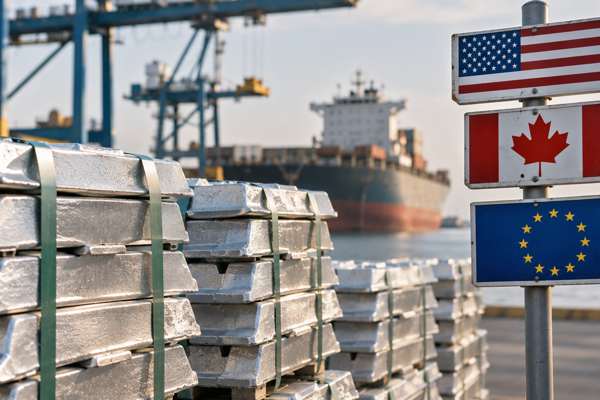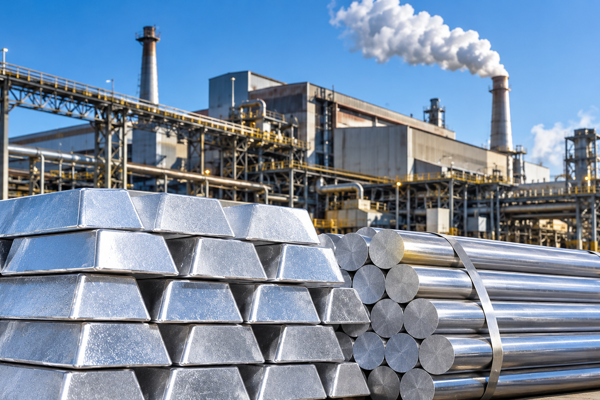
Century Aluminum’s proposed USD 4 billion primary aluminum smelter in Inola, Oklahoma, is “moving forward on all fronts” as the company prepares for construction, despite local opposition and legal challenges, CEO Jesse Gary said during the company’s third-quarter earnings call. Developed jointly by Century Aluminum and Emirates Global Aluminium (EGA), the project is designed to produce 750,000 tonnes of primary aluminum annually, potentially doubling U.S. primary aluminum production. The facility is expected to create thousands of direct and indirect jobs and add USD 1.5 billion to Oklahoma’s gross domestic product, according to company estimates. The partners had targeted construction to begin by the end of 2026. However, local restrictions and permitting challenges have affected the...
LME aluminium stocks declined by more than half during the first nine months of 2026, falling by 267,875 tonnes from 509,250 tonnes on January 2 to 241,375 tonnes on September 30 (52.6 per cent). The decline continued throughout the period, with average warehouse inventories falling each month. Compared with the same period in 2025, monthly average stocks were lower across all nine months, with the gap widening in the third quarter. Q1 LME aluminium stocks fall 18.2 per cent LME aluminium inventories continued to decline during Q1 2026. Month-end stocks fell from 495,725 tonnes in January to 465,550 tonnes in February, before dropping further to 416,775 tonnes in March. Monthly average inventories stood at 498,670 tonnes in January, 481,801 tonnes in February and 440,710 tonnes in March....
Grow with
AL Circle

China's annual capacity of primary aluminium may rise by 60 percent in coming four years as smelters build new facilities in resource-rich western and northern provinces, a director at the state-backed China Nonferrous Metals Industry Association said on Wednesday. Hu Changping said capacity would jump above 40 million tonnes by 2015 from 25 million tonnes projected by the end of 2011. China, the world's top producer and consumer of aluminium, may see annual demand grow by an average 8.7 percent between 2011 and 2015, down from 17.3 percent in the past five years, Hu told an industry conference in Zhuhai city, Guangdong province.
National Aluminium Company which has come under attack from the State Pollution Control Board (SPCB) for recurring incidents of ash pond slippage has proposed to dump its fly ash in abandoned stone quarries. As a long-term measure for efficient management of fly ash disposal, the aluminium major is in the process of building a 21-km pipeline. The company has hitherto commissioned three km of the pipeline, said S S Mohapatra, director (production), Nalco. B K Patnaik, state Chief Secretary said, “Nalco has proposed to dump fly ash in some abandoned stone quarries. The revenue department will identify suitable quarries for this purpose. The slurry pipeline of Nalco is expected to be completed by June next year.” Earlier, the state environment department had asked the SPCB to insist on Nalco...
RIO Tinto could be facing more than $US5 billion of writedowns in February on its ailing aluminium and diamond businesses, on top of up to $US750m wiped from analysts' full-year profit forecasts. Analysts sliced up to 5 per cent from 2011 full-year profit estimates for Rio after executives told the market that evaluation costs had risen and the aluminium unit was likely to only break even. The aluminium unit, most of which was acquired in the ill-fated $US40bn Alcan takeover in 2007, is expected to bear the brunt of the unquantified writedowns flagged by chief financial officer Guy Elliott on Monday. Deutsche Bank analyst Paul Young said Rio's aluminium business, which has already had about $US8bn of its assets and Alcan goodwill written off since the acquisition, now had an estimated...
World primary Aluminium production was at 21.29 million tons in Jan-October 2011, up 21% from 20.11 million tons in Jan-Oct 2010. The report from International Aluminium Institute showed that the production of primary Aluminium in Gulf region was 2.858 million tons in Jan-Oct 2011, up 30% from 2.20 million tons in Jan-Oct 2010. Oceania also showed a rise of primary Aluminium production to 1.92 million tons in Jan-Oct 2011, up 1.21% from 1.89 million tons in Jan-Oct 2010. Asian primary Aluminium production was 2.11 million tons during first 10 months of this year, up 2% from 2.075 million tons in first 10 months of the corresponding period previous year. North America showed a production of 4.12 million tons compared to 3.90 million tons in Jan-Oct 2010. Meanwhile, Aluminium three month...
Data from the U.S. Conference Board shows the country’s Consumer Confidence Index has climbed to 56, a seven-month high in November. LME aluminum failed to receive much support from such data, however, due to a strong wait-and-see sentiment caused by weak aluminum demand. The metal closed USD 31/mt lower at USD 1,996/mt after a temporary stay at USD 2,034/mt, the intraday high. Positions increased 1,245 lots to 965,178 lots, a new high of the year. LME aluminum is relatively weak at the moment and only received limited support from improvement in the global economy. The Euro Zone meeting will be the market focus today. SMM expects LME aluminum to fluctuate between USD 1,970-2,030/mt during today's trading. The most active SHFE aluminum contract 1202 is expected to continue test of support...
Marubeni Corp said on Tuesday it would spend about $180 million to double its stake in Aluminerie Alouette, North America's biggest aluminium smelter, to 13.33 percent to tap growing demand in emerging economies. Japan's fifth-biggest trading house said it will buy additional shares in the Quebec-based aluminium producer, which is 40 percent-owned by Rio Tinto Alcan of Canada and 20 percent-owned by Norway's Norsk Hydro, from the Canadian government company Investissement Quebec in early 2012. The stake increase will double Marubeni's equity holdings in terms of aluminium output in the company to 76,000 tonnes a year. Its global equity holdings in aluminum production will thus rise to 200,000 tonnes in 2016, from the current 160,000 tonnes, putting it on par with Japan's top aluminium...
The short term outlook remains challenging as the industry experiences higher input costs and lower LME prices which are currently well below the industry's marginal cost of production. At current prices, Rio Tinto Alcan's underlying earnings are expected to be around break even in the second half of 2011. The medium to long term fundamentals of aluminum remain strong, with demand forecast to grow by almost six per cent per year to 2020 and supply expected to remain in balance. The cost curve is expected to steepen mainly because of rising energy costs. Rio Tinto is advancing the second phase of transformation of the Aluminum product group to achieve an EBITDA margin of 40% in 2015 and increase shareholder value. This will be achieved through: 1. Further operational and business...
Aluminum is a highly cyclical industry, and Alcoa's (AA) shipments have not yet recovered to prerecession levels; aluminum prices are still more than 35% below their 2008 peak after losing some of their gains in the past few months. We think that long-term fundamentals support aluminum demand and pricing and that Alcoa is well positioned thanks to its global scale, strength in alumina, favorable cost position, and growth projects in lower-cost assets. However, global macroeconomic concerns challenge the near term. Earnings at Alcoa's alumina and primary metal segments--its upstream businesses--don't depend as much on end market consumption as the downstream businesses. Alumina is perpetually in short supply relative to aluminum capacity, and Alcoa always can sell any excess aluminum...
From January to October 10 kinds of non-ferrous metals output reached 28,760 thousand tons,which was an increase of 10.4% yoy, while the growth rate slowed down by 10.85%. Electrolytic aluminum output reached 14,680 thousand tons,which was an increase of 9.5% and the growth rate slowed down by 18.1%. Production of alumina improved by 16.2%,but growth rate reduced 11.9%.
LME aluminum will rebound to $2,043 per tonne, as a wave (3)-3 has completed. A Fibonacci retracement analysis on the fall from $2,130 to $1,990 reveals a target at $2,043, the 38.2 percent level, which could be the ultimate high the current wave (3)-4 could reach. Support is at $1,990, a break below which will confirm the resumption of a downtrend towards $1,945, the 261.8 percent Fibonacci projection level of a wave (3) target.
The most active SHFE aluminum contract 1202 opened at RMB 15,835/mt and closed at RMB 15,830/mt, up RMB 20/mt or 0.13%. Positions of the contract increased 1,910 lots to 89,096 lots. SMM expects the contract to struggle near the mark and may slip little bit lacking support. Traded prices of spot aluminum in Shanghai were between RMB 15,880-15,930/mt on Monday, with premiums of RMB 0-50/mt over the SHFE current-month aluminum price. In the morning, as SHFE aluminum was more resilient than LME aluminum, and as goods holders continued to depress sales due to tight supply, spot aluminum prices kept rising despite the still low downstream buying interest. Spot premiums over the SHFE current-month aluminum price expanded to RMB 50/mt after supply at lower prices led to competition. Transactions...
News said on November 28th that European leaders will propose a new solution for the region’s debt crisis and IMF may provide Italy with 400-600 billion euro of financial aid. Meanwhile, U.S. National Retail Federation data show retail sales during this year's Thanksgiving Day surged 16% from last year to USD 52.4 billion. LME aluminum opened at USD 2,005/mt and hit an intraday high of USD 2,040/mt supported by positive news from both Europe and the U.S. The metal erased some gains at the tail of trading and finally closed at USD 2,026/mt, up USD 34/mt from the previous trading day. Total positions decreased 7,780 lots to 963,933 lots. The aluminum stock was little changed. SMM expects LME aluminum to fluctuate between USD 2,010-2,060/mt today. The most active SHFE aluminum contract 1202...
"Producing aluminium is technologically advanced. We therefore need good cooperation from universities like the Qatar University to educate the engineers of tomorrow producing the metal of the future, said Odd Ivar Biller, senior vice president in Hydro and Qatalum board member, at the Qatar Aluminium Symposium on November 24. The aluminium conference in Doha was hosted by the Qatar University and sponsored by the Qatalum aluminium company and the Norwegian aluminium company Hydro. The Qatar Aluminium Symposium covered highlights from the complete aluminium value chain, including production, fabrication and the use phase of aluminium. The symposium aimed to demonstrate the key attributes that make aluminium the material for the future, already in use today. "Hydro is very pleased with the...
Kubikenborg Aluminium (Kubal) of Sweden has placed an order with VHE for the supply of a stub straightening machine. Inward bending of anode stubs, generally known as “toe-in“, is a well understood occurrence in all pre-bake aluminium smelters. The difference in linear expansion of the carbon anode and the steel yoke or spider of the anode rod at high temperatures in the reduction cell means that the yoke expands more than the anode, bending the stubs which are anchored in the anode block. Stubs become bent inwards just above the iron thimble, changing the geometry of the yoke, and stubs can no longer be correcly located in the anode holes during subsequent rodding. Ultimately the stubs will no longer fit into the holes. The machine to be supplied to Kubal will be designed for the 2x2...
According to China Customs China exported 63,825 tons of aluminum alloy ingots in October,which is an increase of 7.2% compared with September. Analysts agreed that the increasing demand from Japanese clients was the main reason that caused the growth in export. It is learned that China exported 42 thousand tons of aluminum alloy ingots to Japan in October which was a growth of 20% compared with September.Since enterprises in Japan were urgently in need of casting aluminum alloy that were used in auto parts and domestic appliances,this stimulated those enterprises to import aluminum alloy ingots from China. Japan is the main importer of Chinese aluminum alloy ingot. Analysts said that with the overall recovery of Japanese enterprises and enhanced production in the second half of...
Rio Tinto tried to tell investors how strong their aluminium business was on Monday but instead faced a barrage of questions about how quickly they could get rid of it. The aluminium division is expected to break-even in the second half of 2011 compared to a $US1.4 billion ($A1.43 billion) underlying earnings result in the first half. Rio Tinto chief financial officer Guy Elliott also signalled that the company would incur impairments on aluminium assets in its full-year financial results due to be published in February. The global resources giant last month revealed plans to sell many of its aluminium assets, including all of its Australian smelters and its troubled Gove bauxite mine in the Northern Territory. Analysts questioned the wisdom of Rio Tinto's actions in creating a second...
A JOBS boom bucking an industry trend has confirmed the Hunter as Australia’s premier manufacturing region. Figures show 53,000 people lost their jobs in the manufacturing sector throughout Australia in the 12 months to September 2011. In the same period, trend data showed 4000 Hunter workers gained employment in the manufacturing workforce, which is the second-largest employer in the region behind healthcare. In the Hunter, 11.1per cent of the workforce is employed in manufacturing compared with 8.9per cent across Australia and it has an unemployment rate (2.8per cent) that is almost half of the national average (5.3per cent). The Hunter Business Chamber – sourcing information from the Hunter Valley Research Foundation, Australian Bureau of Statistics and elsewhere – has outlined the...
The Nigerian Senate's committee on privatization has called for the sale of the government's stake in the Aluminum Smelter Company of Nigeria (ALSCON) to Russia's Rusal to be revoked, according to the committee's report published Wednesday. The report was the outcome of a wider investigation begun last September of the privatization of government-owned companies by the state privatization agency, the Bureau for Public Enterprises, from 1999 to date. "The National Council on Privatization should rescind the sale of ALSCON...and re-advertise [the smelter] for sale," the report said. The panel investigated the sale of the government's 77.5% stake in the 193,000 mt/year smelter, built at a cost of $3.2 billion but sold to Rusal for $250 million. The committee was told that Rusal only paid...