The 2025 global EV sales data point to a newly aligned market than even two years earlier. Growth is no longer limited by consumer acceptance or product availability. Instead, it is being rationed by three quantifiable constraints, such as entry price dispersion of more than EUR 20,000 (USD 23,600) between major regions, infrastructure expansion lagging BEV stock growth by a factor of two in key markets, and abrupt regulation withdrawals that can erase a quarter’s worth of demand in a single quarter.
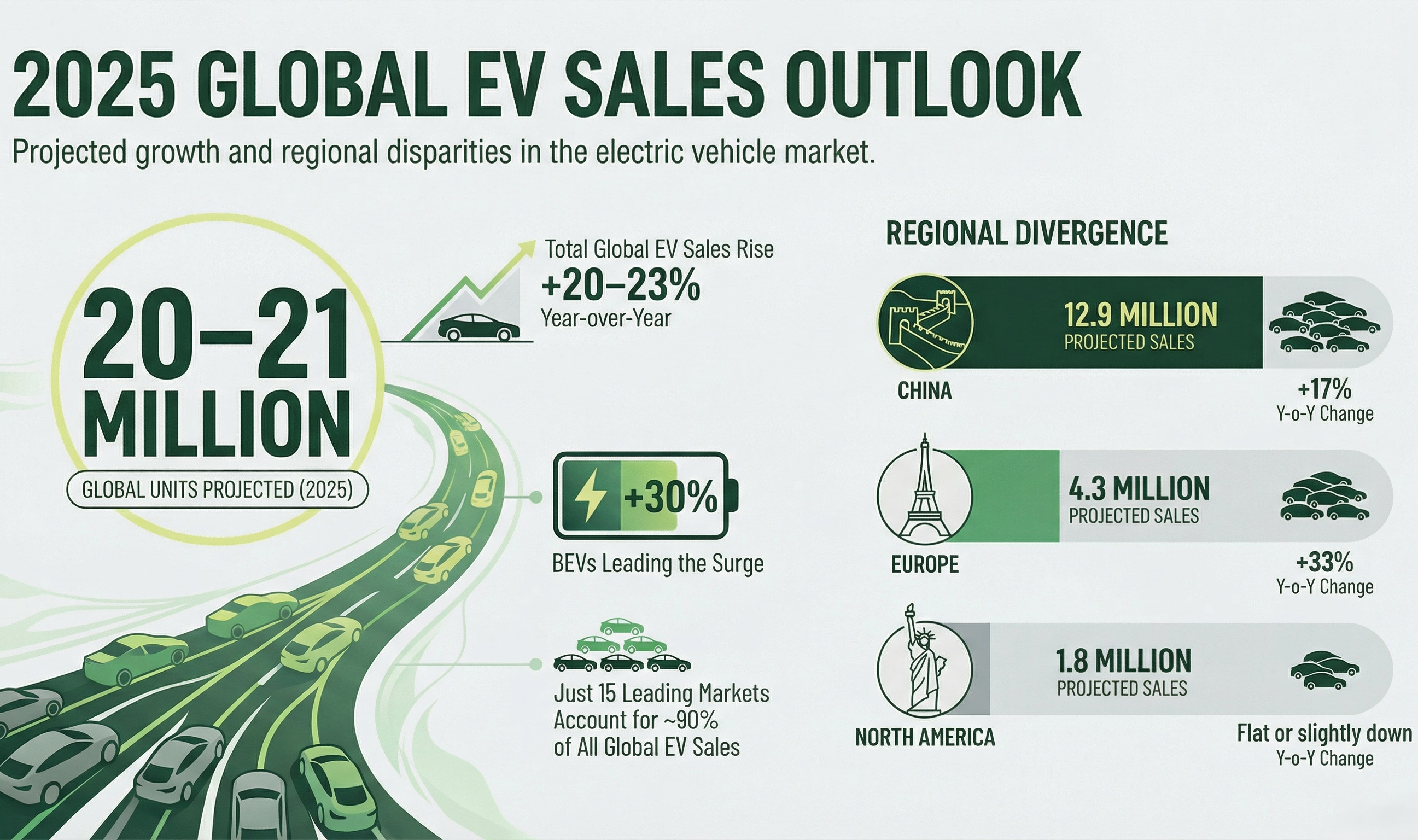
Based on cumulative data through October and full-year estimations, total EV sales in 2025 are estimated at approximately 20-21 million units, up around 20-23 per cent year-on-year compared with 2024, with battery electric vehicles (BEVs) at the core of the expansion.
BEV sales across the 40 markets tracked by PwC Autofacts expanded 30 per cent year-on-year in 2025, taking full-year BEV volumes to their highest level on record. Fourth-quarter EV sales crossed 4 million units for the first time, up 17 per cent Y-o-Y, and BEVs accounted for more than 20 per cent of all vehicles sold globally for a second consecutive quarter.
PwC’s data show global BEV volumes rose by 30 per cent in 2025 vs 2024 wherein the first three quarters of FY2025 saw BEV sales of 9.53 million, bringing a cumulative close to 14 million sold throughout the calendar year.
However, the sales share between ICEs and EVs differed from region to region. Furthermore, the subcategorised contribution of EV types was also uneven in China, Europe and the US (where it is the largest market for electric vehicles).
China: BEVs gain share as PHEVs lose relevance
China accounted for the largest share of global EV volumes, with estimates ranging from roughly 12.9 million units in 2025, up 17 per cent from 2024.
BEV sales rose 33 per cent Y-o-Y for the full year, while Q4 volumes increased 16 per cent to 2.87 million units. BEVs captured 36 per cent of all vehicle sales in the quarter, pushing total EV share to 59 per cent.
The composition of growth shifted decisively. PHEV sales declined 11.6 per cent Y-o-Y (2025: 1,515,000 vs 2024: 1339260) in Q4, marking the second consecutive quarterly contraction after several years of expansion. PHEV sales figures stood at 4,895,000 during FY25 as compared to 4,840,000 for FY24, noting a 1.1 per cent growth Y-o-Y Entry-level BEVs priced between EUR 3,600 and EUR 8,100, such as the Wuling Hongguang Mini EV and BYD Seagull, absorbed demand previously served by PHEVs.
The weighted average entry price of China’s top-selling BEVs in 2025 stood near EUR 13,000, less than half the European average and roughly one-third of US levels.
ICE sales in China fell 4 per cent over the year, reinforcing that BEV growth is now displacing combustion volumes directly rather than merely expanding the overall market.
For the global aluminium value-chain 2026 outlook, book our exclusive report “Global ALuminium Industry Outlook 2026"
Europe: BEV momentum rebuilds as ICE sales collapse
In the just passed quarter, Europe delivered the strongest Y-o-Y acceleration among mature auto markets. In the five largest countries, Germany, France, the UK, Italy and Spain, BEV sales rose 41 per cent Y-o-Y in Q4 2025, lifting quarterly BEV market share to a record 20 per cent.
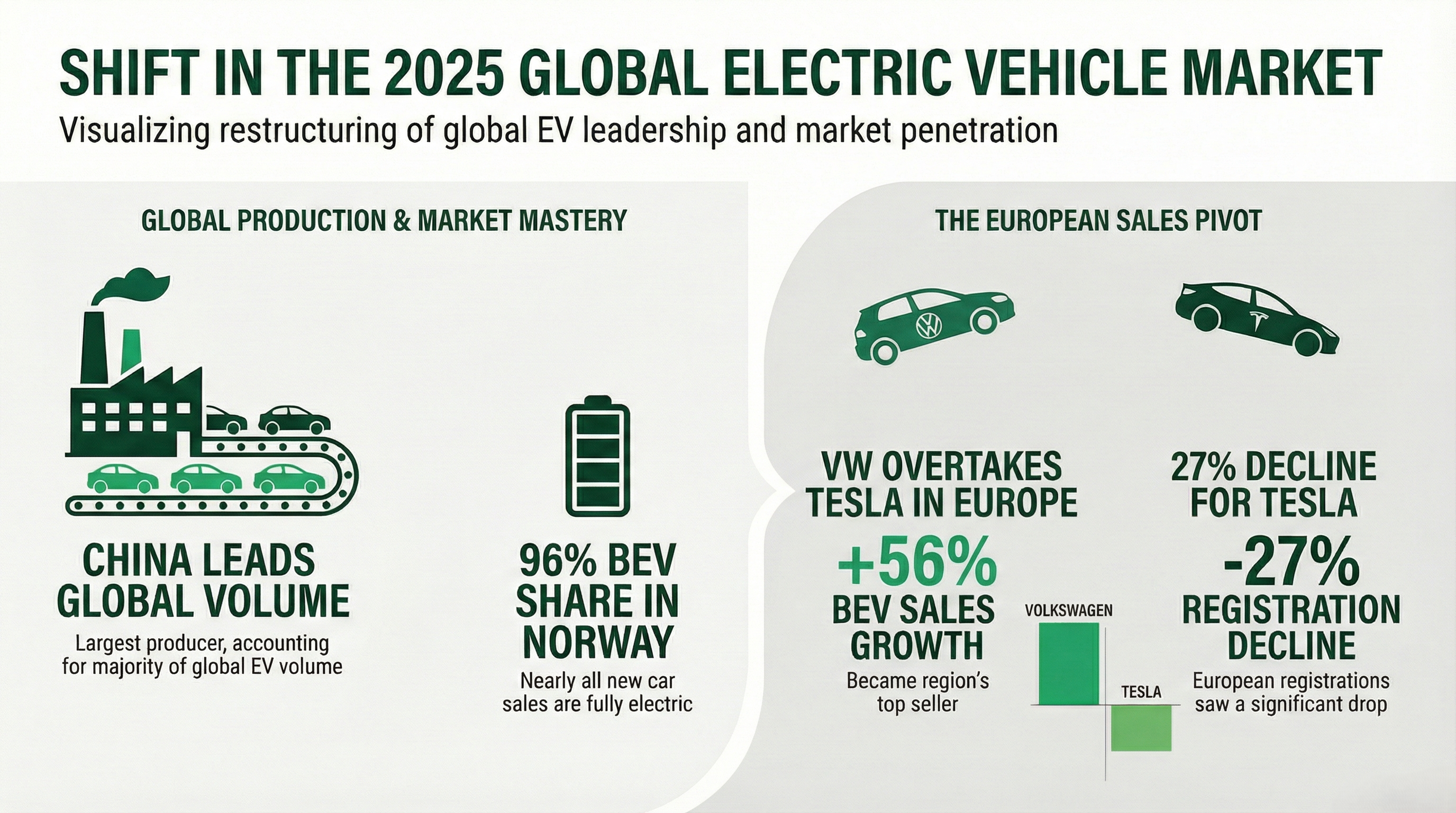
Germany provided the clearest rebound signal with a total EV sale of 1,672,651 during 2025. After a 27 per cent decline in 2024, BEV sales increased 43 per cent in 2025 (545,142), with Q4 volumes up 56 per cent Y-o-Y (sales volume 162,940 units) and market share reaching 22 per cent, the highest level in more than two years.
France recorded a 12.3 per cent Y-o-Y increase in 2025 BEV sales (326,923 vs 291,143), pushing BEV share to an all-time high of 20 per cent. The UK matched that milestone with a 28.5 per cent yearly share in the vehicle purchase and registration scenario.
Southern Europe showed the steepest growth curve. Spain and Italy posted full-year BEV sales growth of 77 per cent (101,661 vs 57,377) and 44 per cent (94,624 vs 65,619) respectively, lifting Q4 BEV penetration to 10 per cent in Spain and 9 per cent in Italy.
In FY2025, EV sales in Europe were close to 8427000 units. However, coming to whole year results, most of the European nations suffered saturation in the EV market as a constant constraint for further growth. When compared against the whole year’s data, EV sales in France (-30.5 per cent), Germany (-20.4 per cent), Italy (-19.3 per cent), Spain (-13.5 per cent) and UK (-19.2 per cent) along with Austria (-12.2 per cent), Belgium (-13.3 per cent), Denmark (-38.8 per cent), Finland (-25.5 per cent), Netherlands (-37.3 per cent) and Norway (-42.3 per cent) have shown a downward trend in EV sales in 2025.
ICE attrition accelerated in parallel. ICE registrations across the top five markets fell 18 per cent Y-o-Y in Q4, leaving fewer than one in three vehicles sold powered solely by combustion engines. On a full-year basis, 64 per cent of vehicles sold across these markets in 2025 were electrified, including BEVs, PHEVs and hybrids.
PHEVs in Europe: A compliance tool with a shrinking window
European PHEV sales rose 40 per cent Y-o-Y in Q4 2025 (units sold 788,000), driven by triple-digit growth in Spain and Italy. The expansion was tactical rather than structural. OEMs leaned on PHEVs to manage fleet CO₂ compliance ahead of stricter utility-factor rules taking effect from 2026, which will raise the official CO₂ values assigned to PHEVs.
France diverged from the trend, with PHEV sales falling 24 per cent Y-o-Y in Q4. The data suggest that while PHEVs remain a short-term regulatory buffer, their growth trajectory is increasingly policy-dependent and vulnerable to tightening emissions accounting.
United States: Incentive withdrawal reverses late-year momentum
3546000 EV sales have been recorded for the United States during the calendar year 2025. The US market reflected the sensitivity of battery electric car demand to fiscal support. After a 23 per cent Y-o-Y increase in Q3 2025 as consumers rushed to secure expiring incentives, BEV sales fell 31 per cent Y-o-Y in Q4 following the termination of federal tax credits at the end of September. PHEV volumes dropped 47 per cent, and total EV sales declined 10 per cent in the quarter.
Despite the volatility, BEV market share for full-year 2025 remained broadly flat at just under 8 per cent, indicating that growth stalled rather than reversed at an annual level. Hybrids absorbed displaced demand, rising 11 per cent Y-o-Y in Q4 and reaching a record full-year market share of 13 per cent. The US pricing structure remained a constraint, with the weighted average BEV entry price at approximately EUR 37,400 (USD 44,100), nearly three times the Chinese level.
Domestic OEMs dominate volume segments
Across regions, domestic manufacturers led volume growth. China’s top-selling BEVs were overwhelmingly local models, while Europe’s rankings increasingly featured regionally developed small and compact BEVs. In contrast, the US top-10 list remained heavily concentrated around two Tesla models, underscoring slower diversification.
The pricing gradient remained stark. Average BEV entry prices stood at EUR 13,000 (USD 15,340) in China, EUR 32,800 (USD 38,700) in Europe’s top four markets, and EUR 37,400 in the US. The correlation between lower entry prices and higher BEV penetration held consistently across regions.
Don't miss out- Buyers are looking for your products on our B2B platform
Global electric vehicle assembly projection
The EV assembly is projected to accelerate materially beyond 2025, with PwC forecasting total EV production to rise from 44.3 million units in 2026 to 69.4 million units by 2031, implying a 57 per cent increase over five years.
Battery electric vehicles are expected to remain the primary growth engine, with BEV assembly forecast to expand by 72 per cent between 2026 and 2031, outpacing both plug-in hybrids and conventional hybrids. PHEV production is projected to grow by 56 per cent, while hybrid electric vehicles (HEVs) are expected to increase by 42 per cent over the same period. The data indicate that post-2025 electrification will be increasingly BEV-centric at the production level, reversing the transitional dominance of hybrids seen in several markets during the early 2020s.
Regionally, China is expected to consolidate its position as the largest EV assembly hub, driven by continued policy support and scale efficiencies, accounting for the single largest share of incremental BEV and PHEV output through 2031. BEV production in China alone is forecast to rise from 17.7 million units in 2026 to 30.4 million units by 2031, a 72 per cent increase, while total EV assembly across Western and Central Europe is projected to grow from 17.7 million to 25 million units, representing a 42 per cent expansion.
North America’s EV production growth remains more moderate in comparison, reflecting uncertainty around incentive structures and regulatory continuity.
Must read: Key industry individuals share their thoughts on the trending topics
Global EV launch lineup 2026
On a bright note, global automakers are entering 2026 with a deeper and broader EV lineup than in previous years, reflecting both volume and premium segments. Legacy players and new entrants alike have slated a pipeline of launches to sustain market relevance even as demand growth moderates.
Mass-market and volume-oriented EV launches are expected from established players such as Hyundai with its refreshed Ioniq 4 and Ioniq 8 BEVs targeted for 2026, alongside Volkswagen’s planned ID.2 and ID.3 X models aimed at the entry-level European EV segment. Premium and performance-oriented launches, including the Polestar 6 and other flagged entries timed for 2026, round out the broader portfolio expansion. These model programs are designed to fill gaps in existing ranges and accelerate conversions from internal-combustion market share to electrified alternatives over the next two years.
The 2026 EV launch is also anticipated to reflect strategic responses to evolving demand signals seen in 2025. China’s continued BEV dominance will be supported by new and refreshed models from domestic OEMs that emphasise affordability and localised technology features, while in Europe and North America, competitive model launches are structured to counter slower policy-driven demand cycles and pricing pressures seen in late-2025 volumes. Although PwC’s Q4 report does not detail specific names, the aggregate expectation is one of a materially expanded and diversified model set for 2026, spanning compact hatchbacks, crossovers, premium EVs and performance platforms.
Information credit: https://www.strategyand.pwc.com/