Brazil’s importation market for Aluminium wires remains wavering during 2017-20
Brazil has a developing mixed economy that is the ninth-largest in the world by nominal Gross Domestic Product and eighth-largest by purchasing power parity in 2019. According to the International Monetary Fund, Brazils 2019 nominal GDP was R$6.826 trillion or US$1.868 trillion.
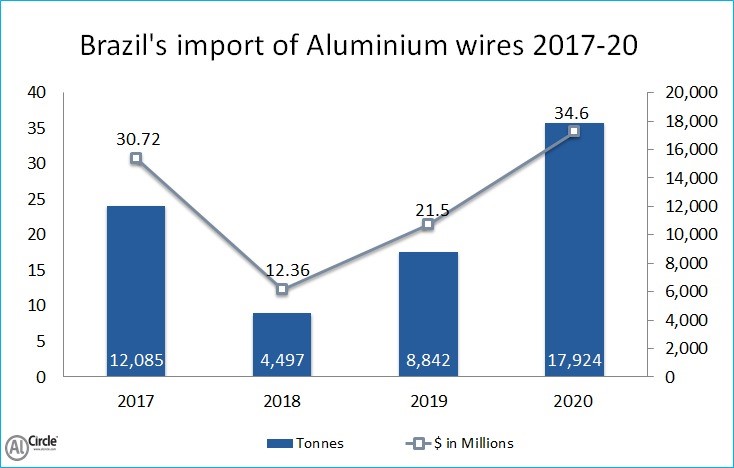
The Latin American nation’s import of aluminium wires during 2017-19 was recorded at 25,424 tonnes and revenue expenditure stood at $64.58 million. The projected export for 2020 has been analysed to stand at 17,924 tonnes and expenditures to outreach at $34.60 million. When the evaluated import volume and expenditure of 2020 get summed with the previous three years, it depicts 43,348 tonnes and $99.18 million respectively.
Aluminium provides a better conductivity to weight ratio than copper and therefore is also used for wiring power grids, including overhead power transmission lines and local power distribution lines, as well as for power wiring of some aeroplanes.
Brazil’s import of aluminium wire in 2017 remained at 12,085 tonnes and the foreign revenue expenditure reflected was $30.72 million, whereas in 2018 the import saw de-growth by 62.78%, as the import volume fell to 4497 tonnes and expenditure also dropped to $12.36 million.
Aluminium wire importation of Brazil in 2019 exhibited tick-up by 96.61%, as the import volume rose to 8842 tonnes and revenue expenditure also climbed to $21.50 million.
The projection for 2020 has been analysed with growth by 102.71%, as the import volume to reach at 17,924 tonnes and expenditure to surge at $34.60 million.

Brazil’s major trading nations for aluminium wire importation are Argentina, Bahrain, Canada, India, Italy, Malaysia, China, Russia, UAE, Turkey, Venezuela, etc.
AVC Gemino Doors & Walls joins Aluminium Stewardship Initiative as new Industrial User member
Next articleNovel 3D-printed Aluminium device upgrades capture of carbon dioxide emissions from fossil fuel plants
Grow with
AL Circle