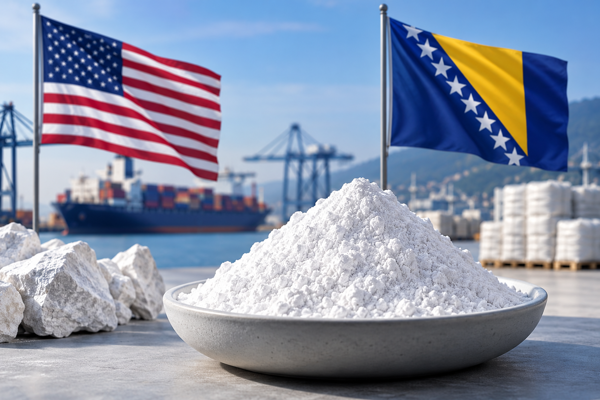
The US aluminum trihydrate market strengthened in September 2026 as downstream procurement, rising overseas production costs, and shipping bottlenecks supported prices. In contrast, Bosnia’s market faced a quarterly correction as European buyers drew on accumulated inventories and lower caustic soda costs eased manufacturing pressures, highlighting diverging regional price trends. US aluminum trihydrate market gains on demand and supply constraints US aluminum trihydrate prices increased 2.38% month over month in September, supported by purchases from wire and cable manufacturers, electrical infrastructure compounders, and electric vehicle (EV) component producers. Demand remained particularly resilient for applications involving low-smoke cable compounds and flame-retardant materials....
China-based China Aluminum International Engineering Co., Ltd. (CHALIECO) has won a bid for an engineering, procurement and construction (EPC) contract valued at approximately USD 833 million for a proposed alumina project in Vietnam, adding to investment activity in the country’s mineral processing sector. The project, being developed by Binh Phuoc Ore Mining and Beneficiation Joint Stock Company, is designed to process 2.4 million tonnes of alumina annually. The proposed contract is valued at around CNY 5.595 billion (USD 839.04 million), with completion expected within 27 months of the contract’s effective date. CHALIECO to oversee turnkey refinery development Under the proposed turnkey arrangement, CHALIECO’s responsibilities will cover the full project delivery process, from...
Grow with
AL Circle
Alumina prices driven by growing Chinese demand and tight supply climbed significantly to touch US$351 per tonne in 2016- the highest in the last two years. The price graph picked up momentum from August onward with the upturn in all commodity prices. According to the commodities forecast, the alumina price will settle within an average of US$310per tonne in first quarter of FY2017. Aluminium’s value chain starts with bauxite mining and moves to alumina refining before it is processed into raw aluminium. Companies such as Rio Tinto, Norsk Hydro Alcoa and Nalco that have both alumina refining and aluminium smelting operations are going to be benefitted due to high alumina prices. Alcoa was the top alumina producer in 2016, with a strong first-quarter cost position on the global cost curve....

Noranda Alumina confirmed that the company has secured a long term agreement with the Century Aluminum to supply smelters in Hawesville and Sebree, Kentucky with smelter grade alumina. Commenting on the announcement, David D'Addario, the chairman and chief executive officer of Noranda and managing partner of DADA Holdings, said that the long term agreement with the Century Aluminum marks an essential development in Noranda’s future. The alumina refining and Jamaican bauxite mining assets of Noranda were acquired by DADA Holdings in the late 2016, which is an investment and management company located in Fort Lauderdale, Florida. The new contract will cover the total alumina requirement of the Century smelters. According to the DADA management group, Noranda asset was procured to find a...

Alcoa Corporation announced on Tuesday that it will permanently close the Suralco alumina refinery and bauxite mines in Suriname, which has been curtailed since November 2015. The Suriname government and Alcoa will continue to work on the agreement concerning Suralco’s remaining activities in Suriname, and till the time a decision is reached on the agreement, Alcoa will continue to operate the Afobaka hydroelectric facility, the power supplier to the Suralco alumina refinery. With the closure of Suralco operations, Alcoa expects to record $90-million after-tax and charges related to the restructuring activities during fourth-quarter of the current fiscal. Alcoa’s share is estimated to be $151-million over five years, with $27-million to be spent in 2017. The company also expects to record...

According to USGS’ recently published bauxite and alumina industry survey for the Third Quarter 2016, imports of alumina during the third quarter of 2016 were 315,000 tons. This records a 3% increase from those in the second quarter but 20% drop from the third quarter of 2015. The general downturn of the primary aluminium industry in the U.S. has caused the drop in the import of alumina YOY. The leading sources of imported alumina during the third quarter of 2016 were Brazil that exported 38% of alumina and Australia supplying 30% and Jamaica 18%. Exports of alumina during the third quarter of 2016 were 366,000 tons, the same as those in the second quarter but 38% less than those in the third quarter of 2015. The leading destinations for alumina export during Q3 2016 were Iceland that...

Global alumina prices have risen steadily since late September in 2016 on the back of raw material restocking by the smelters in China where the commodity prices in the domestic market have also witnessed a steep rise, driven by strong demand, refinery closures (on alleged environmental laws incompliance) and limited transportation availability. Region-wise alumina prices and LME aluminium have continued to diverge through 2016, leaving some smelter owners reluctant to lock in their raw material costs against the LME aluminium price. The divergence has been such that the alumina market has grown independent of that of aluminium over the course of past one year. Alumina prices globally, including in China, experienced a steep rally in the fourth quarter of 2016 after a wave of smelter...

According to a recent Technavio report, the global activated alumina market is slated to witness a steady growth of around 8 per cent CAGR over 2016-2020 piggybacking the growth of adsorbent market and a wide range of catalyst-based applications market all over the globe. Activated alumina is produced by dehydroxylating aluminium hydroxide. A highly porous material, activated alumina can has a surface area significantly over 200 square metre per gram. Its adsorbing capacity is very high, which makes it ideally suited for use in a number of chemical industries. The report says, during the forecast period, activated alumina will be used for the removal of impurities such as fluoride and arsenic from drinking water and also for the drying of liquids, air, and gasses. The processed mineral...

Iran has about 350,000 tons of yearly aluminium output capacity and the country is endowed with potential for the development of a successful aluminium industry. The country has cheap power as it is endowed with immense natural gas reserves. Qualified yet cheap labour force, production technology and growing domestic market also contribute towards the opportunities for such a development. Despite Iran’s possible advantages in the industry, lack of raw material reserves pose a hurdle in realizing the potential, as said by Iranian Mines and Mining Industries Development & Renovation Organization's aluminum advisor, Mohammad Ashofteh Ajbisheh. Iran’s southern neighbours too have no bauxite mines, and some of them have partnered with certain African, Brazilian and Australian companies for...

India's two leading aluminium producers, National Aluminium Company Limited (NALCO) and Vedanta, finally seem to be collaborating with each other to sort out alumina sourcing related issues that the latter has been facing since long. The central government has asked the Navaratna PSU to consider selling alumina, which it otherwise exports, to Vedanta. The metal and mining giant's past attempts to participate in Nalco's tenders were earlier thwarted several times by the Nalco unions. It is perceived that the current softening on the stand came after Mines Minister Piyush Goyal expressed his shock at Nalco's strategy to rather export alumina than allow for its conversion within the country, during his visit to Bhubaneshwar earlier this month. It is learnt from reliable sources that Nalco is...

China is one of the world’s top alumina producers and a leading supplier of alumina to the global primary aluminium industry. China has around 60 million tonnes of alumina capacity but produced around 47.3 million tonnes of the aluminium-making ingredient from January to October last year. The country boasts world’s top alumina producers like Aluminum Corp of China (CHALCO), Shandong Xinfa Aluminium Group and China Hongqiao Group. {newsStudioGallery} Aluminum Corp of China (CHALCO), the country's biggest producer of alumina and primary aluminium, posted profits of 330 million yuan ($49.4 million) during the first half of the year, the highest level in almost five years, attributed mostly to the reduction in the CoP of alumina and aluminium. An analysis of the trading patterns of alumina...

Alumina prices, buoyed by the China factor, climbed significantly to touch US$351 per tonne in 2016- the highest in the last two years. The price escalation which started in January 2016, after a few months' initial volatility, picked up momentum from August onward. Since then, the commodity price has been rising exponentially. China is viewed as the prime factor responsible for this buoyancy though no fundamental alumina shortfall has been reported in the country unlike in late-2014. In fact, the uptick in price caused Chinese alumina output to surge in October and November such that alumina supply in the domestic market was in surplus by almost 150kt in November. Currently, a regional tightness is being observed in China with transport constraints obstructing delivery of alumina from...

The United Arab Emirates has grown over the years from essentially an oil-based economy to the world's fourth largest aluminium producing country, thanks to Emirates Global Aluminium's (EGA) contribution as major aluminium manufacturer of the region. The industrial champion with two operating sites in Abu Dhabi and Dubai currently produces 2.4 Mtpa of primary aluminium, contributing two to three per cent of the UAE's non-oil gross domestic product (GDP). As far as raw material sourcing for aluminium smelting is concerned, at present, the UAE is entirely reliant on third party imports for its alumina needs. It imports close to five million tonnes of alumina every year. {newsStudioGallery} However, the country's first alumina refinery adjacent to EGA's operations in Al Taweelah is coming up...

2016 has been a reasonably good year for alumina. The commodity, unlike other components in the entire cyclical asset basket, witnessed a sustained demand push all through, thanks to a global deficit market and prices kept rising supported by supply concerns arising mainly out of China. There were mergers and acquisitions, investments and divestures, closures and starting of new ventures as is common in almost every sector across industries. Now, that we gear up to begin a new year it’s time we take a look back at the events and phenomena that made headlines in the alumina industry in the last one year: Market Ups & Downs: 1. According to the latest report provided by Altech Chemicals, the global market for high purity alumina (HPA) is forecast to reach 86,831 tons by 2024 from the...

CBIX eased US$0.4/dmt to US$50.3/dmt for the week on the back of lower Value in Use (ViU) priced Solomon Islands material countering higher priced imports from Brazil and Australia. News from Malaysia reports exports from Kuantan now moving to help clear stocks, but sentiment on ground suggests the mining ban will continue until at least the March 2017 election. Malaysian prices edged higher, with unwashed ore selling for US$27.5/dmt FOB and washed also higher at US$40-41/dmt FOB. Chinese domestic alumina prices nudged slightly higher, with the north index up 0.6% (RMB18/t or US$2.6/t) to RMB2,994/t and the south up 0.2% (RMB5/t or US$0.7/t) to RMB2,980/t (US$431/t). Alumina market tightness persists, driven by new smelter start-ups and ramp-ups of idled capacity, stocking prior to the...

The demand for alumina or aluminium oxide, which is obtained by refining bauxite ore and electrolysed to yield aluminium metal using the Hall-Héroult process, is on the rise driven by enhanced consumption by the aluminium industry. Prices of the mineral though remained under pressure in H2 2016 due to a combined effect of softening Chinese demand for imported alumina, swift Chinese refinery restarts and lower refining costs, the outlook seems bright for 2017, states CRU. {newsStudioGallery} The global activated alumina and high purity markets, too, are anticipated to exhibit high rates of growth during 2016-2020. This is mainly attributable to industrial and economic development in the countries in the Asia-Pacific region. In fact, Asia-Pacific is estimated to have the largest market for...

Silvio Porto is appointed new Executive Vice President Bauxite and Alumina, and member of Hydro's Corporate Management Board. The change is effective as of December 13, 2016. Silvio Porto comes from the position as Chief Operational Officer (COO) in Bauxite and Alumina. He joined Hydro in 2014, when he was appointed plant manager for Hydro Paragominas bauxite mine. Porto has more than 30 years' experience from the aluminium industry with management positions in bauxite mining, alumina refineries and aluminium smelters. Porto replaces the interim head of Bauxite & Alumina, Chief Financial Officer Eivind Kallevik, who fully resumes his CFO position.

The dynamics of the global alumina industry has undergone a sea-change over the last five years. Driven by a humongous demand for aluminium in China, followed by other growth areas such as the Middle East and India, bauxite production and alumina refining capacity has increased immensely across the major alumina producing regions of the world. According to CRU's Bauxite and Alumina Long Term Market Outlook (2016 edition), the Global alumina capacity is forecast to grow by 29.6% over the next ten years, reaching 179.6 million tonnes by 2024. Capacity expansion of metallurgical grade alumina, primarily in China, is projected to be the main driver for this growth. China's net alumina investment requirement is expected to peak in 2025 at 10 million tpy, while the world ex. China is forecast...

According to a recently published market report, the global high purity alumina market is slated to grow at a CAGR of 27.11% by the period 2016-2020. The growing adoption of LED lighting systems and displays, changing Government regulations encouraging energy-efficient lighting systems across economies, and Increase in demand from APAC have been identified in the report as the key growth drivers of the market. Alumina, commonly known as aluminium oxide, is primarily used as a feedstock for the fabrication of metallic aluminium, known as smelter grade alumina (SGA). Approximately 90% of alumina is used in aluminium fabrication, and the remaining 10% is dedicated to the non-metallurgical market for industrial use. High-purity alumina, which characterizes alumina with a minimum purity of...

Australia is the top bauxite producer in the world with about 81million tons of bauxite production and that has induced some of the top aluminium companies invest on alumina refineries in Australia, especially Western Australia. {newsStudioGallery} According to the data from International Aluminium Institute, Australia produced 20.7 million tons of alumina in 2014 and 20.3 million tons in the year 2015. For the year 2016, Australia produced 15.6 million tons of alumina till date. Most of the alumina produced in Australia is exported around the world. In 2014, Australia exported 20 million tons of alumina globally. The amount dropped slightly to 19.6 million tons in 2015. For 2014 and 2015, the total value of alumina export was USD 6.5 billion and USD 5.7 billion respectively. For the year...