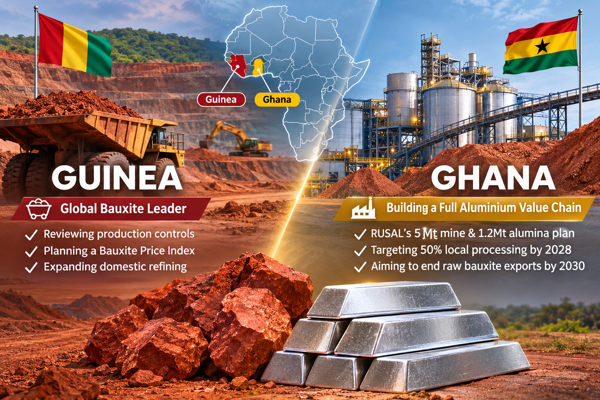
Guinea and Ghana are approaching the global bauxite market from very different positions. While Guinea has established itself as the powerhouse of international bauxite supply, its growing export volumes are creating a new challenge of maintaining prices and protecting the economic returns from its mineral wealth. Ghana, meanwhile, is looking beyond raw ore exports, pursuing foreign investment, domestic alumina refining and stronger integration across its aluminium industry. The contrast is becoming increasingly momentous, with Guinea considering production controls and a national bauxite pricing mechanism to strengthen its influence over the market. Au contraire, Ghana is attracting international companies, including Russia’s RUSAL, to develop its largely untapped deposits and establish...
Industrial emissions across the European Union (EU) have declined by 3.3 per cent year-on-year in 2025, while the European Commission plans to widen the Carbon Border Adjustment Mechanism (CBAM) to cover 180 additional downstream aluminium and steel products. The proposed expansion, scheduled for 2028, signals a broader application of the EU’s carbon rules, extending their reach beyond basic materials to manufactured goods. According to the Commission’s November 9 report on the functioning of the European carbon market in 2025, lower emissions from metals, cement and chemicals contributed to industrial emissions reduction from installations covered by the EU Emissions Trading System (ETS). Under the ETS, free emission allowances are distributed according to performance benchmarks based on...
Grow with
AL Circle

Aluminium ingot inventories at three major Japanese ports fell about 6.3% month-on-month in July, trading house Marubeni Corp’s data showed on Monday August 12. The total inventories at Osaka, Yokohama and Nagoya stood at 234,000 tons in July down from 249,600 tons in June. Inventories were down 0.5% year-on-year. This week there is a summer holiday in Japan with a lot of factories shut and the draw-down in stock is partly in preparation.
Eskom has finally owned up to the full liability it faces as a result of preferential deals to supply cheap power to BHP Billiton’s aluminium smelters, putting it at a stunning R11.5bn in its latest financial statements — double that stated in previous years. In last year’s statements, Eskom put the liability from the contracts at R5.9bn. For the year ending March 2013, this has been restated as R11.5bn. This is essentially "lost" revenue, as a result of the contracts which supply the smelters according to various formulas at less than half the cost it takes to produce the power. The Billiton contracts were kept under wraps until March, when court action by Media24 forced Eskom to reveal the true cost of the agreements. In its latest statements, Eskom appears to be taking into account...
Meridian Energy has posted a 53 percent increase in underlying net profit after tax of $162.7 million, but has had to write down the total value of its assets by $476m after renegotiating the Tiwai Point aluminium smelter power deal. The new deal, announced last week, gives the smelter cheaper power after majority owner Rio Tinto sought to renegotiate after a fall in global aluminium prices. The writedown is the last piece of the puzzle as the Government seeks to partially privatise Meridian in a share float that is expected to see the country's largest power company by value list on the NZX later this year. There are no details in the result of the float of up to 49 percent of the company, and no indication whether the total $252.4m in dividends for the last financial year will be...
Rusal CEO Oleg Deripaska is making moves – to help his company’s margins. Bloomberg reported that Deripaska indicated 8.4% of the company’s production output will be halted this year to help support aluminum prices. “The company will idle 350,000 tonnes of capacity at five of its plants with high production costs until aluminum rises to USD 2,400 per tonne. Aluminum prices fell more than 13% this year to USD 1,799 per tonne as global stockpiles reached records and last month traded at the lowest level since 2009,” he is quoted as saying. Prices for Chinese aluminum bar saw the biggest increase on the weekly Aluminum MMI® this week, rising 1.1 percent. The price of Chinese aluminum billet declined 0.4 percent over the past week. The cash price of Chinese aluminum fell 0.1 percent. The...
Base metals on the London Metal Exchange (LME) have closed higher after prices surged following another round of upbeat Chinese economic data that stoked investor hopes for better demand from the world's top metals consumer. At the close of open-outcry trading in the London ring on Friday, LME three-month copper was 1.2 per cent higher on the day at $US7,274 a metric ton, it's highest closing price since early June. Aluminum closed up 1.6 per cent at $US1,870 a ton. All metals surged to post multi-week price highs during the session, with zinc closing some 2.5 per cent higher on the day at $US1,942 a ton, and tin posting its highest closing price in nearly four months at $US22,075 a ton. Data early in the session showed China's July industrial production rose 9.7 per cent on the year...
Rio Tinto's decision to call off the divestment plans for its Pacific Aluminium unit will not impact stakeholders of Australian Boyne Aluminium Smelters and the New Zealand Aluminium Smelters, a spokesman for Sumitomo Chemical, which has stakes in both companies, said Friday. "Following a comprehensive review we have... determined that the divestment of Pacific Aluminium for value is not possible in the current environment and it will be reintegrated into the Rio Tinto Alcan group," the miner said in its results statement Thursday. "This [calling off the divestment plans] is a move within the Rio Tinto group and will not have any effect on the stakeholders," the Sumitomo Chemical spokesman said. Sumitomo owns 20.64% of New Zealand Aluminium Smelters and 2.46% of the Boyne Smelters. "Since...

A reliance on expensive, imported energy has temporarily shuttered Jamaica’s bauxite alumina industry. But foreign operators who are working there hope to slash costs and kick-start production once more. Both United Co Rusal and Alcoa are looking at alternatives to the costly oil they are forced to import to provide energy to power their operations in the Caribbean country. Their options are coal and natural gas. Coal requires huge capex for infrastructure but has lower cash costs, while gas has lower capex but higher cash costs. In the interim, around 10 million barrels of oil equivalent is imported annually by Jamaica’s bauxite and alumina industry, the government estimates. “Energy is the main problem of our entire mining sector,” told Phillip Paulwell, the country’s minister of...

In Q2 2013, Vale's bauxite extraction was 2.8% higher than in Q2 2012 and 6.0% higher than in Q1 2013 as a result of increased alumina production. Alumina production increased 8.5% against Q2 2012 which experienced processing issues and slightly decreased against Q1 2013. Internal consumption of alumina amounted to 121 kilo tonne (an increase of 0.8% on Q2 2012 and 1.7% on Q1 2013) representing 29.7% of total alumina production and consistent with the aluminium smelter running at its full 250 kilo tonne per annum capacity. Primary aluminium production in Q2 2013 was 63 kilo tonne an increase of 1.6% on Q2 2012 and 3.3% on Q1 2013. Electricity generation in Q2 2013 increased 4.3% on Q2 2012 and decreased 17.6% on Q1 2013 reflecting seasonal demand. Supply of electricity to other Group...
State-owned diversified miner PT Aneka Tambang (Antam) is seeking partners for the development of a processing plant to convert bauxite into smelter grade alumina (SGA). Antam president director Tato Miraza said the company sought a maximum of two partners for the project, which will be located in Mempawah, West Kalimantan. “We seek partners to hold around 30 to 35 percent ownership in the project,” Tato said. According to Tato, Antam is currently assessing a number of bidders or investors from various countries, such as China, Russia, Japan, the United States and some others from the Middle East. The SGA plant is expected to have an annual production capacity of 1.2 million metric tons of alumina. Antam has finalized feasibility studies for the project and is expecting to kick off plant...
LME aluminium is expected to retrace to $1,853 per tonne, as it failed to break a resistance at $1,878. The resistance is provided by the 100 percent Fibonacci projection level of an upward wave c, which looks exhausted, as it could have unfolded too fast. Strengthening this resistance is another one that has been established by a trendline ascending from the July 2 high of $1,852. Chances are the wave c may peak around $1,878 or could have peaked at the $1,877, the Aug. 9 high. The 76.4 percent projection level at $1,853 will provide a support, a break below which will result in a further loss to $1,838, the 61.8 percent projection level. No information in this analysis should be considered as being business, financial or legal advice. Each reader should consult his or her own...
Hindalco Industries’s net profit for the quarter ended June is estimated to be lower than in the previous quarter, owing to a drop in net sales, brokerages have said. The company’s aluminium volumes are expected to have fallen six per cent quarter-on-quarter because of disruptions at the Hirakud unit due to heavy rains, Bank of America Merrill Lynch said in a report. “In copper smelting, we expect volumes to decline five per cent quarter-on-quarter due to the maintenance shutdown (at Dahej in Gujarat),” it said. The company’s earnings before interest, taxes, depreciation and ammortisation margin was expected to shrink, too, due to lower sequential earnings from copper treatment, as well as refining charges, said brokerages. Hindalco runs custom smelting operations. Its profits do not...
CME Group, the world's leading and most diverse derivatives marketplace, today announced the first Aluminum MW U.S. Transaction Premium Platts (25MT) Futures (AUP) contracts were traded on Thursday 8 August. This trade was brokered by Jeffries Bache. Yesterday's trade was a 54 lot strip transaction for November and December 2013 between a physical trader and a major dealer. "This innovative aluminum swap futures contract enables commercial market participants in North America to better manage their price risk on an average basis throughout the month," said Harriet Hunnable, CME Group Managing Director, Metals. This contract is the first Exchange product that enables the aluminum Midwest premium to be managed. This is a complementary product to the LME aluminum contract. The US Midwest...
Rio Tinto has revealed an 18% drop in underlying earnings, down to US$4.2bn, in the first half of the year. It blamed lower metal prices and higher taxes for the decline. Rio also put on hold its efforts to sell its aluminium business interests after it couldn’t find a buyer. The FTSE 100 miner did, however, sweeten the pill for investors with a 15% increase in its interim dividend which this year will by 83.5p per share. It also said that cash flows were improving thanks to cost saving ‘momentum’ and highlighted progress with a number of significant projects. The ramping up Oyu Tolgoi copper-gold mine in Mongolia is now consistently operating above 80% of its design capacity. At the same time the group’s large, 290mln tonne, expansion of its iron ore operation in Australia’s Pilbara...
NZ Finance Minister Bill English was transparent about the reasons for injecting $30 million into the Tiwai Point aluminium smelter. Not known as a champion of government intervention, especially when it involves injecting taxpayers' money into struggling businesses, English said the deal would give some certainty to smelter workers and it would support the float of Meridian shares and give potential investors more certainty about what they're buying into. That's the real reason for a subsidy that goes against every economic principle this Government holds dear. Meridian supplies the power to the smelter and if Tiwai Point was to close, Meridian would lose its biggest customer. The numbers are huge. The plant gobbles up more electricity than Auckland city; it consumes one-seventh of all...
As Aboriginal leaders call for their communities to become economically independent, the people of northeast Arnhem Land may soon own their own mine. At the Garma Festival held over the weekend on a Yolngu site 14km outside of Nhulunbuy, the Gumatj Aboriginal Corporation and Rio Tinto-owned Gove Operations have signed a memorandum of understanding to carry out a feasibility study for bauxite mining on Gumatj lands in northeast Arnhem Land. Should the mine prove to be commercially feasible it would be owned and operated by the Gumatj Aboriginal Corporation, something welcomed by community leader Galarrwuy Yunupingu as giving substance to a desire for self-sufficiency by allowing Aboriginal people to commercially develop their land. He said Aboriginal people wanted to have the same...
Dominican Republic exported 300,000 tons of wet bauxite in two shipments out of the port at Cabo Rojo, Pedernales (southwest) in July, a resumption expected to increase government revenue for the rest of the year and provide more jobs in the country’s poorest region. A Mines Agency (DGM) report lists 21,998 wet tons sent to America and 186,982 to China. The DGM report says a 170,000-ton shipment will be completed and sent to China by the end of August. "The resumption of bauxite exports at Pedernales has resulted in the creation of 454 new jobs in Pedernales province, since operations of the mine at Las Mercedes began in May this year," says the DGM, headed by Alexander Medina. The government agency says the work on environmental mitigation begins at the end of this month will, which will...
The future of the Gove alumina refinery is again in doubt following the announcement by mining giant Rio Tinto that it is reintegrating its subsidiary Pacific Aluminium in the parent company because it could not sell it for a good price. The Northern Territory Government says it believes the move will not have an impact on continuing negotiations for a new gas supply deal to keep the refinery operating but Rio Tinto has not commented on the future of the talks. Pacific Aluminium is made up of several assets, including the Gove alumina refinery and bauxite mine near Nhulunbuy in East Arnhem Land. It was first set up as a separate company by Rio Tinto in October 2011 with the intention it would be sold. At the time, Rio Tinto said it wanted to sell 13 aluminium units worldwide, including...

Exactly one hundred years ago in 1913 a new technical development made the industrial scale production of aluminium tubes feasible, and marked the start of a unique success story. The First World War then put a temporary stop to any further development of the aluminium tube. But a promising start had been made and the foundation stone for the modern tube industry had been laid. Development of the large-scale production of the aluminium tube took place in Germany after the First World War, in the twenties and particularly in the thirties. Metal tubes had previously only been made from tin, lead or tin-plated lead. But tin was very expensive, and it required foreign currency; and just like lead, it was subject to controls for a time. Furthermore, food legislation limited the use of lead for...