





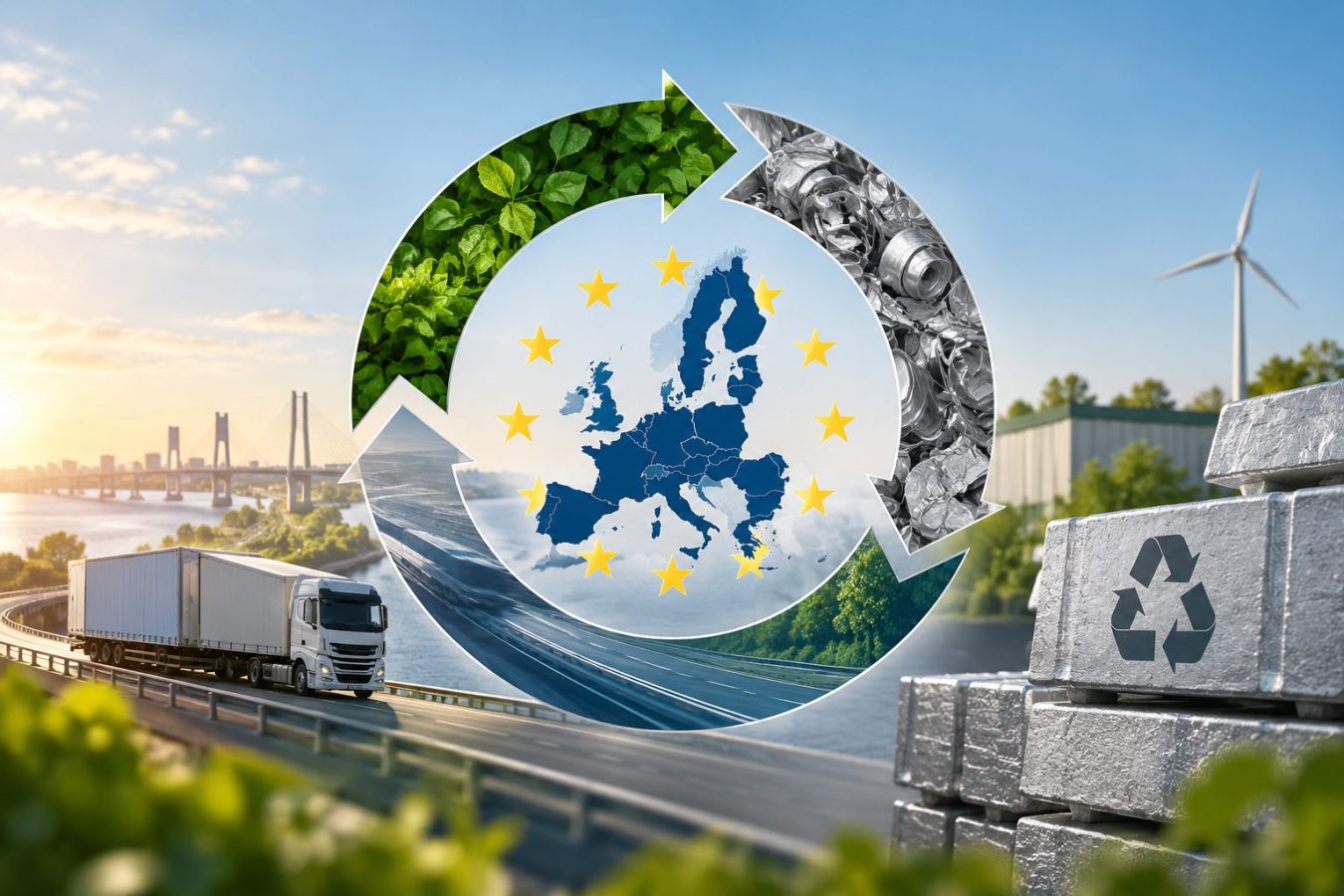
Europe has set itself an ambitious task: To become climate neutral while reducing its dependence on imported resources and building a more circular economy. The objectives may well be contradictory. In order to achieve them, Europe will need to resolve a tension at the heart of its industrial strategy: How can the European Union strengthen circularity without turning the Single Market into a protected market for materials?
The need for an open single market
The answer should be a genuinely open circular single market, one in which materials, products, investment and technologies can move efficiently across borders, while environmental measures ensure that recycling and recovery can take place while respecting high standards. Circularity should strengthen Europe’s competitiveness, not become a justification for protectionism.
The European Commission’s forthcoming proposal for a Circular Economy Act is intended to establish a stronger single market for secondary raw materials, increase the availability of high-quality recycled materials and stimulate demand for them. While the direction is right, the challenge will be to ensure that this ambition does not lead to attempts to artificially retain materials within national or European borders simply because they are considered strategically important.
This distinction matters particularly for metals. Aluminium, steel, copper and other materials operate in global markets in which supply chains cross multiple jurisdictions. Scrap and other secondary materials are not simply waste: They are feedstocks with an economic value. In 2024, the EU exported 35.7 million tonnes of recyclable raw materials to non-EU countries, while importing 46.7 million tonnes. Metals accounted for 19 million tonnes of EU exports and 6.3 million tonnes of imports. These flows demonstrate that circularity is already an international market, not something that stops at Europe’s external border.
Trying to prevent those flows through blanket export restrictions could produce unintended consequences. If recyclers, collectors and traders cannot sell materials to the highest-value legitimate market, the value of those materials may fall. That can weaken the commercial incentive to collect, sort and process them in the first place.
This is particularly important because Europe’s circular economy depends on a functioning chain of incentives. Someone must collect the scrap. Someone must sort it. Someone must invest in processing capacity. Someone must transport it. And ultimately someone must be willing to pay for the resulting secondary material. If policy artificially suppresses the value of recyclable materials by restricting their access to markets, Europe risks undermining the very collection and recycling economics it is trying to strengthen.
The same principle applies to feedstock availability. Recycling plants require reliable and competitively priced supplies of material. A facility in Germany, Italy or Spain should not be dependent solely on material generated within its own national borders. A circular single market should allow feedstock to move to where it can be processed most efficiently.
Open trade also matters beyond Europe’s borders. European recyclers may need imported scrap or secondary materials to operate efficiently, just as overseas processors may depend on European material. Restricting imports of primary raw materials while simultaneously restricting exports of secondary materials could create an artificially insulated European market in which prices no longer reflect global supply and demand, as that would be counterproductive. Europe’s objective should be to reduce its dependence on virgin materials through greater efficiency, recycling and substitution and not to disconnect European prices from international markets.
Trade liberalisation need not harm the environment
There is an important distinction between trade liberalisation and environmental laissez-faire. Open markets do not mean allowing uncontrolled waste exports. The EU’s revised Waste Shipments Regulation strengthens traceability and environmental requirements, while facilitating shipments destined for recycling within the single market. From May 2026, digital procedures under the new system are intended to make intra-EU waste shipments easier to track and more efficient. At the same time, EU regulation should target environmental harm rather than legitimate trade in valuable secondary raw materials.
This is especially important for the aluminium industry. Aluminium is inherently well suited to circularity because it can be recycled repeatedly while retaining its material properties. But recycling economics depend on collection rates, scrap availability, processing capacity and market prices. Europe should therefore concentrate on improving collection infrastructure, reducing contamination, investing in sorting and recycling technologies and creating predictable demand for high-quality recycled aluminium. EU decision-makers should also resist the assumption that every tonne of scrap leaving Europe represents a failure of European industrial policy. If a tonne of material can be recycled efficiently and sustainably elsewhere, that may still be preferable to material being collected poorly, stockpiled or ultimately discarded because European processing capacity or demand is insufficient.
Striking the right balance
The EU’s Critical Raw Materials Act already recognises both sides of the equation. It seeks greater collection and recycling of critical raw materials while also recognising that international trade is essential to diversification and security of supply. The objective, therefore, should not be autarky; rather, it should be resilience through diversification, competition and investment.
Europe can build a circular economy without building a fortress around its material markets. The policy test should be straightforward: Does a measure increase the amount of material collected, recycled and productively reused, or does it merely redirect trade?
A successful circular single market would make it easier, not harder, for materials to move to their most efficient use. It would combine environmental standards with open trade, competitive markets and investment in recycling capacity.
Europe’s circular transition will ultimately depend on making secondary materials economically attractive. That requires demand, investment and above all functioning markets. The greenest tonne of material may be the one that is recycled in Europe. But the second-greenest may be the one recycled efficiently elsewhere. Europe should pursue circularity with open doors, not closed borders. A truly circular single market should circulate materials freely, reward efficiency and let competition, rather than protectionism, determine where resources create the greatest value.


 Voyagerman Technology


