








Within the global aluminium recycling industry, the growing demand for low-carbon materials, tighter sustainability targets and increasing scrap utilisation are becoming important. Why so? Because they are creating opportunities across the value chain for the recyclers. However, alongside these opportunities lie challenges, which somehow remain unaddressed, creating a continuous impact on the recycler’s profitability: Price volatility.
Many aluminium recyclers, within the current market dynamics, are well aware of the price fluctuations and how the impact can be severe. Additionally, they also understand that these shifts in metal prices, customer contracts and scrap values can quickly influence their profit margin. Moreover, there are many aluminium recyclers that still operate without a structured hedging strategy, leaving their businesses exposed to market movements that can occur within days or even hours.
To help industry professionals better understand and manage these risks, AL Circle is organising the third edition of its specialised online course, “Hedging for Recyclers – Become an Expert in 6 Hours.” Led by Jorge Eduardo Dyszel, LME-Certified Risk Management Consultant, the programme is designed to help recyclers, scrap traders and commercial professionals build practical knowledge of metal price risk management and hedging strategies.
Why volatility is becoming harder to ignore
Today’s aluminium market is influenced by multiple factors simultaneously:
- Global economic uncertainty
- Energy price fluctuations
- Supply chain disruptions
- Trade policies and tariffs
- Regional scrap availability
- Changes in manufacturing demand
These variables can affect both primary aluminium and scrap markets, creating challenges for recyclers that buy and sell material on different timelines. A profitable transaction today may become significantly less profitable if market prices move before the material is processed, delivered or invoiced. Understanding how to manage this exposure is increasingly becoming a competitive requirement rather than an optional skill.
Risk management is no longer reserved for large players
One of the most persistent myths in the recycling industry is that hedging is only relevant for multinational organisations. In reality, risk management principles can be adapted for companies of different sizes. Whether a recycler handles a few thousand tonnes annually or operates across multiple facilities, the underlying challenge remains the same: Protecting margins against adverse price movements.
The question is not whether volatility exists. The question is whether a business has a plan to respond to it.
Building practical hedging knowledge
Many professionals entering risk management quickly discover that theory alone is not enough. However, the questions that often arise are:
- How can recyclers identify their actual price exposure?
- Which contracts should be hedged?
- What role does the London Metal Exchange (LME) play?
- How are hedge positions monitored and adjusted?
- How can companies avoid over-hedging or under-hedging?
- What internal controls should support a hedging programme?
These are practical business questions that require practical answers. For recycling companies seeking to strengthen commercial decision-making, structured education can significantly shorten the learning curve.
Learn directly from an industry risk management expert
For professionals looking to move beyond theory and develop a structured approach to managing price risk, AL Circle is organising the third edition of its specialised course, “Hedging for Recyclers – Become an Expert in 6 Hours.”
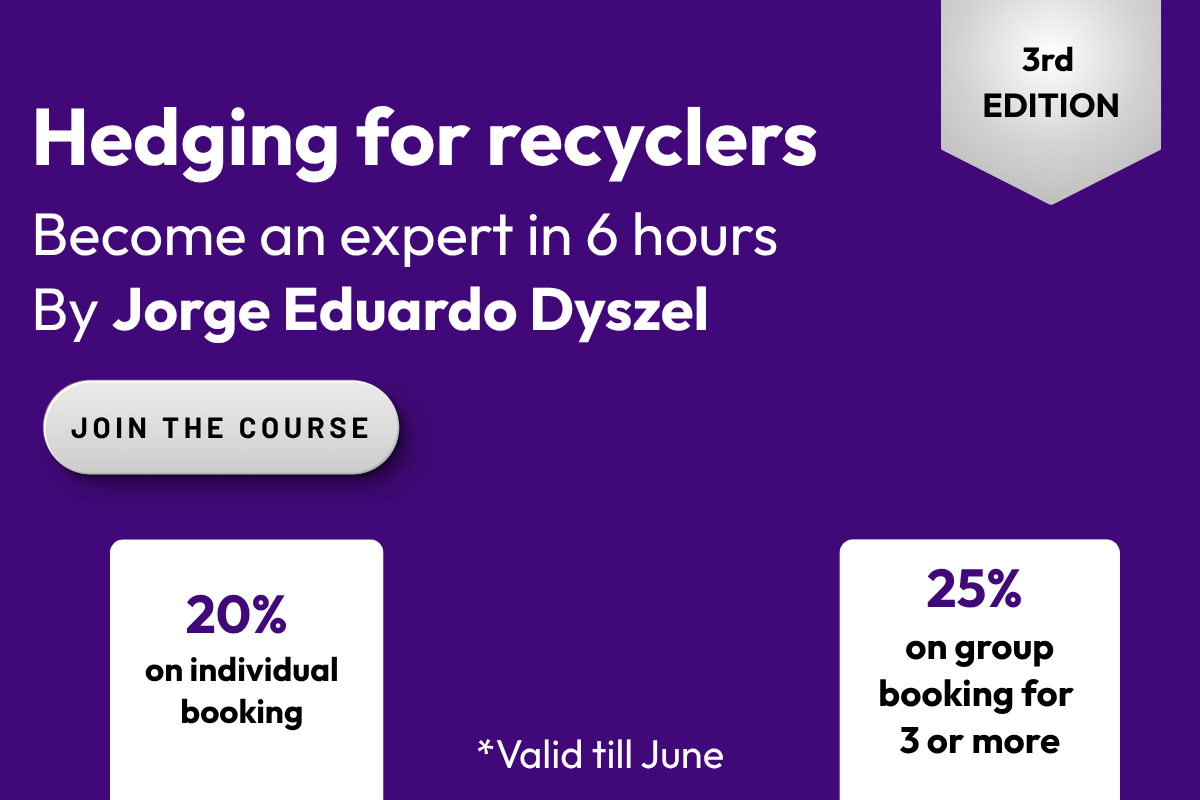
Designed specifically for recyclers, scrap traders, purchasing managers, commercial teams and finance professionals, the programme provides practical insights into managing metal price exposure in real-world business environments. The course is structured to help participants build the knowledge and confidence needed to identify, assess and manage metal price risk more effectively.
Course details
- Date: 20 July 2026
- Duration: 6 Hours
- Mode: Online
- Trainer: Jorge Eduardo Dyszel
What participants will learn after attending
- Metal price risk in recycling operations
- LME fundamentals & market mechanisms
- Hedging tools & practical applications
- Managing procurement & sales exposure
- Designing an effective risk management framework
- Real-world case studies relevant to recyclers
Turning volatility into a business advantage
Price volatility is unlikely to disappear from the aluminium market anytime soon. However, companies that understand how to identify, measure and manage risk can often make decisions with greater confidence and consistency. For recyclers looking to strengthen margins, improve forecasting and build resilience in uncertain market conditions, developing hedging expertise may be one of the most valuable investments they make this year.
Registration is now. Avail the early bird discount, valid till this month only.

 Voyagerman Technology


