











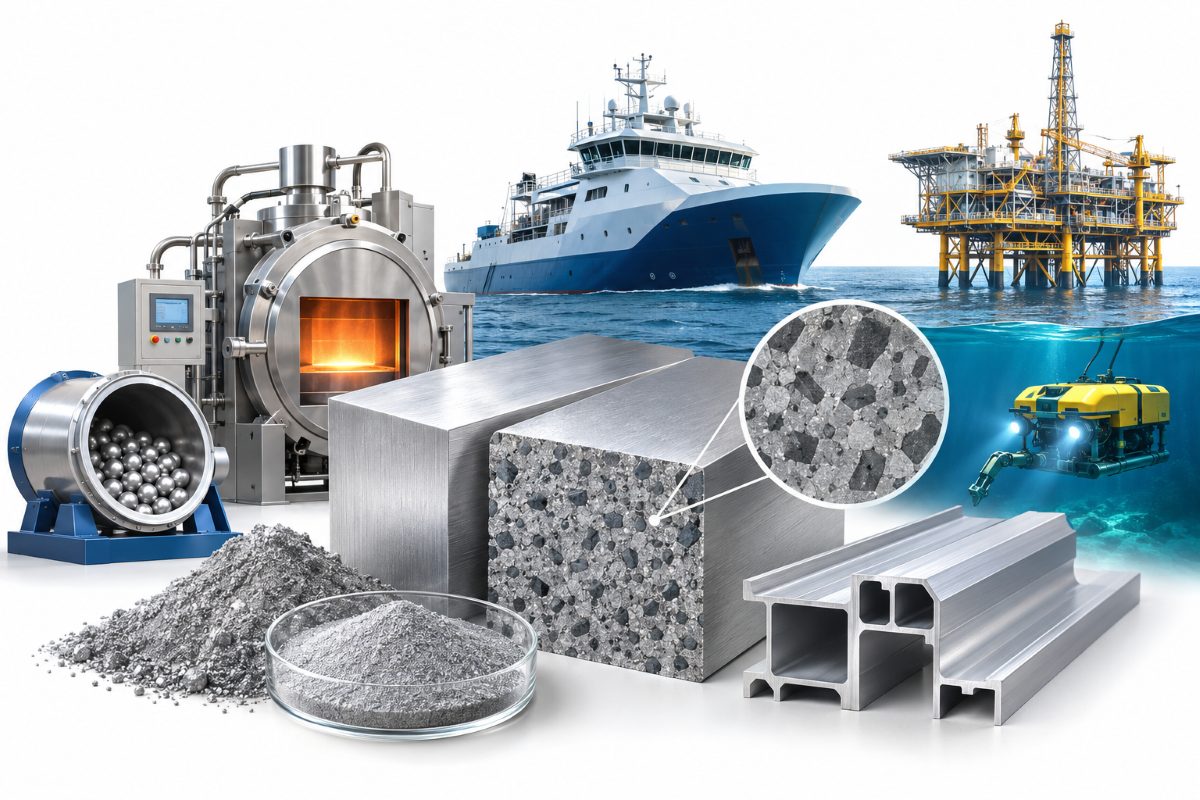

For engineering materials, one of the most demanding sectors that operates is the marine industry. Why so? Mainly because of seawater exposure, corrosion and mechanical stress. Adding to this are the places that operate in harsh conditions, creating considerable pressure both on the performance and the durability of the materials used in ships, underwater equipment and offshore structures.
Features like lightweight and corrosion resistance have always made aluminium a standout choice of material and are now opening up new possibilities. One such development is the use of aluminium matrix composites (AMCs), with powder metallurgy emerging as an important processing technique to enhance their performance.
What makes AMCs stand out from others?
In conventional aluminium alloys, the application involves sustained mechanical stress. This further creates challenges, as the operating conditions require properties beyond those of traditional alloys. To overcome this challenge, AMCs come into the picture.
AMCs combine an aluminium base material with reinforcing elements such as ceramic particles, carbon-based nanomaterials and hybrid reinforcement systems. The resulting material is designed to improve specific mechanical and functional properties.
Some of the potential advantages include:
- Enhanced mechanical strength: Improved resistance to dynamic stresses and demanding operating conditions.
- Better corrosion resistance: Greater potential to withstand challenging marine environments.
- Lightweight construction: Reduced material weight without compromising targeted performance requirements.
These characteristics make aluminium matrix composites an interesting area of development for next-generation marine materials.
Powder metallurgy: The technology behind stronger aluminium composites
In the current situation, along with the rise of AMCs, powder metallurgy has also gained the spotlight. This manufacturing approach, unlike conventional casting, offers greater control over material microstructure, reinforcement distribution and processing conditions.
To the development of AMCs, there are contributions from four powder metallurgy techniques, including:
- Mechanical alloying: This enables the development of composite powders through controlled mechanical mixing and alloying
- Spark plasma sintering: Uses controlled heating and pressure to consolidate powder-based materials
- Hot isostatic pressing: Applies high pressure and elevated temperatures to consolidate materials
- Microwave sintering: Uses microwave energy to facilitate heating and consolidation
With the potential to influence the final composite’s performance and microstructure, each technique offers a different processing route.
Where could these advanced aluminium materials be used?
As mentioned above, features that made aluminium a standout choice of material also make AMCs relevant to several marine engineering applications. Some of the potential areas of application that can be included are:
- Shipbuilding: Used in structural components requiring lightweight construction and mechanical durability
- Offshore platforms: Materials exposed to continuous seawater contact and demanding operational conditions
- Underwater equipment: Components requiring specific combinations of strength, weight and corrosion resistance
- Marine infrastructure: Structural sections designed to withstand challenging environmental conditions
Will marine engineering be reshaped by AMCs?
A critical direction in advanced materials engineering has been achieved after the development of powder metallurgy-processed aluminium matrix composites. This is because it offers greater control over the reinforcement distribution and microstructure and these technologies will expand the performance possibilities of aluminium-based materials.
However, their wider industrial adoption will depend on further research into processing efficiency, material consistency, long-term corrosion behaviour and performance under actual marine operating conditions. As marine engineering continues to demand materials that balance strength, durability and lightweight construction, advanced aluminium composites could play an increasingly important role in shaping the next generation of marine structures and equipment.
Source: Powder metallurgy advances strengthen aluminium composites for marine applications