








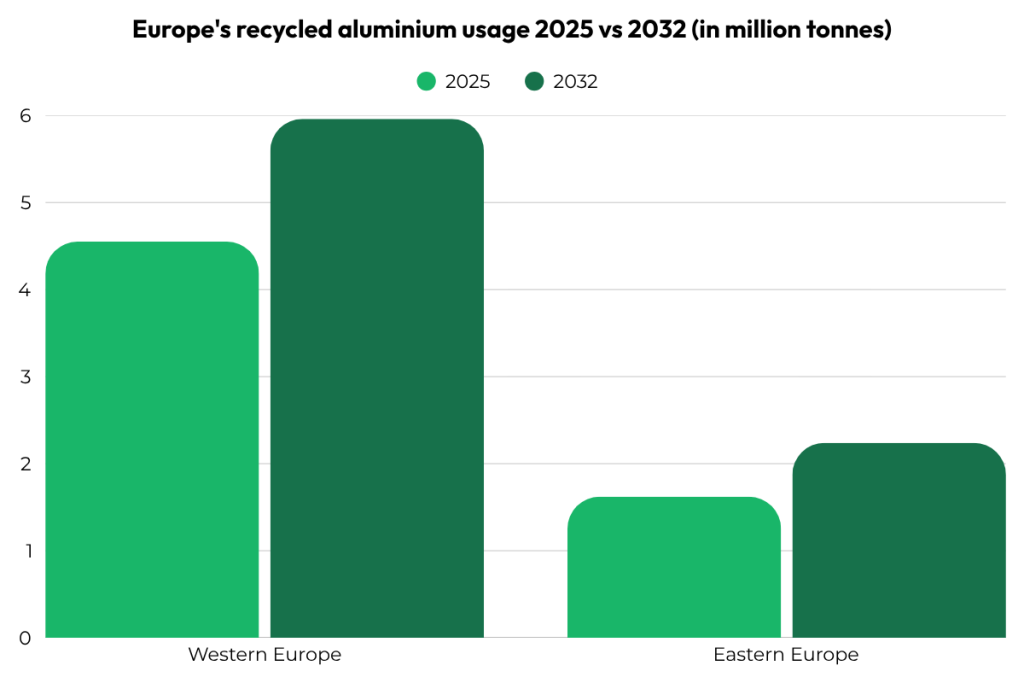
In Europe, the recycled aluminium market is expected to maintain a steady growing pace until 2032. The pace is mainly supported by the rising demand from a variety of end-use sectors. While Western Europe still holds the majority of recycled aluminium consumption, Eastern Europe is quickly becoming a key player in this market. Europe as a whole is now highlighting how various end-use sectors are working together to boost the demand for recycled aluminium.
According to AL Circle’s report, “World Recycled Aluminium Market Analysis: Industry Forecast to 2032,” consistent growth in the consumption of recycled aluminium over the coming years will be witnessed in both Western and Eastern Europe. The major driving force behind this consumption growth will not be owed to one particular industry or sector anymore. This is more because sectors like packaging, extrusion products and steel applications are also increasing their share of use, aiding in creating an ample demand for recycled aluminium throughout Europe.
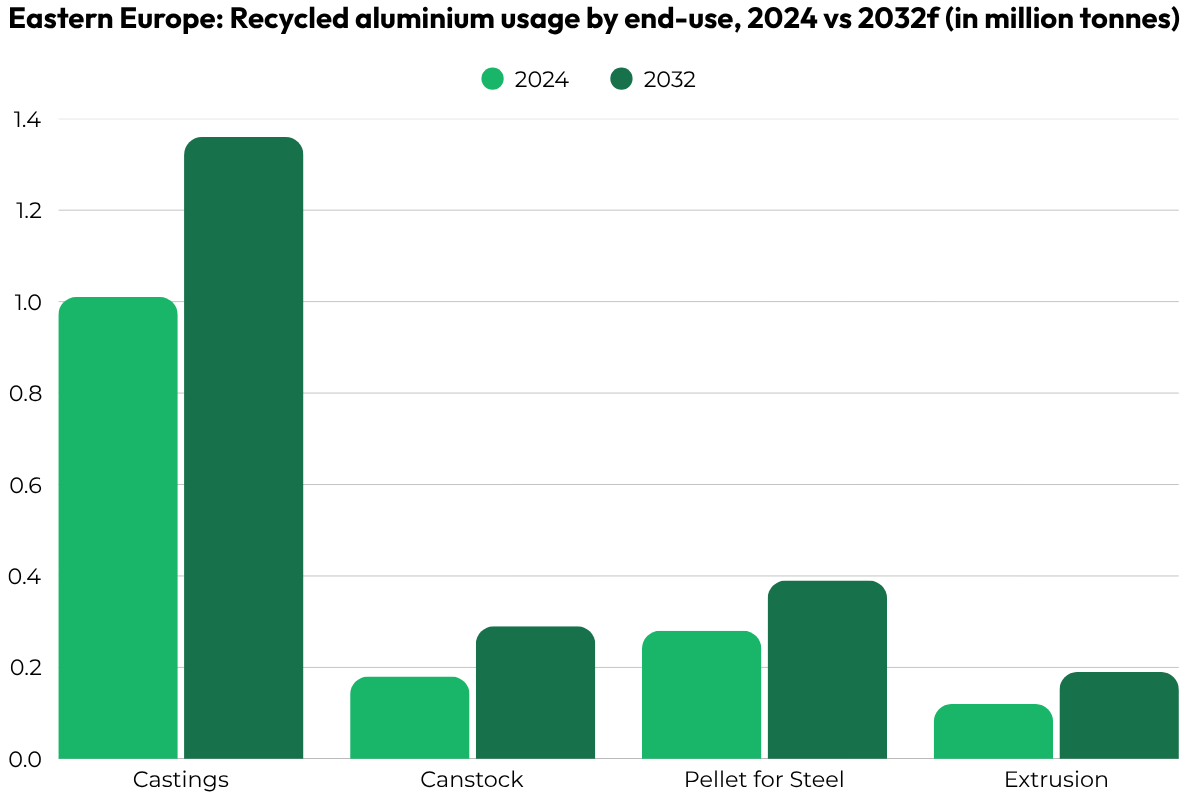
Eastern Europe: Usage and forecast by end-use sectors at a glance
In Eastern Europe, the recycled aluminium market is expected to keep growing steadily across all major end-use sectors right up to 2032. The outlook till 2032 shows that the demand is not rising in traditional areas like castings only, but also in canstock, pellets for steel, and extrusions. This indicates that the country is slowly shifting towards a more varied consumption pattern, underscoring the region’s increasing role in boosting Europe’s overall recycled aluminium market.
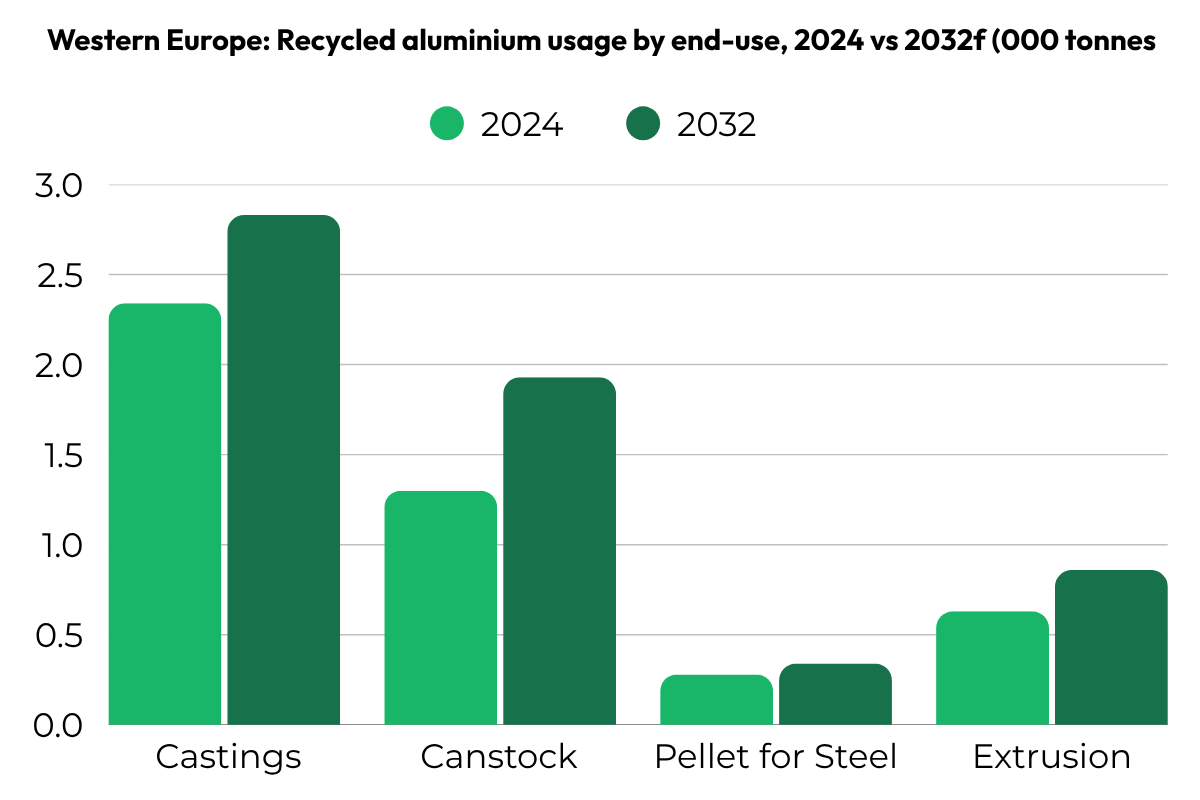
Western Europe: Usage and forecast by end-use sectors at a glance
In Western Europe, the recycled aluminium market is also set to grow steadily across all major sectors by 2032. In the overall consumption, castings are said to hold the lion’s share, but a significant growth is also expected in canstock, pellets used for steel and extrusion applications. This trend highlights the region’s diverse industrial demand and its ongoing shift towards a more circular aluminium economy.
Product-wise usage & forecast
Castings: The cornerstone of Europe’s recycled aluminium demand
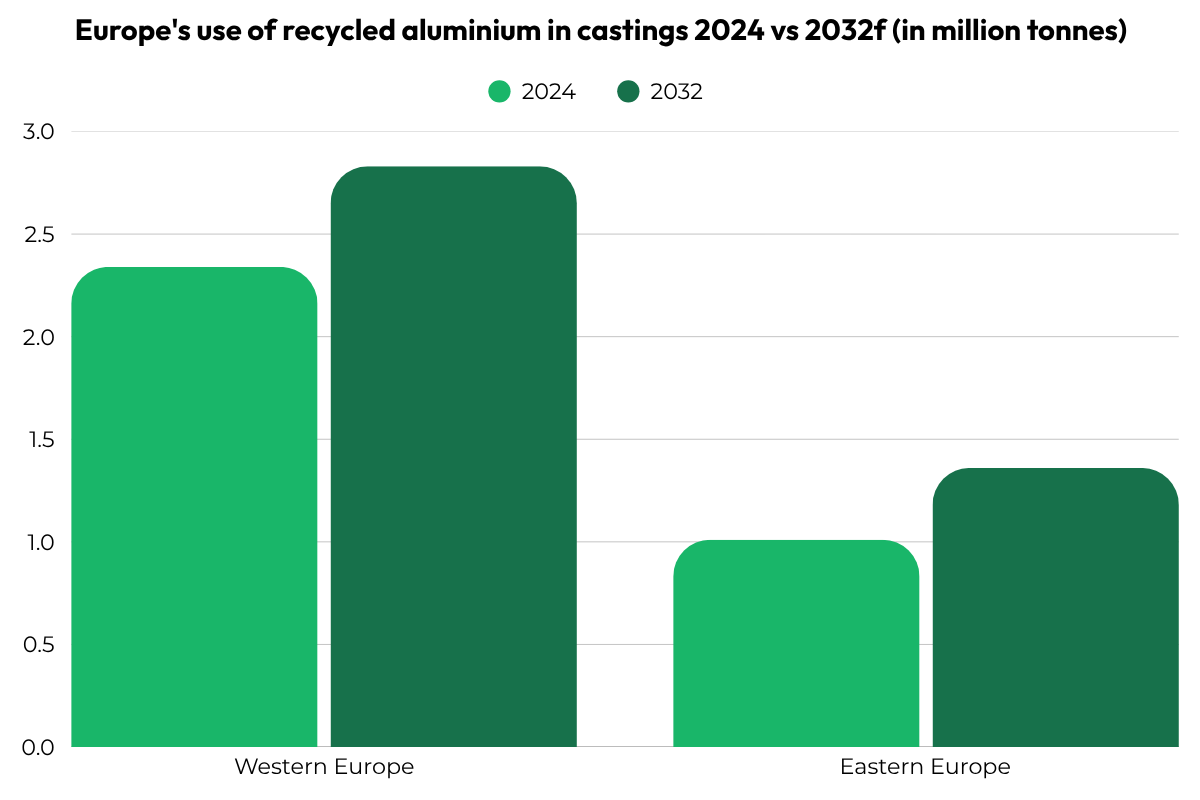
In Europe, casting holds the majority of usage in the end-use sectors, showcasing its vital importance in the region’s manufacturing scenario.
In Western Europe, the use of recycled aluminium for castings is expected to rise from 2.34 million tonnes in 2024 to 2.83 million tonnes by 2032. This keeps castings firmly in the lead, even with a modest compound annual growth rate (CAGR) of 2.81%. Over in Eastern Europe, a similar story unfolds, with castings projected to grow from 1.01 million tonnes to 1.36 million tonnes during the same timeframe, reflecting a more robust CAGR of 4.09%.
The forecasts indicate castings will continue to be the main force driving recycled aluminium demand across Europe in the coming years, closely tied to the strong automotive manufacturing sector, where aluminium is increasingly favoured for crafting lightweight, high-performance vehicle parts. Germany and Italy are leading the charge as major aluminium casting producers in Western Europe, with the automotive industry consuming the lion’s share of castings.
Despite some ups and downs in vehicle production recently, long-term predictions suggest a steady demand for aluminium castings, ensuring that this sector remains a cornerstone of Europe’s recycled aluminium market while also aiding the broader shift towards more resource-efficient manufacturing practices.
Canstock: Accelerating Europe’s circular packaging economy
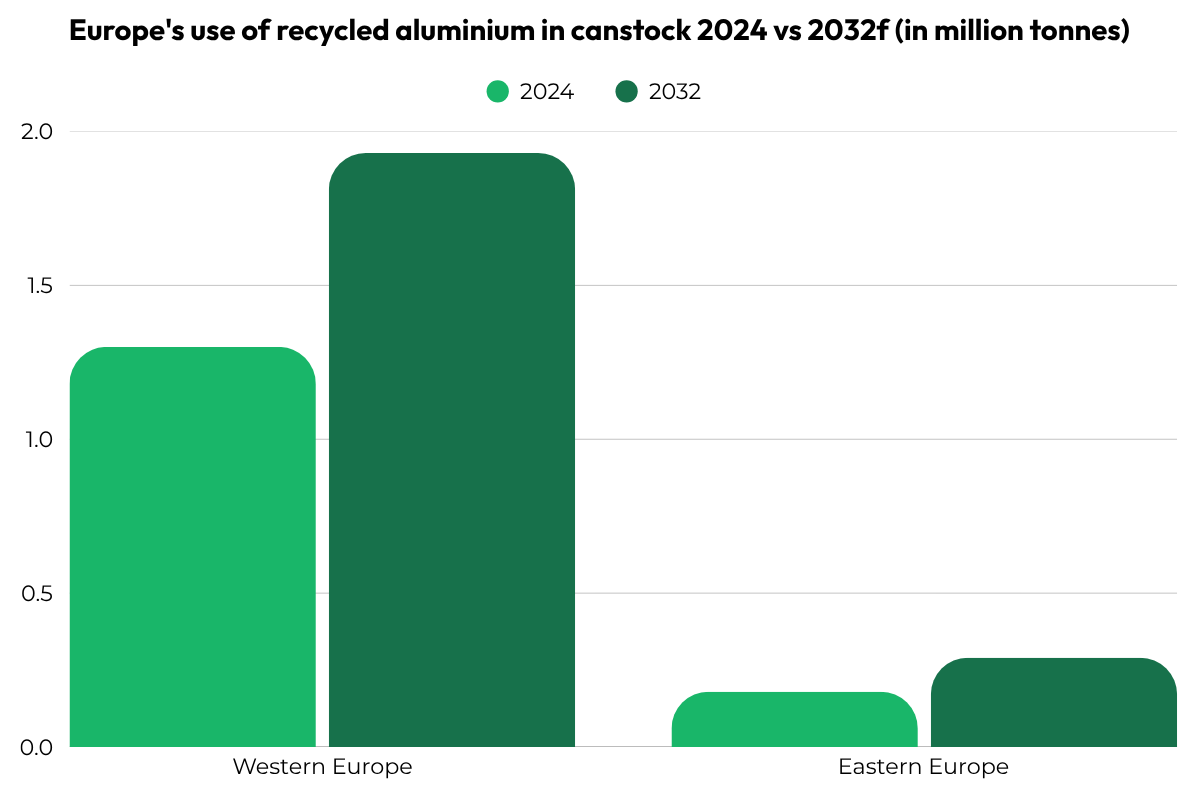
For the recycled aluminium used in Europe, canstock is emerging as one of the hottest sectors. This is mainly because of the region’s ongoing move towards sustainable packaging solutions.
In Western Europe, the consumption of recycled aluminium for canstock is projected to jump from 1.30 million tonnes in 2024 to 1.93 million tonnes by 2032, reflecting a CAGR of 5.25%. Although in small volume, Eastern Europe is set to experience an even more impressive CAGR of 6.31%, with demand climbing from 0.18 million tonnes to 0.29 million tonnes during the same timeframe. The number shows the rising significance of canstock in bolstering Europe’s recycled aluminium market.
Major players like Crown Holdings, Can-Pack and Ball Corporation are ramping up their production capacity to meet the surging demand for aluminium beverage cans. Coupled with Europe’s strong focus on recycling and circular packaging initiatives, these trends are likely to solidify canstock as a key driver of recycled aluminium consumption across the continent in the years to come.
Pellet for Steel: A stable contributor to Europe’s recycled aluminium demand
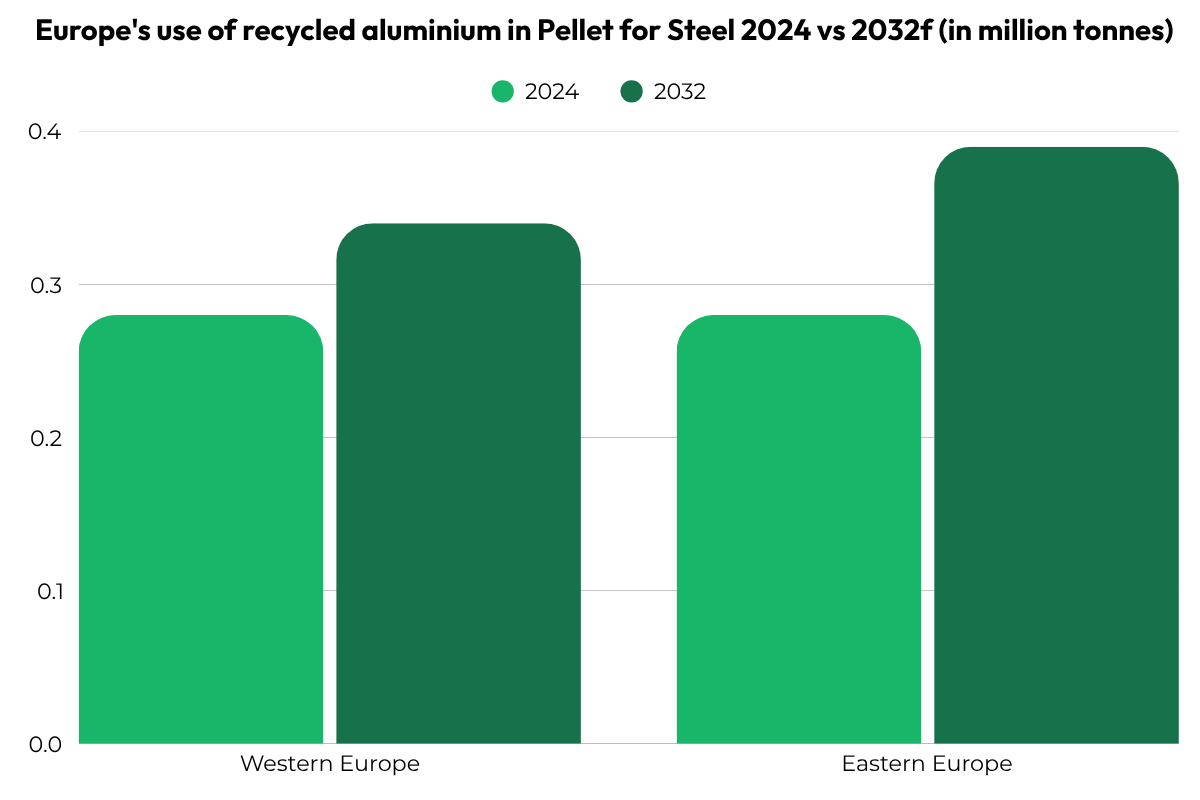
Concerning Europe’s recycled aluminium consumption, pellets for steel make up a smaller portion but still play an important role in driving demand throughout the steel value chain.
In Western Europe, the use of recycled aluminium for steel pellets is expected to grow from 0.28 million tonnes in 2024 to 0.34 million tonnes by 2032, which translates to a CAGR of 2.89%. Meanwhile, Eastern Europe is set to experience even stronger growth, with consumption projected to rise from 0.28 million tonnes to 0.39 million tonnes during the same timeframe, reflecting a CAGR of 4.87%.
This reflects a steady upward path for the sector across Europe, where the pellets for steel may not reach the consumption levels of castings or the rapid growth seen in canstock, but can increase the diverse landscape of Europe’s recycled aluminium market. Additionally, the ongoing demand in both Western and Eastern Europe highlights the sector’s capacity to serve as a dependable outlet for recycled aluminium, complementing other significant end-use applications and supporting the region’s broader goals for a circular economy.
Extrusion: Expanding opportunities across Europe’s industrial sectors
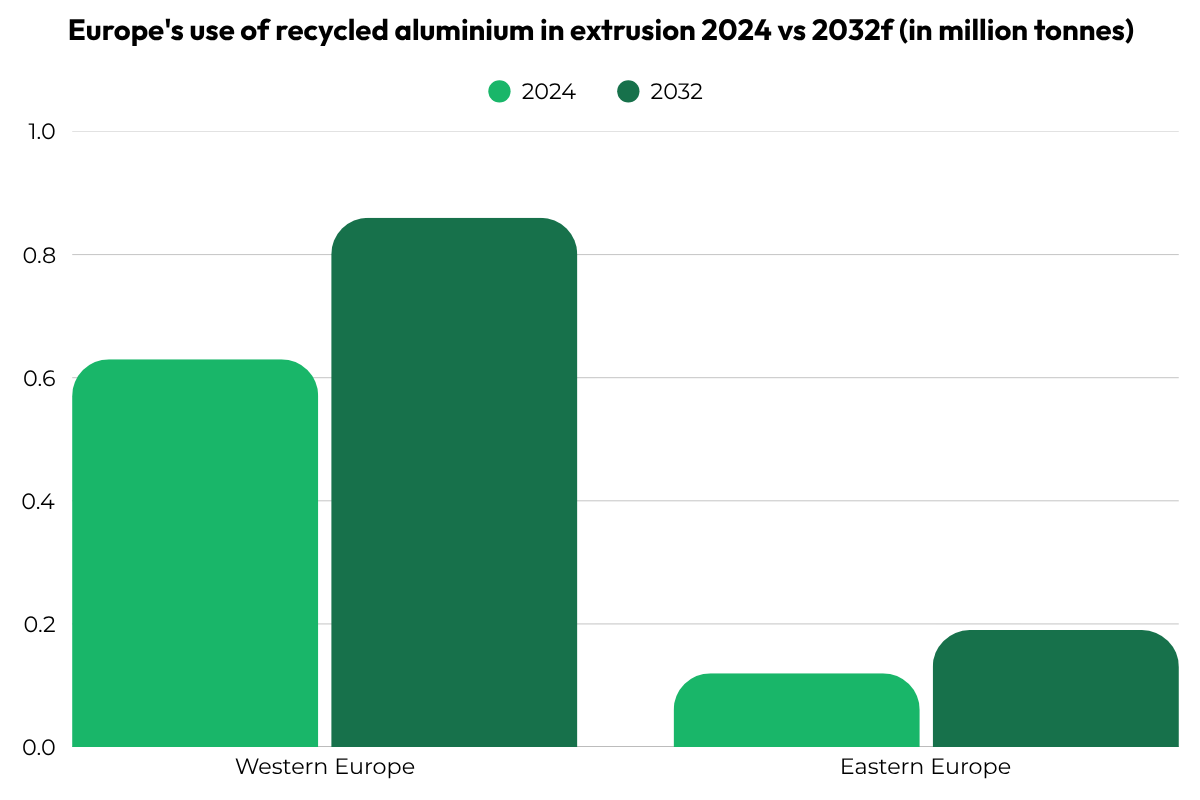
Due to the surge in demand from various downstream industries, extrusion as an end-use product is getting immense traction within the recycled aluminium industry in Europe.
In Western Europe, the use of recycled aluminium for extrusions is expected to climb from 0.63 million tonnes in 2024 to 0.86 million tonnes by 2032, which translates to a CAGR of 4.28%. On the other hand, Eastern Europe is set to experience the fastest growth rate among its major end-use sectors, with consumption projected to rise from 0.12 million tonnes to 0.19 million tonnes at a CAGR of 6.51%.
These numbers align with the sector’s increasing impact on Europe’s recycled aluminium market, including the rising adoption of recycled aluminium in extrusion applications, which highlights its growing significance across construction, transportation, energy and other industrial fields. The demand for recycled aluminium extrusions is likely to keep climbing because manufacturers focus more on lightweight, durable and low-carbon materials.
Key trends and drivers in Western Europe
- The automotive sector continues to be the biggest driver of demand, with Germany and Italy at the forefront of aluminium castings production in the region.
- The packaging industry is experiencing rapid growth, fueled by rising investments in aluminium beverage can manufacturing and recycling facilities.
- Efforts towards a circular economy are boosting domestic recycling, as major players invest in processing used beverage cans (UBC) and advanced recycling technologies.
- The push for low-carbon aluminium production is also rising, with capacity expansions aimed at increasing recycled content and cutting down carbon emissions.
- Industry leaders like Novelis, Hydro, Aluminium Dunkerque and Trimet Aluminium are making significant investments to enhance Europe’s recycling capabilities and improve the utilisation of scrap materials.
Key trends and drivers in Eastern Europe
- The demand for recycled aluminium is set to rise steadily, fueled by a boost in industrial activity throughout the region.
- Castings remain the frontrunners in consumption, but canstock and extrusion applications are anticipated to experience the fastest growth leading up to 2032.
- Packaging and extrusion sectors are emerging as significant areas for expansion, driven by a growing appetite for sustainable materials in manufacturing.
- With ongoing industrial modernisation and investments in recycling, the industry can expect to see enhanced production capabilities and better utilisation of recycled aluminium.
- Eastern Europe is outpacing Western Europe in growth rates, showcasing a broader acceptance of recycled aluminium across various end-use sectors and highlighting the region’s vital role in Europe’s circular aluminium economy.
Conclusion
The recycled aluminium market in Europe is ramping up by holding a steady growth, mainly backed by rising demand from various end-use sectors instead of just one. While castings still lead the way in consumption, there’s a noticeable rise in the use of canstock, extrusions and pellets for steel, highlighting the region’s rapid move towards a circular and low-carbon economy. As both Western and Eastern Europe work to enhance their recycling systems, these changing demand patterns are likely to open up fresh opportunities for recyclers, producers and manufacturers downstream. Know more about the European recycling market from AL Circle’s specialised report, “World Recycled Aluminium Market Analysis: Industry Forecast to 2032”. Also, follow the page, “Europe Aluminium Recycling Market” to get recent updates.

 Voyagerman Technology


