








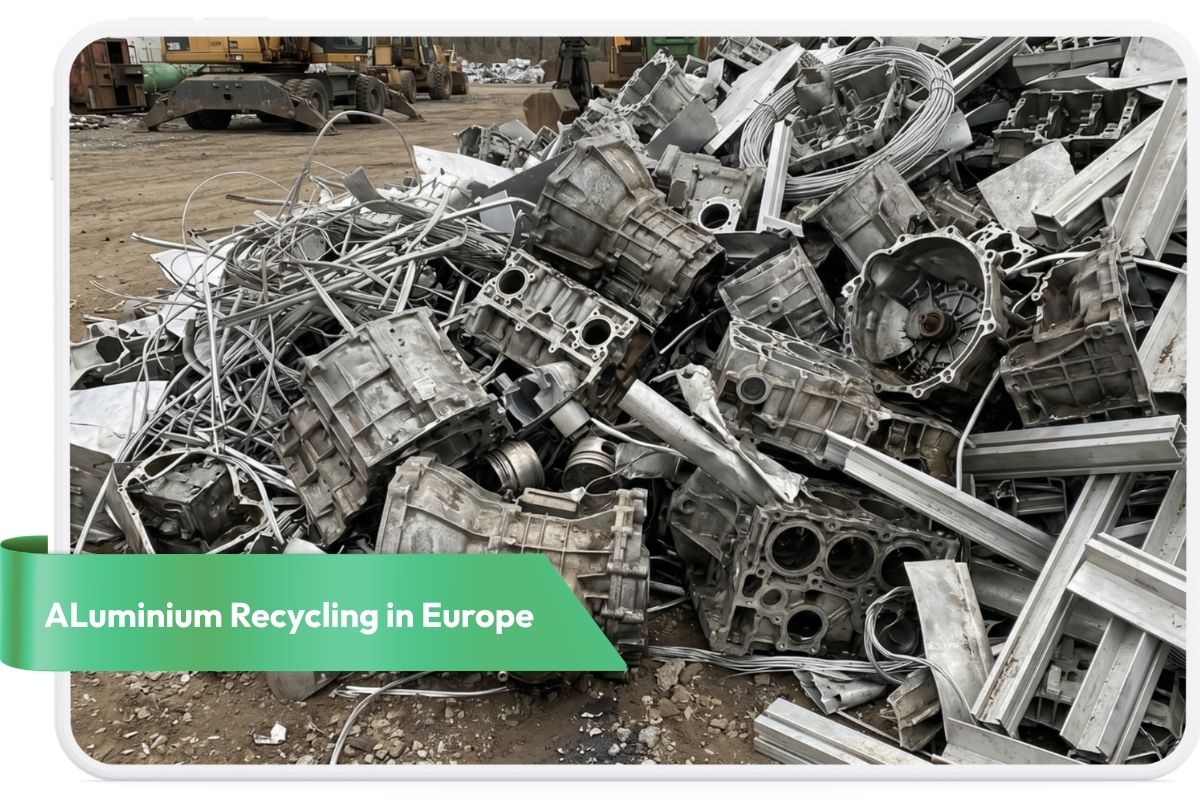
Demonstrating a staggering aluminium recycling rate of 76 per cent, Europe is gaining increasing attention as a recycler. It boasts large processing capacities, led by legacy and new-age companies. From primary producers taking an interest in recycling to large mergers and acquisitions shaping new companies seeking to improve recycling methods, Europe is a growing hub, with aluminium recyclers looking to capture demand for low-carbon aluminium within the region and across the world. The following list compiles various segments of the aluminium recycling chain in Europe, including handling, trading and the actual melting and processing that produce secondary ingots and finished products like can sheet.
Note: The companies listed below appear in no particular order and are not ranked by capacity or production volume.
Constellium
This French aluminium recycler was born from the sale of Alcan Engineering Products (Rio Tinto) to Apollo Global Management in January 2011. Today, it is one of the largest aluminium recyclers in the world, operating 15 plants across Europe, in countries like France, Germany, Switzerland, Spain and the Czech Republic. The company’s raw material stream is largely based on recycled materials, with a focus on high-quality inputs like used beverage cans (UBC).
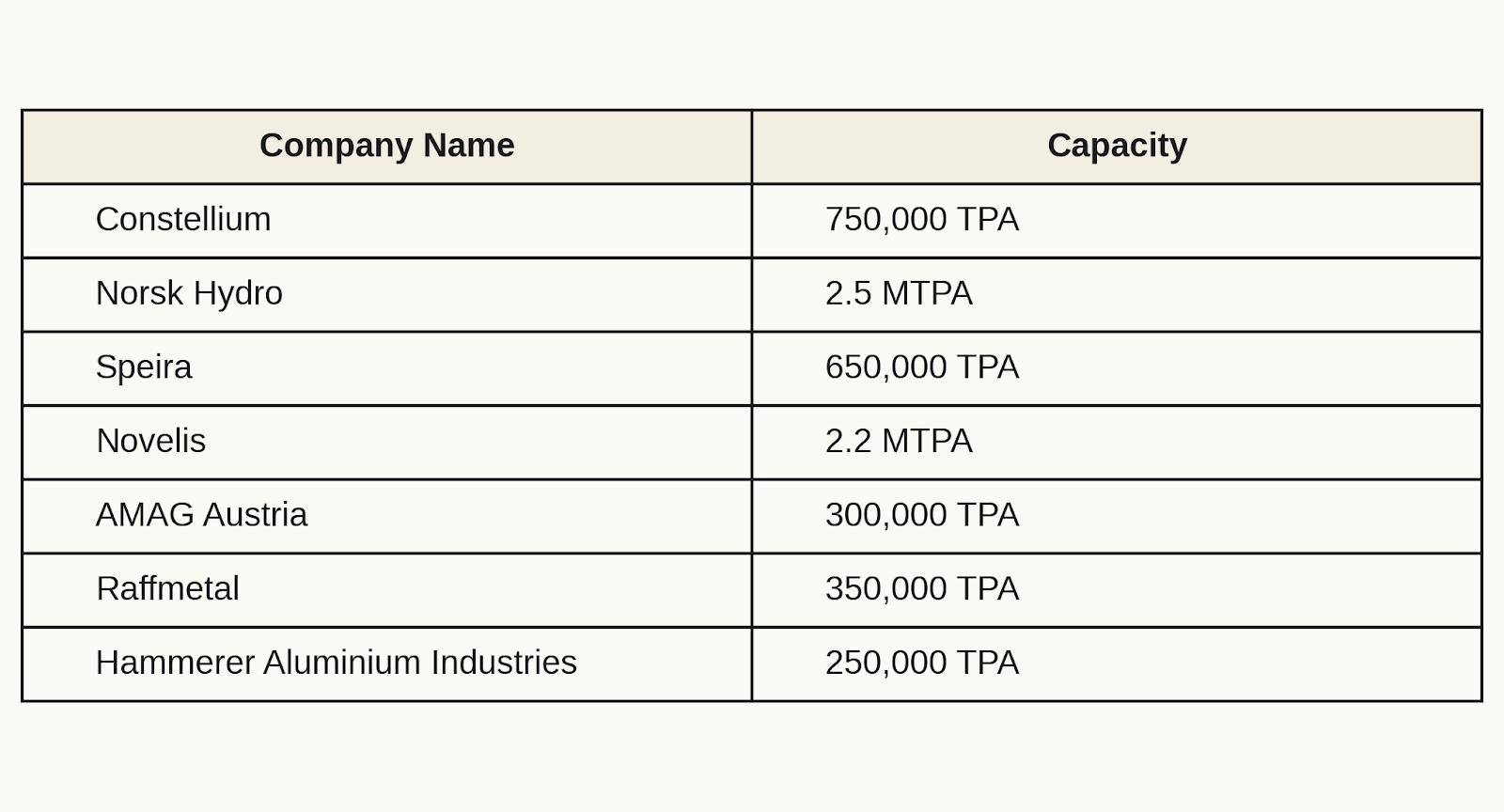
Constellium has an installed aluminium recycling capacity of over 750,000 tonnes per year.
Constellium’s plants specialise in turning pre-and post-consumer scrap, such as beverage cans and automotive parts, into high-quality aluminium products. The site in Muscle Shoals, US, Constellium operates one of the largest used beverage can (UBC) recycling facilities in the world, recycling the equivalent of 25+ billion cans (340,000 tonnes) every year. The facility in Neuf-Brisach has also expanded its recycling capacity of automotive and packaging products to 290,000 mt with a new recycling centre.
By 2030, Constellium aims to achieve at least 50 per cent of all aluminium they use coming from recycled sources. To increase recycled content in can lids, Constellium participates in the High Recycled Content (HRC) specified alloy project with the EAA. The French company has also partnered with Renault Group on automotive lightweighting and collaborated with TARMAC Aerosave to recycle end-of-life aircraft.
Norsk Hydro
It is one of the oldest aluminium companies in the world, dating back to 1905. Founded in Norway, Hydro started its journey as a primary aluminium producer, but has increasingly invested in recycling capacity over the past two decades. The company currently operates around 22 plants across Europe, in countries such as Austria, Belgium, Finland, Sweden and Portugal. Today, Hydro has a total recycling capacity of around 2.5 million tonnes, with around 450,000 tonnes coming from post-consumer scrap, which has reached the end of its usable life. Hydro CIRCAL and REDUXA are its two famous low-carbon aluminium brands, operating a vast global network of aluminium recycling.
Hydro’s 2030 vision includes reaching a goal of 1.2 million tonnes of post-consumer scrap being recycled across its global operations. Apart from remelting and recycling aluminium, Hydro was also one of the first companies to invest in research and development to understand and implement aluminium scrap sorting. Operated under the name HySort, the company’s sorting technology allows the company to separate high-quality aluminium alloys from mixed scrap that could contain a variety of metals like steel, copper, zinc and traces of other elements. This enables the use of obsolete scrap to sort high-value packages that can be remelted without using primary aluminium to maintain chemistry. Hydro’s Torija recycling facility in Spain recycles up to 70,000 tonnes of post-consumer scrap annually, while its Székesfehérvár facility in Hungary has a capacity of 90,000 tonnes per day. Alumetal network (Poland & Hungary) boasts a combined capacity of 280,000 tonnes per year.
Aluminium Kruger
This is a third-generation family-run business based in Verl, Germany. The company is focused on high-quality aluminium sorting operations, where employees use X-Ray technology to separate the various alloys. While the private firm does not disclose its annual handling capacity, it has eight trucks and says that its customers have access to about 600 containers worth of aluminium scrap. Kruger is also a well-known aluminium trader in Germany, supplying scrap to many of the larger production hubs in the country. It also undertakes pre-melt processing such as crushing, baling and briquetting. Kruger also undertakes storage and transportation under its full-fledged distribution model. It provides services for both small and large batches of aluminium scrap for recycling. In many cases, they also provide containers for export orders and assist with freight and other logistics.
Speira
Similar to Constellium, Speira was founded as an amalgamation of assets bought by KPS Capital Partners in the mid-2010s. Speira now operates Hydro’s Rolling business and Real Alloy’s European secondary smelter plants. Together, the company has an annual aluminium recycling capacity of around 650,000 tonnes per year. Since its inception in 2021, the company has already invested in modernising its equipment and aims to be the leader and global benchmark in sustainable aluminium recycling across the globe. This includes a complete overhaul and replacement of its secondary smelting operations in Rheinwerk, Germany.
Speira recently invested in the development of a shipbuilding alloy, named Maris Njordal, using 5xxx series aluminium. In doing so, it has expanded its customer base and real-world applications for its products. Speira is also an active participant in the European Aluminium Packaging Group’s mission to reach 100 per cent can-to-can recycling in Europe by 2030. It is currently working to raise recycled content in new cans to help achieve the goal.
Novelis
The world’s largest aluminium recycler has a considerable presence in Europe. Novelis’ presence in the continent is largely in Germany, Italy, Switzerland and the UK. Across its global recycling operations, Novelis can produce up to 2.2 million tonnes of recycled aluminium per year. In fact, Novelis operates the world’s largest single-site aluminium recycling plant in Nachterstedt, Germany, producing around 400,000 tonnes of recycled aluminium per year.
Similarly, it operates Alunorf in Nuess, Germany, which is the largest integrated aluminium rolling mill in the world. The plant, which produces 1.6 million tonnes of rolled products a year, is a joint venture between Novelis and Speira. On the other hand, the Sierre, Switzerland plant manufactures high-quality aerospace-grade rolled products for Airbus. The Latchford, UK plant is involved in UBC recycling and also plays a vital role in the automotive aluminium closed loop in the country. In Italy, the Bresso and Pieve facilities are focused on can sheet production and some speciality alloys as well.
AMAG (Austria Metall AG)
AMAG Austria Metall AG is the largest single-site aluminium recycler in Europe. Besides, it is a large aluminium rolling company that operates four plants in Austria, with three in Germany that are dedicated to AMAG components, a division that produces ready-to-install aluminium parts for the aerospace industry. AMAG has an annual rolled production capacity of 300,000 tonnes across its plants. It also owns 20 per cent of Canada’s Aluminerie Alouette, which produces 630,000 tonnes of primary aluminium per year.
AMAG received a USD 86.6 million loan from the European Investment Bank in February this year to advance its research and development of technology in the manufacturing of its rolled aluminium products. While AMAG supplies aluminium components to Airbus, like many others on this list, it is also a tier-1 supplier for Comac, the first Chinese aerospace manufacturer, which plans to compete with the established duopoly in the segment. Apart from the aerospace industry, AMAG’s products also have applications in consumer goods like aluminium cans, automotive goods and parts of the electrical grid.
Raffmetal
This is one of the leading Italian aluminium recycling companies, founded in 1979 in Casto, Italy. The company has a yearly production capacity of over 350,000 tonnes across its five plants in the country. The most interesting fact about Raffmetal is its Silval Speciality Alloys plant. The facility produces primary-grade aluminium alloys from recycled materials. This consists of continuous casting ingots, with chemistry that is comparable to products made from extracted ores and alumina. Silval does this using its own proprietary technology that sorts high-quality aluminium alloys from scrap and then uses unique alloying techniques to meet primary standards. Raffmetal also operates an in-house salt slag recycling facility. While many companies discard or landfill salt slag, the material does contain small amounts of aluminium alloys, with some batches containing up to 10 per cent metallic aluminium. By treating the waste from smelting within the same facility, Raffmetal not only reduces waste but also increases its aluminium recovery.
Alutrade
This is one of the largest aluminium recycling and processing firms in the UK. Alutrade, founded in 1987, has been at the forefront of the aluminium recycling industry in the region. The company’s recycling plant in Oldbury, England, has an annual capacity of 30,000 tonnes. The family-owned business prides itself on being a mix of cutting-edge technology and a people-first attitude. Alutrade’s services include extrusion recycling, UBC handling and processing, shredder residue, precision cutting of aluminium products, along with full-scale aluminium waste management systems. The company is part of the Council for Aluminium in Building and a founding member of the latter’s Closed Loop Recycling Scheme. The project raised aluminium recycling by 3,300 tonnes in 2019, rising to 6,000 tonnes in 2022 and expected to continue rising as the years go by. It is focused on the proper collection and sorting of aluminium alloys to ensure sustainable remelt production and treatment of the scrap.
Hammerer Aluminium Industries
The company was founded in 2007 in Ranshofen, Austria, after the corporation took over the family business. The company is heavily invested in aluminium recycling, with 250,000 tonnes in annual casting capacity and 125,000 tonnes in extruded aluminium products per year. Today, it operates seven production facilities across Germany, Poland, Austria and Romania. It recently acquired a stake in Aluminij Industries, a large aluminium producer and exporter in Bosnia and Herzegovina.
In 2025, the company invested in a briquetting press for aluminium chips at the Ranshofen site. This unit is expected to further increase the recycling rate at the plant by utilising milling and sawing chips from manufacturing activity. The briquettes can then be used in the production process once more, thus reducing waste. This truly represents closing the recycling loop within the Hammerer Ranshofen facility. The firm also opened a new extrusion line in Gumi, South Korea, in May 2025, in partnership with LS Cable & System.
What do they all have in common?
While every company on this list has its own way of doing business and serves different customers across the value chain, each one of them contributes to the goal of a truly circular economy. The investments made across Europe to facilitate aluminium recycling are no small feat. In fact, all of these players play an important role in ensuring that the world is less dependent on mined materials and can benefit from everyday recycling processes to ensure both material availability and a much lower carbon footprint than primary aluminium. From the largest rolling mill to the distributors that enable the right packages to be delivered to them, the aluminium recycling chain in Europe is a large spider web that depends on the smooth operations of each stakeholder in it. We also see how various technologies are constantly improving how the industry treats and handles aluminium scrap.
Also read: Pay, sip, return, repeat: Story of Deposit Return Schemes in Europe’s aluminium recycling



 Voyagerman Technology


