“The unfortunate pandemic that we are facing is a catalyst for the Industry 4.0,” Éloïse Harvey, B.Eng. & Mgmt, President of Mecfor
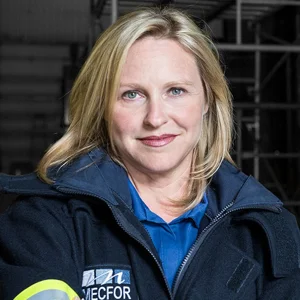
Éloïse Harvey is president of Mecfor, a Quebec-based company that supplies and manufactures specialized equipment for heavy industry, primary aluminium smelters and secondary plants, mining, rail and nuclear. Éloïse Harvey has been working for the heavy industry (with a strong focus on the aluminium sector) since 1999 holding various positions related to sales, marketing and business development for MECFOR and today she is president for Mecfor.
We are glad to get an opportunity to interview Ms Harvey to know her individual insights into the Industry 4.0, especially in light of the COVID-19 pandemic. She thinks implementation of new technologies in the aluminium industry does change the dynamic that exists between equipment manufacturers and aluminium producers. She says COVID-19 has forced companies to revisit their operations and has brought more awareness of applied technologies in the day-to-day.
To know more about her views and thought, here is an excerpt from the interview:
AlCircle: Being a manufacturer of state-of-the-art equipment, designed particularly for aiding each operational sector of the aluminium industry to easily track its respective operations, could you please share your views on the emergence and importance of Industry 4.0?
Ms Harvey: The industrial sectors as we know them are grappling with increasingly demanding production and profitability imperatives. Industry 4.0 is the buzzword that identifies the trend of integrating technology into equipment to enhance efficiency, reliability, and constancy in operations.
For sure, implementation of new technologies in the aluminium industry does change the dynamic that exists between equipment manufacturers and aluminium producers, some presenting more risk and uncertainties at first. The challenge is trying to push new technology in an industry that is a bit risk adverse and doing so in time where capital expenditure is at its lowest due to the overall world economic situation and when LME price is down. Suppliers will have to find ways to convince smelters that it is an investment and not an expense and demonstrate a ROI. Proving quick ROI is not always easy to do with new technology since the ROI is usually theoretical and not proven yet.
That being said, at all level, Industry 4.0 will have an impact on how tasks are being achieved and the way we are doing business.
AlCircle: Do you think post-COVID-19 adoption of Industry 4.0 shall be further accelerated by companies in their business operations?
Ms Harvey: The unfortunate pandemic that we are facing is a catalyst for the Industry 4.0. Glancing back few years ago, industries would have had hard time to cope with this brutal stop of activities. Thanks to technologies and applications, businesses were able to stay connected and adapt ‘work-from-home’ model from centralized ‘head office’ operations.
This unprecedented situation has brought us to realized that we can work differently integrating technology into our practices. So, yes, COVID-19 has forced companies to revisit their operations and has brought more awareness of applied technologies in the day-to-day.
We expect that this pandemic should accelerate the process towards replacing the workforce with technology whenever possible as stay at home edicts and other sanitary orders could have a major impact on production.
AlCircle: Based on your experience, how impactful do you think has the adoption of Industry 4.0 been for companies associated with the aluminium industry?
Ms Harvey: At our level, this question is a bit hard to answer. We can only present assumptions and observations, but working on a project called ‘Casthouse equipment of the future’ we feel that visiting an aluminium smelter today and the same smelter 5 to 10 years from now would be like looking at black and white historical pictures from the very beginning of this industry. We trust that the evolution or Industry 4.0 revolution will give place to the best practices from metal flow management to handling of finish products.
AlCircle: How do you integrate Industry 4.0 into your equipment designing and making for the aluminium sector?
Ms Harvey: Just as an example, we are seeing an increase of demand in remote monitoring of equipment like telemetry and Casthouse Smart tools using Mecfor’s QuicKonnect Casthouse solution for tending, skimming and charging of furnaces. There is also the automatization with more robots integrated to solution. Nowadays, Mecfor is getting many requests for information on its Descaling Robot Arm for the Alumina industry. We are glad to see that technologies not only have impact on productivity, but also on workers’ safety.
AlCircle: Do you think the adoption of Industry 4.0 has helped the aluminium smelters and plants enhance their productivity and efficiency?
Ms Harvey: In this journey, there will be quick wins and long run changes; definitely, Industry 4.0 is a game changer.
We are still at the early stage of the implementation of 4.0 technologies in smelters therefore it is difficult to say that it has had an impact today but every step in the right direction is bringing our clients, the smelters, towards greater efficiency over time. Mecfor is glad to be part of this wave of change.
AlCircle: How do you see the future of Industry 4.0 in the aluminium industry post COVID-19?
Ms Harvey: All Western smelters will probably need to push for more automation and reduced personnel in order to maintain and improve their position on the cash cost curve. We believe that one way of achieving that objective is through 4.0 technologies implemented in the plants. Therefore, we believe that it will become mandatory for smelters to move towards that direction even if the change is somewhat risky and difficult, and requires lots of energy and investment.
On another token, with all new usages found of the grey metal, we trust that the industry will gain better vitality and will still show the same dynamism in keeping a step ahead; as an example, the new self-disinfecting anodized aluminium developed by A3 Surfaces Inc.

