The EV battery that runs on water and aluminium: an Interview with Akshay Singhal, Founder & CEO, Log 9 Materials

- Category
- Interview
- Date
- Source
- AlCircleNews
- Edited By
- Beethika Biswas
When the news of a Bangalore based start-up Log 9 Materials developing an EV battery powered by water and aluminium appeared in media, it generated curiosity in the metal industry, battery industry as well as the EV market. AlCircle decided to learn a little more about the innovative technology and spoke to Akshay Singhal, Founder & CEO, Log 9 Materials. He explained to us the technology behind this innovation and also shared his journey as a technopreneur. Here is an excerpt from the interview:
AlCircle: Please brief us a little on your journey as a technopreneur. How did Log 9 Material come into being?
Mr Singhal: My journey as a technopreneur started when I joined the Indian Institute of Technolgy – Roorkee (IIT-Roorkee) in 2015 to pursue my Bachelors in Material Engineering. In the sophomore year of graduation, I developed a keen interest in nanotechnology and started researching actively on the subject. Along with my labmates, while working under Dr. Indranil Lahiri of IIT Roorkee, I had excelled in synthesizing various nanomaterials and modifying those chemically for practical applications.
It was around this time when the “wonder material” graphene caught my attention; I could sense and realize that graphene-based nanotechnology has immense potential in disrupting the future of mankind. At the same time, it also dawned upon that commercial production of high-quality graphene nanomaterials in India was very scarce at that time.
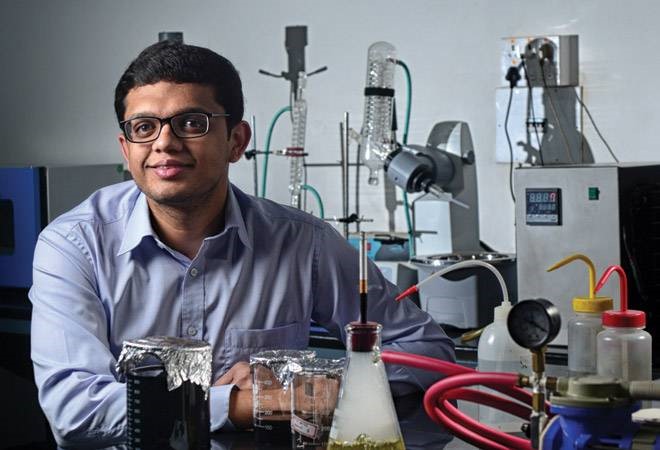
I strongly believed the strikingly superior properties graphene possesses can be leveraged only if processes are developed to manufacture and make it commercially viable for the market. With this in mind, I began extensive research on graphene-based air and water filtration/purificiation technologies, and simultaneously decided to establish Log 9 Materials as a nanotech product development and manufacturing company (with graphene technology as our core area of expertise).
Initially bootstrapped and supported by my parents and a few batchmates, Log 9 Materials was lucky to receive a pre-seed funding from TIDES—IIT Roorkee’s incubation centre, We utilized the initial funds to research and develop B2C products, thereby paving the way for end-user, large-scale commercial applications of graphene in India. Thus came up our first graphene based filtration product, ‘Ppuf’—a graphene-based filter that helps reduce the toxic chemicals in cigarette smoke.
We raised two rounds of successive funding in 2017 and 2018 and moved to Bengaluru and set up our office there. Ever since, Log 9 has been the pioneer start-up in India in deciphering new frontiers in graphene synthesis and functionalization as well as design of innovative products and applications based on graphene technology. While in our first one or two years, we had experimented in diverse areas of air and water purification, applications in Graphene in defence, battery technologies and so on, recently we have narrowed down our approach to the domains of filtration and energy.
While Log 9 has already come a long way in its attempt to invent breakthrough technologies and products in this domain that will act as a boon for the future of mankind, a lot more remains to be done. Our current focus is on scaling up by bringing to the fore ready-to-market technologies that can create a revolutionary impact and replace conventional products in the energy and filtration industries, as well as further add value towards the commercial and real-life adaptation of Graphene-based technologies.
AlCircle: Give us a heads up on Log 9 Material’s metal metal-air battery concept.
Mr Singhal: The metal-air battery, which is the latest project conceptualized and implemented by Log 9, has the potential to revolutionize both clean energy and electric mobility and transport sectors. We are using Graphene to make aluminium batteries commercially viable as well as economical, and it is a primary energy generation technology quite similar to a fuel cell. Log 9 has successfully demonstrated a working prototype of Aluminum air battery on a vehicle platform. This enables clean and zero emission electric mobility which is refuelable and removes the need for change in consumer behaviour for long charging times.
Powered by our graphene-based novel cathode, the metal-air batteries have demonstrated increased energy efficiency as compared to conventional battery technologies. We believe that greater adoption of metal-air batteries shall reduce most issues related to range anxiety or worries about huge investments on charging infrastructure development for the electric vehicle sector.
Log 9’s mission is to enable 100% clean and circular energy economy feasible by using Aluminum leading to zero emissions, zero waste generation and non-dependence on rare minerals.
AlCircle: How does your metal battery use aluminium and water to get charged?
Mr Singhal: To put it simply, our system is using aluminium metal as an anode, oxygen as the cathode, and water as the electrolyte. In this, a membrane made out of graphene allows air to pass into the electrolyte chamber, wherein an electrochemical reaction between aluminium, water and air (Oxygen) releases energy.
As it is essentially an energy generation solution and not an energy storage device, the metal-air batteries developed by Log 9 don’t require any charging grid. Instead, it runs on a refuelling mechanism where only thing required is aluminium as the fuel. So every hundred-odd kilometres, one would need to pour a bottle of clean water (around 1 litre) to keep the vehicle moving and slide in new Aluminum plates every 1000 kms.
AlCircle: How commercially viable is your concept to be used in EVs?
Mr Singhal: We believe that our metal-air battery concept is not only commercially viable, but is also a sustainable solution for EVs in the long run.
Log 9 is ensuring lower cost with the use of graphene. We are currently in the phase of optimizing the battery and initiating product development cycle to make it feasible for the market. Our aim is to enable commercial launch for stationary by early next year, and commercial prototyping of this battery by the end of 2020 for mobility applications.
We are leveraging our material competency to reduce the cost of the battery in order to make this solution commercially attractive. However, it is important to note that large-scale commercialization and adaption will only kick off as OEMs take a note to manufacture batteries indigenously, thus reducing dependency on foreign imported technologies/metals for EV batteries.
With the massive push for electric mobility noticed in recent times on the part of the Government of India and private stakeholders, we are hopeful that our metal-air battery should be ready for commercial production and efficient and constant use in EVs in our country in the coming 18-24 months.
AlCircle: Tell us in brief about how the use of Graphene can substitute lithium in the metal-air batteries?
Mr Singhal: Graphene facilitates improved efficiency and lower costs for metal-air batteries, hence enabling Aluminum-Air battery technology to become mainstream. Optimization & improvement of clean energy generation technologies will limit our dependence on Li-Ion technology which not only required limited resources like Lithium and cobalt but also does not ensure end to end environment friendliness. This is because most of electricity used to power Lithium-Ion based EVs still is coming from thermal power plants.
AlCircle: What is your view on aluminium air batteries? Do you think aluminium can be another material which can substitute lithium ion EV batteries?
Mr Singhal: Aluminium–air batteries have gained great interest amongst the scientific community in recent times due to their high energy density (can go upto 8000 Wh/Kg), low-cost (roughly 1/10th compared to Hydrogen Fuel Cells) and being the safest solution as compared to other battery technologies. However, till recently, a few technical concerns remained when it came to use of Al–air batteries suitable for electric vehicles. For instance, the anodes made of pure aluminium usually get corroded over a period, so it needed to be alloyed with one or more other elements.
But gradually, these problems are now addressed at various levels. So much so, this type of battery now appears to be more sustainable, robust, and easily adoptable solution as compared to traditional Li-Ion batteries. In the near future, there is a tremendous possibility that aluminium can emerge as the material of choice to substitute lithium ion EV batteries; given the fact that Aluminium is a large energy density material. Since India does not have any Lithium reserves of its own, this can lead our nation towards a strategic advantage in terms of energy economics.
Also, circular energy economy based on Aluminum which we call “Aluminum Economy” will enable truly clean eco-friendly scenario where energy is clean from generation to utilization. This is possible because it is easy to deploy Solar and Wind energy to convert Aluminum Oxide (Bauxite) to Aluminum metal which acts as a fuel for automobiles or powering up building and converts back to Aluminum Hydroxide which is again converted back to Aluminum metal using renewable energy.
AlCircle: You are currently trying your metal-air battery on your electric car Mahindra e2o Plus. Has it been used in any other vehicle?
Mr Singhal: Not yet, but we plan to develop and demonstrate the feasibility of this technology on multiple vehicular platforms in the next 18-24 months.
AlCircle: What is your view on electromobility in India? Do you think EVs will eventually take over conventional vehicles in India?
Mr Singhal: It would not be an exaggeration to say that India is at the cusp of an electromobility revolution. The modern-day society is currently in a transition phase from fossil-fuel based economy to embracing clean energy alternatives, and EVs have certainly got to play a big role in this context.
Off late, there have been a lot of efforts by the Government and private sector to keep the momentum going in favour of EVs. Currently the EV market in India is dominant with Li-ion batteries which need to be charged every 200 odd-km; higher battery power translates into higher costs, which hurts consumer sentiments too. As the EV market continues to evolve, batteries with metal-air technologies will lead the growth in my opinion. Electric vehicle with metal-batteries have the potential of generating 7-8 times the range of traditional lithium-ion batteries. Adoption of such alternative battery technologies will greatly reduce issues of range anxiety and total cost of ownership, and therefore lead to increased acceptance of EVs.
While scepticism and regulatory concerns remain to be solved, it is heartening to note that major automakers of India and the world are presently venturing to expand to EV portfolios, and the Government is also emphasizing upon giving incentives to them to provide a major push to the electromobility sector. I believe that EVs may eventually take over all forms of conventional vehicles in India, but whether it will happen in the next 10 years, 20 years or more, is a matter to be seen.
AlCircle: What is your view on the possibilities of aluminium as a metal?
Mr Singhal: In my opinion, Aluminum is the fuel of the future. Since, India has one of the largest reserves of bauxite (ore for aluminium) in the world; we for the first time have the opportunity to become the fuel provider of the world. This is diagonally opposite to the current scenario of India being the largest importer of fuel in the world.
Disclaimer: “The information presented herein is neither intended nor implied to be a substitute for professional advice. The views and opinions shared in the interview section of www.alcircle.com are unique to the interviewees and do not necessarily reflect the viewpoint of www.alcircle.com."

