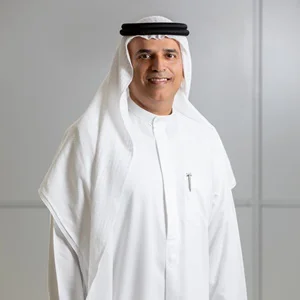
“EGA has strength from mine to metal and a strong balance sheet to pursue growth,” Abdulnasser Bin Kalban, CEO at Emirates Global Aluminium
- Category
- Interview
- Date
- Source
- AlCircle.com
Upon his appointment as Chief Executive Officer in 2020, Mr Bin Kalban has served as an Alternate Board Member since May 2017. He also sits on the Board of Guinea Alumina Corporation (GAC), EGA's bauxite mining subsidiary.
As CEO, Mr Bin Kalban is responsible for managing EGA's ongoing operations and business and reports to the Managing Director.
Mr Bin Kalban joined DUBAL in 1996 and worked in both Major Projects and the Power and Desalination Department. (DUBAL merged with EMAL to form EGA in 2014). In 2014, Mr Kalban left his position as General Manager of Power and Desalination at EGA to become CEO of Dubal Holding LLC, EGA's 50 per cent shareholder.
Mr Bin Kalban is a Board Member of the International Aluminium Institute, the Gulf Aluminium Council, and the Emirates Research and Development Council.
In 2023, Mr Kalban was appointed as a Board Member of the UAE International Investors Council. Mr Kalban has a bachelor's degree in Electrical Engineering from Western Michigan University in the United States and has completed Strategic Management and Leadership Courses at Insead Business School in France and Harvard Business School.
AL Circle: Congratulations on achieving a record-high production across the value chain in 2023. What are your strategies to keep up the momentum in 2024 and beyond?
Abdulnasser Bin Kalban: At EGA, we deliver competitive performance by focusing on what we control – the safety of our people, operational excellence, our costs, and our long-term commercial relationships with our global customers.
Operational excellence includes creeping production from our existing assets. In 2023, we achieved record production at every step of our value chain, from mining to cast metal.
This is not new for us. In fact, we crept our metal production by nine per cent from 2020 to 2023, which is stronger organic growth from existing assets than any other major peer.
Our bauxite mine and alumina refinery began production in 2019, so the scope for creeping production at these assets over recent years has been even higher. During 2023, we exported 14.1 million wet metric tonnes of bauxite from Guinea. Al Taweelah's alumina refinery produced 2.48 million tonnes of alumina, well beyond the original design capacity.
We will continue to creep production from existing assets wherever we can. We also believe our strong performance means we have earned the right to grow beyond our existing assets to meet the increasing global demand for aluminium, particularly in low carbon primary and recycled aluminium.
AL Circle: As the demand for low-carbon aluminium has grown exponentially in recent times, do you plan to innovate another product like CelestiAL solar aluminium? Please share your marketing plans for CelestiAL solar aluminium to increase its usage in the end-use market.
Abdulnasser Bin Kalban: In 2023, we produced 66 thousand tonnes of CelestiAL solar aluminium, up from 57 thousand tonnes in 2022. We were the first company in the world to start making aluminium using solar power back in 2021.
We are already innovating this product. BMW Group is our largest customer for CelestiAL, and almost all our supply to them in 2023 was, in fact, CelestiAL-R – solar metal sweetened with recycled aluminium.
Demand from our customers for CelestiAL is high. Our production is constrained by how much solar power we can import from the grid, which is very limited. Decarbonising energy is a key priority for EGA to increase our low-carbon aluminium production. That means divesting captive natural gas-fired power assets and instead sourcing more power from the grid. This requires some complex deals, and we are working hard with our partners to get this done. In addition to decarbonising our aluminium production, our energy demand would unlock significant new developments in solar power in the UAE. We are making good progress, and I hope we can update you soon.
Another product we expect to start producing is RevivAL, which is recycled metal. We are developing the UAE’s largest recycling facility in Al Taweelah, which will have a production capacity of 170,000 tonnes per year. Recently, we announced the signing of a binding sale and purchase agreement for the acquisition of a German aluminium recycling firm, Leichtmetall.
AL Circle: According to a Gulf Investment Report in 2023, investing in green and sustainable projects is forecasted to boost the Gulf countries' gross domestic product (GDP) to $13 trillion by 2050. How do you plan to tap this potential market with your low-carbon aluminium?
Abdulnasser Bin Kalban: One of EGA's many strengths is the geographical diversification of our sales – we sell metal in more than 50 countries around the world. For us, the growth opportunity is global and we are excited about the potential for aluminium as an essential material for the development of a more sustainable society.
We sell around 10 per cent of our metal at home in the UAE - 293 thousand tonnes in 2023, compared to 268 thousand tonnes in 2022.
We are strong supporters of operation 300bn, the UAE's strategy to more than double the contribution of the industrial sector to the economy by 2031. The main way we contribute is by growing EGA itself. Our metal supply is an important enabler for the development of further downstream industrial companies beyond the 26 companies that make products in the UAE using our metal today. Further increasing our local procurement is also a priority – we currently spend around $1.7 billion each year locally.
In 2023, EGA and the aluminium sector that has grown around us contributed $6.5 billion to the UAE economy, over 1% of the UAE's GDP, and supported over 57 thousand jobs in the country.
AL Circle: Would you like to share some suggestions with your industry peers on reducing carbon emissions in the aluminium manufacturing process? What sustainability measures do you take at your refining and mining projects?
Abdulnasser Bin Kalban: Aluminium is an essential material for the development of a more sustainable society. It also matters how sustainably aluminium is made. All aspects of sustainability are important, but clearly, decarbonisation is the central challenge for our generation of aluminium industry leaders. We must decarbonise aluminium production if our metal is to reach its full potential to contribute to human progress over the decades ahead.
I am not here to give advice to others, but I am here to say that we must work together to solve the decarbonisation challenge. That is exactly what we do through industry bodies such as the International Aluminium Institute. We share common challenges within our industry, such as decarbonising the Hall–Héroult process by either reinventing it or implementing carbon capture and utilisation. Clearly, we also share common challenges beyond our industry, such as decarbonising electricity generation.
Emissions from bauxite mining are a very small proportion of total emissions from the production of aluminium, but clearly, if we are to reach net zero, we must tackle them. The main sources of emissions are power generation and mobile equipment. In Guinea, we are exploring alternatives to diesel for power generation, such as solar and hydroelectric. The alternatives for mining vehicles are electrification or biofuels.
The challenge in alumina refining is decarbonising the production of steam and high-temperature heat, which we need for thermal energy. We are working with partners in a cooperative research centre in Australia to find technical solutions to these challenges.
AL Circle: Is your latest fully industrialised technology, DX+ Ultra, enabling you to stay at the forefront of technological advancements in the aluminium industry? How does this technology stand out in the global market?
Abdulnasser Bin Kalban: We have been developing our own aluminium smelting technology for over 30 years, and this has been the foundation of our global competitiveness. Since 1990, Emirates Global Aluminium’s technology development has more than doubled the size of cells that are technically and commercially viable. Our technology development and earlier work started in 1980, has reduced the amount of electricity required to produce each tonne of aluminium by 37.5%, improving both cost and environmental performance.
Since the 1990s, every smelter expansion at EGA has been built with our own technology, and we have retrofitted all our older production lines.
We have also licensed our technology internationally to Bahrain, and we have deployed our know-how in Indonesia. We have other technology licensing opportunities under development around the world.
We are proud of DX+ Ultra, but we are not stopping there. We are at an advanced stage in the development of the next generation of our smelting technology, and we are soon going to build pilot pots at EGA to prove it further.
AL Circle: How do you envision the future of the global aluminium industry, and what role does your company aim to play in shaping that future?
Abdulnasser Bin Kalban: I am very optimistic about the prospects for aluminium because of its role in decarbonisation economy-wide. Global aluminium demand is set to grow from around 100 million tonnes per year today to more than 140 million tonnes per year in 2040. That growth in demand is clearly going to be for low-carbon primary and recycled aluminium, and the role of grey aluminium will decline after 2030.
EGA has strength from mine to metal and a strong balance sheet to pursue growth. That is an exciting opportunity for us. EGA is going to become bigger and more international in our production footprint as well as growing at home.
We are exploring many opportunities in both low-carbon primary production and recycling, and you will have to wait and see what we are going to do next. What I can tell you is what our first moves have been, and both are in recycling.
We are building the UAE’s biggest aluminium recycling facility in Al Taweelah. This plant will have an annual capacity of 170 thousand tonnes of billets per year.
We also recently announced the acquisition of Leichtmetall, a European producer of high-strength recycled aluminium. This is still subject to regulatory approval, but it is EGA’s first major acquisition since the formation of our company through the merger of Dubal and Emal a decade ago. Leichtmetall will be our first metal production facility outside the UAE and our first recycling operation.
This is an exciting time to be in the aluminium industry. The dawn of our global sector was well over a century ago, but the sun is still rising for us.

