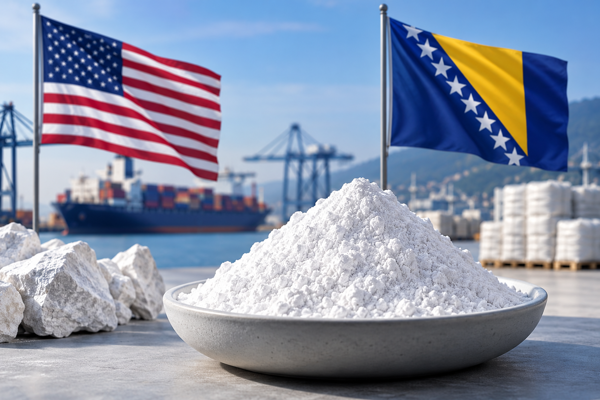
The US aluminum trihydrate market strengthened in September 2026 as downstream procurement, rising overseas production costs, and shipping bottlenecks supported prices. In contrast, Bosnia’s market faced a quarterly correction as European buyers drew on accumulated inventories and lower caustic soda costs eased manufacturing pressures, highlighting diverging regional price trends. US aluminum trihydrate market gains on demand and supply constraints US aluminum trihydrate prices increased 2.38% month over month in September, supported by purchases from wire and cable manufacturers, electrical infrastructure compounders, and electric vehicle (EV) component producers. Demand remained particularly resilient for applications involving low-smoke cable compounds and flame-retardant materials....
China-based China Aluminum International Engineering Co., Ltd. (CHALIECO) has won a bid for an engineering, procurement and construction (EPC) contract valued at approximately USD 833 million for a proposed alumina project in Vietnam, adding to investment activity in the country’s mineral processing sector. The project, being developed by Binh Phuoc Ore Mining and Beneficiation Joint Stock Company, is designed to process 2.4 million tonnes of alumina annually. The proposed contract is valued at around CNY 5.595 billion (USD 839.04 million), with completion expected within 27 months of the contract’s effective date. CHALIECO to oversee turnkey refinery development Under the proposed turnkey arrangement, CHALIECO’s responsibilities will cover the full project delivery process, from...
Grow with
AL Circle

Many experiments with red mud have been performed till date all around the globe for its reuse in a more efficient and sustainable way. Red mud is a toxic by-product generated in the industrial production of alumina. It is rich in iron and considered as a treasure trove of elements. With an annual generation of about 150 tonnes of red mud during bauxite to alumina production, more and more scientists are getting involved in examinations for its reuse in metal industry. In the recent time, some scientists at an experimental metallurgy plant in Aachen in Germany are also pursuing an experiment on the same. Mixed with carbon and then melted at high temperatures, the scientists are striving to prepare the red mud for reusing it in the steel industry. Bernd Friedrich, a metal recycling expert...

While Hydro’s Alunorte alumina refinery operates at 50% of its capacity, the prices seem to be rising over the course of March. According to Metal Bulletin, spot alumina prices gained 27.8% over the course of March, with buyers forced to pay up for units in a tighter market. Metal Bulletin’s benchmark daily FOB Australia alumina index settled at $447.30 per tonne on Thursday March 29, up from March 1’s calculation of $349.88 per tonne. “There was definitely more length in the Pacific [at the time of the force majeure announcement] but the available Australia units got tied up pretty quickly and since then people have started to panic,” a producer source is quoted by Metal Bulletin. As Brazil is not a major alumina supplier to China, this has not affected alumina prices in the country....

The closure of 50% operations in Hydro’s Alunorte Refinery recently will have a significant effect in the alumina market in 2018. Hydro’s Alunorte is the world's largest alumina refinery and is located in Pará, Brazil. On average, 14% of its production goes to the domestic market and the other 86 % goes for export. When we see the table above, we see the top alumina producers are China, Australia and Brazil. However, China exports a very insignificant portion of its alumina production and consumes most of it domestically. Jamaica has restarted Alpart alumina refinery and it has started shipping to China. Jamaica, Australia, Vietnam remain the top alumina supplier to China and continue to remain so in 2018. For ex-China world, Australia and Brazil play a dominating role as alumina...

After being forced to reduce alumina production substantially under a judicial order last month, the Alunorte refinery in North Brazil, owned by Norway’s Norsk Hydro, has to now start closing down half of its alumina capacity in the next two weeks to preserve equipment, said two people familiar with the matter on Tuesday. Some anonymous sources further reported that the company will be forced to completely shut down three of its seven alumina lines in case the judicial order is not lifted. The steep reduction in alumina production after the company declared force majeure has already led to a hike in alumina prices. They increased by about 13 per cent last week to close at US$438 per tonne, according to the MB pricing. Analysts are of the opinion that the possibility of a protracted outage...

Emirates Global Aluminium, the largest industrial company in the United Arab Emirates outside oil and gas, has passed 20 million hours work on its Al Taweelah alumina refinery construction project without a single Lost Time Injury. This is the equivalent of one person working in construction for more than 7,000 years without an accident that leads to time off work. Al Taweelah alumina refinery, located next to EGA’s Al Taweelah aluminium smelter in Abu Dhabi, is one of the largest industrial construction sites in the UAE, with more than 11,000 people working on site. The alumina refinery is the first to be built in the UAE. Alumina is the feedstock for aluminium smelters. Abdulla Kalban, Managing Director and Chief Executive Officer of EGA, said: “Safety is the first priority of everyone...

Norwegian aluminium producer Norsk Hydro today announced that the company is in talks with the environmental authorities of Pará to resume normal operations at Alunorte alumina refinery in Brazil. Alunorte alumina refinery is currently operating at 50 per cent capacity. “In addition, Alunorte is seeking an agreement with the public prosecutor, Ministério Público. Ministério Público has on 26 March 2018 published their counterproposal for an agreement. This proposal will be evaluated by the company,” Hydro said in a statement. “Inspections conducted by several local, state and federal authorities, including environmental regulators IBAMA and SEMAS, have confirmed the integrity of the bauxite residue deposits and that there have been no spill or overflow. This was later re-confirmed by...

According to the latest USGS release on Bauxite and Alumina in the Fourth Quarter 2017 ; imports of alumina by the U.S. in the fourth quarter of 2017 stood at 355,000 tonnes. The volume was 3% less than the amount of 364,000 tonnes imported in the third quarter of 2017 and 34% more than that in the fourth quarter of 2016. Alumina imports for the full year 2017 stood at 1.33 million tonnes. This registers a 17% increase over the volume in 2016 but 87% less than those in 2015. This indicates increasing domestic aluminium production in the U.S. in 2017, in comparison to 2016. The leading sources of imported alumina in the fourth quarter of 2017 were Brazil (44%), Australia (28%), and Jamaica (13%). Exports of alumina during the fourth quarter of 2017 were 121,000 tonne, 17% more than the...

The on-going SMM Copper Aluminium Summit in Shanghai is opening up a number of discussions on the alumina and aluminium sector in China and also throwing light on the possible impacts of the latest tariff on aluminium and steel industry. According to Guo Qiuying, an aluminium analyst at SDIC Essence Futures, there is limited downward room for alumina prices due to costs of essential raw materials like caustic soda and bauxite. The analyst expects the prices of raw material to rebound in 2018, lifting alumina prices. Environmental concerns will continue to draw attention from the government and supply will remain tight due to restricted capacity. Today’s average spot alumina price stands at RMB 2730 per tonne, flat since the last change on March 12. Spot alumina prices have continued...

Hydro expands the scope of the ongoing independent review of Alunorte by Brazilian environmental consultancy SGW Services to include all interfaces with areas adjacent to the refinery operation. Hydro’s Internal Audit will conduct a full review of all licenses, complementing SGW’s review of Alunorte’s permits and relevant legislation. The decision to expand the scope of SGW’s mandate and to launch an internal audit follows an infraction notice from Pará State Environment and Sustainability Secretary - SEMAS on 15 March. The notice relates to an unlicensed connection between the Alunorte refinery and a licensed drainage canal from the adjacent Albras aluminium plant, leading to discharge of untreated rainwater from the roof of the coal storage shed at Alunorte into the Pará River through...

About 30 percent production of alumina refineries and aluminium smelters was cut in many parts of China, including Henan, during November 2017 to March 2018 for bringing the air pollution in check. March 15 was the date they were looking forward to for restarting the alumina production after clearing all the environmental and legal pre-requisites. But now, a new hindrance seems to have interrupted their initiation. The rising costs and meagre supply of raw material bauxite may delay the restart of the Chinese alumina refineries in Henan province, as reported by Antaike. This slower than expected return of alumina production in China has brought in a new anxiety among the country’s aluminium smelters, for whom alumina is an essential feedstock. The latter may have to contend with higher...

Altech Chemicals Limited is pleased to provide an update on funding for its proposed Malaysian high purity alumina (HPA) plant and associated kaolin mine in Meckering, Western Australia (the Project). Senior Debt Package On 2 February 2018, the Company announced that it had executed a commitment letter together with agreed terms and conditions formalising the US$190 million senior debt package with German government owned KfW IPEX-Bank. The path to finance close and the ability to draw-down on the senior debt package involves the Company satisfying various conditions precedent, which includes securing a balance of funds for the Project. The options and proposals currently being assessed by the Company include introducing an additional amount of mezzanine debt (unsecured and subordinate to...

As an update on the 50% production cut orders at Hydro’s Alunorte alumina refinery by Brazilian authorities and judiciary, Norsk Hydro says that it is looking at securing alternative sources of alumina to substitute the closed supply at its Brazilian plant on priority basis. Hydro’s Chief Executive Svein Richard Brandtzaeg told this to Reuters. After the court orders Hydro declared force majeure with no time set to restart production. Alunorte produces 5.8 million metric tonnes of alumina per year, according to Norsk Hydro’s website. In a telephone interview to Reuters, Brandtzaeg did not specify any date when full production would resume but, he said that the company is undergoing “very constructive” discussion with the Brazilian authorities. He confirmed that Alunorte had supplies that...

The internal expert task force established to review the Alunorte alumina refinery after the flooding in February has reported preliminary findings. The status report has the following main findings: Discharge of water overflowing from the adjacent waste-water holding pond into the internal open drain, Canal Velho, in addition to the already communicated rainwater release. A release of diluted caustic soda inside the plant due to a power failure on February 17. This was mixed with rain water from the factory area before entering the waste-water holding pond, with overflow into Canal Velho. Based on the preliminary findings of the task force, Hydro has no indications of leaks or overflow from the bauxite residue deposit areas. In addition, an inspection has detected cracks in a pipeline,...

As reported by SMM, China Customs data shows China's imports of alumina in January fell for three consecutive months and touched a new low of 74,000 tonne since August 2017. This is down 48.6% month on month and 72.3% year on year. Higher imported alumina prices in comparison to domestic producers were largely responsible for the fall in import. The average imported alumina price for the month of January and February stood at RMB 3450 per tonne (US$545 per tonne). For the period of February 13 to March 13, the monthly average imported alumina price stands at RMB 3393.75 per tonne (US$536 per tonne). Average imported alumina price fell to RMB 3000 per tonne (US$474 per tonne) on March 12; bringing down the average monthly price. Below graph shows the trend in average imported alumina price...

China’s alumina imports in January dropped 72 per cent from the same period previous year. China imported 73,624 tonnes of alumina from the global market, according to China's customs data. Source: www.metal.com (Unit: tonnes) China’s alumina imports from Indonesia were up 4.74 per cent YoY in January 2018. Indonesia exported 31, 457 tonnes of alumina to China. Australia’s alumina exports to China continued to decline in January. Australia exported 34,500 tonnes of alumina, down 77 per cent YoY. Other exporting countries were Germany, Japan, France, India, the US and South Korea. Total alumina exports by the country declined 24 per cent YoY reaching 4,093 tonnes in January. South Korea’s alumina imports from China were down 17 per cent YoY in January. China exported 1,797 tonnes of...

Norwegian aluminum maker Norsk Hydro’s Alunorte alumina refinery in Brazil made unauthorized spills of waste water last month, the company said on Sunday, more than two weeks after local authorities first began to raise questions. Heavy rain and flooding at the plant in mid-February sparked fears of a leak of toxic bauxite waste around the facility and government warnings of contamination, but Hydro has so far maintained it had found no evidence of emissions. Authorities in late February ordered the plant, the world’s largest alumina refinery, to cut output in half until it addressed concerns, leading Hydro to declare force majeure with no time set to restart production. A Brazilian government-backed research institute on Friday told Reuters it will soon publish evidence of a waste leak...

Ever since the successful restart of Alpart alumina refinery in Jamaica; its Chinese owner Jiuquan Iron and Steel Company (JISCO) has been constantly brainstorming ideas to make the refinery most profitable by expanding production within a short span of time. The company now aims to upgrade the plant and expand its capacity so that it can facilitate one export shipment of alumina every month. The company has already exported two shipments of alumina in just over six months since the reopening of the plant in June 2017. According to the statement by Assistant Managing Director of JISCO Alpart refinery, Sun Jing, the company has already invested US$150 million in order to upgrade the plant in order to commence production so that they can attain the shipment target this year. “I think we are...

Hydro announced that SGW Services will conduct an independent review of the water treatment and effluent management systems at its Alunorte alumina refinery in Barcarena. The independent review by SGW is expected to announce its conclusions during the first week of April. "The objective of the SGW review is to assess whether Alunorte’s water and effluent management system has been operated according to design specifications, applicable permits and legislation, and relevant internal and external requirements. The review will especially focus on all outlets discharging into Alunorte’s external environment, and specify any identified irregularities or gaps,” according to company press release. SGW will conduct an independent environmental review in two phases. The first phase will cover the...