Alcoa backs Equus with $30m as North West Shelf gas project moves towards FID
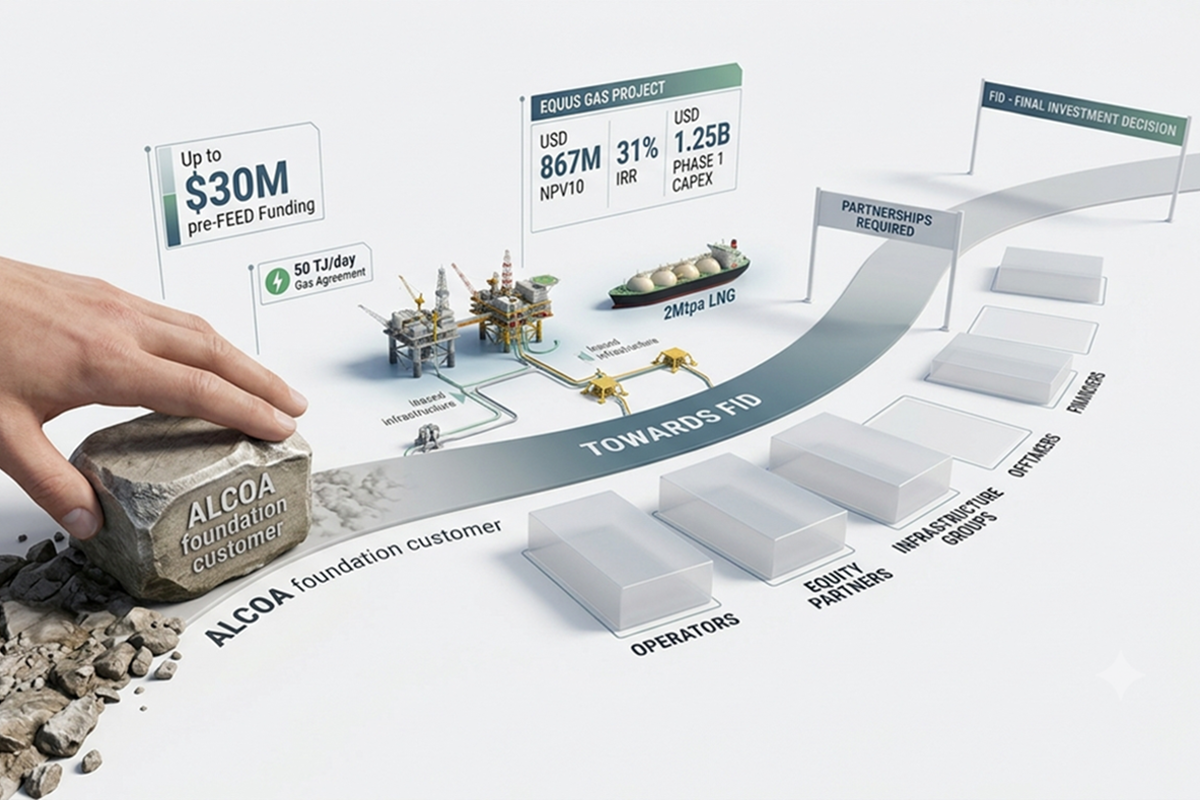
The image used in this article is generated with an AI tool and does not depict any real-time moment
Equus Energy Limited has moved its North West Shelf gas project into a new commercial phase after securing Alcoa Corporation as a foundation customer and outlining a USD 867 million NPV10, 31 per cent IRR and USD 1.25 billion Phase 1 development case. With technical pre-FEED work completed, the company is now seeking operators, equity partners, infrastructure groups, offtakers and financiers to help take the project towards a final investment decision (FID).
Alcoa’s decade-long deal
A key milestone is Alcoa’s agreement to procure gas around 50 TJ per day for 10 years from the Equus project. Alcoa has also committed staged funding of up to USD 30 million to support pre-FEED and FEED activities.
The agreement gives Equus a foundation domestic customer while the company works to secure additional commercial and development partners.
Equus managing director Will Barker stated, “The critical path for us is bringing the partners, and that's what we're focused on now.”
Join the webinar by Alberto Monje Gama to learn about recycled aluminium, CBAM and trust
“We've completed all our pre-FEED studies and have done all that technical work. So now the focus really turns to partnering and commercialisation of this asset,” he added.
Alcoa’s involvement follows its earlier funding support for the technical work, giving Equus both customer backing and financial participation as the project progresses.
USD 867m project economics set the development case
Equus’ preferred development plan carries a post-tax NPV10 of USD 867 million and an IRR of 31 per cent, with payback estimated at around two years. Phase 1 capital expenditure is projected at approximately USD 1.25 billion, while LNG breakeven is modelled at USD 6.60 per MMBtu against a USD 9.50 per MMBtu base case.
The plan targets around 2MTPA of LNG, 50 TJ per day of Western Australian domestic gas and peak condensate production of about 12,000 barrels per day (bpd) over a 15-year project life.
Under the base-case assumptions, Equus estimates approximately USD 22.3 billion in revenue and USD 11.6 billion in EBITDA, implying an EBITDA margin of around 52 per cent.
The economics remain sensitive to LNG prices. At USD 2 per MMBtu below the USD 9.5 per MMBtu base case, NPV10 falls to USD 210 million and IRR to 17 per cent. At USD 2 per MMBtu above the base case, NPV10 rises to USD 1.237 billion, and IRR reaches 38 per cent.
To explore trade opportunities of secondary aluminium, visit AL Biz
Partnering strategy to shape next phase
Equus owns 100 per cent of the project but does not intend to fund and develop it alone. Its preferred model uses leased and third-party infrastructure to reduce upfront capital requirements.
The company plans to fund initial production wells, subsea infrastructure and project management, while a leased floating production, storage and offloading vessel and third-party offshore export pipeline would be supported through lease and tolling arrangements.
Gas processing would use existing infrastructure at either Pluto or Varanus Island under tolling agreements. Barker mentioned, “To bring that capital in, along with the expertise and balance sheet, we need to sell down.”
He further noted that the company’s focus over the next 6 to 12 months would be to bring in operators, offtakers and infrastructure funders capable of supporting an FID.
Alcoa deal strengthens commercial positioning
The Alcoa agreement adds an important commercial element to the project as Equus begins broader discussions with potential LNG buyers, infrastructure partners, equity investors and financiers.
Alcoa would take around 50 TJ per day for 10 years, with supply targeted for the early to mid-2030s, subject to approvals and FID.
“The way we de-risk this asset now is by bringing in the big operating partners, the big gas offtakers, who are able to realise the value of this resource,” Barker said.
The next step is to convert the foundation customer and pre-FEED economics into the wider partnership structure required for development.
Unlock key insights from industry experts on aluminium’s applications in end-user with our magazine - Sustainability & Recycling: Aluminium’s Dual Commitment
Development remains dependent on partners and infrastructure
The project’s first production is modelled for 2033, but the timetable depends on securing partners, funding, approvals, infrastructure access and definitive commercial agreements.
Phase 2 and Phase 3 development is expected to require a further USD 1.53 billion in capital expenditure, with the model assuming these later stages can be funded through project cash flow.
Currently, Equus has three important pieces in place: Alcoa as a foundation customer, up to USD 30 million in Alcoa-backed study funding and a pre-FEED case showing USD 867 million NPV10 and 31 per cent IRR. The next test is whether those credentials can attract the heavyweight operating, infrastructure, offtake and financial partners needed to move the project from commercialisation towards FID.
Hydro locks in renewable power supply through 2040 with Statkraft to drive low-carbon aluminium growth in Norway
Next articleIndia banks propose priority lending for EV charging and e-fleets
Grow with
AL Circle