





The EU Carbon Border Adjustment Mechanism (CBAM) entered its definitive phase on 1 January 2026. Until then, importers of covered products were required to report embedded emissions, but no financial liability was attached. That has now changed.
For aluminium, the focus has been on the cost of importing carbon-intensive metal into Europe. While this is an important event, it is only part of the overall impact. A more significant development is CBAM’s impact on the aluminium pricing mechanism and price benchmarks.
During 2025 and the first quarter of 2026, the leading Price Reporting Agencies reviewed how CBAM-related costs should be treated within European aluminium premium assessments. The decisions that followed changed the composition of the benchmarks used in commercial contracts across the market. That’s increasingly important for this argument because these benchmarks are not used only for imported metal. They also impact the price of aluminium produced within Europe and the subsequent value-added and semi-finished products made from it.
Understanding the aluminium pricing structure
To assess the impact of CBAM on European price benchmarks, it is necessary to begin with the fundamental components of aluminium pricing, and the pricing formula for most major aluminium value-added products is built around three main components:
LME aluminium price + regional P1020 or VAP premium + product-specific premium or upcharge
The London Metal Exchange (LME) provides the global reference price for aluminium. The regional product premium captures the physical value, or the cost of delivering metal into a particular geography, while the product-specific premium reflects the additional value and a conversion cost required to produce billet, slab, foundry alloy, wire rod or another value-added product.
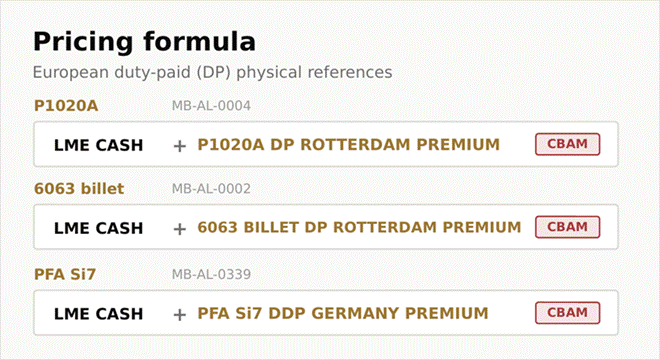
Figure 1 — The European duty-paid pricing formula. Each published European benchmark is an LME cash reference plus a duty-paid physical premium. From 2026, that premium already carries CBAM.
Source: Venarion Commodities.
The precise structure of aluminium pricing varies by geography, product, and supplier. Some producers itemise each element, while others use the benchmark primarily as a reference and an indicator of market direction and negotiate the final price accordingly.
Either way, P1020 remains at the centre of the commercial pricing formula and is most exposed to CBAM. Even where it is not shown explicitly in the contract, a European P1020 premium continues to influence the price of a significant share of aluminium products further downstream in Europe.
CBAM is now inside the European duty-paid premium
Fastmarkets changed its methodology in January 2026 so that CBAM-related costs could be included within its Rotterdam P1020A duty-paid premium. Its duty-unpaid assessment continues to exclude both import duty and CBAM.
Interestingly, Platts initially took a different view and announced that CBAM would remain outside its European duty-paid P1020 and billet assessments. Platts initially introduced a separate calculated CBAM value instead but later revised this approach and reversed its decision.
As physical trading evolved, CBAM costs naturally became included in duty-paid spot premiums in assessed transactions. Platts reopened the methodology in April 2026 and incorporated CBAM costs into its European duty-paid P1020A premium and its delivered duty-paid 6060/6063 billet assessments for Germany and Italy. Its duty-unpaid P1020 assessment continues to exclude CBAM.
The sequence of these methodological changes is significant because it shows how pricing methodologies have adapted in response to market developments. CBAM started as a separate regulatory cost and is now becoming part of the physical market premium.
This does not imply that Price Reporting Agencies are simply adding a theoretical CBAM component to the published premium. PRAs assess prices of real market transactions, bids and offers for physically delivered metal. The premium reflects the extent to which the market passes through, absorbs or shares the additional cost. The CBAM cost reflected in the regional premium will depend on what buyers and sellers are actually getting charged in those assessed transactions, not on a theoretical CBAM import calculation alone.
Duty paid and duty unpaid now tell an important story
The distinction between duty-paid and duty-unpaid benchmarks has become much more important. Duty-unpaid metal has not yet cleared into the EU market, so the duty-unpaid premium excludes CBAM.
Duty-paid metal has cleared into the European market, and the duty-paid premium benchmark now reflects not only the traditional cost of bringing metal into the region and the market demand factors, but also the extent to which CBAM costs were included in that price benchmark.
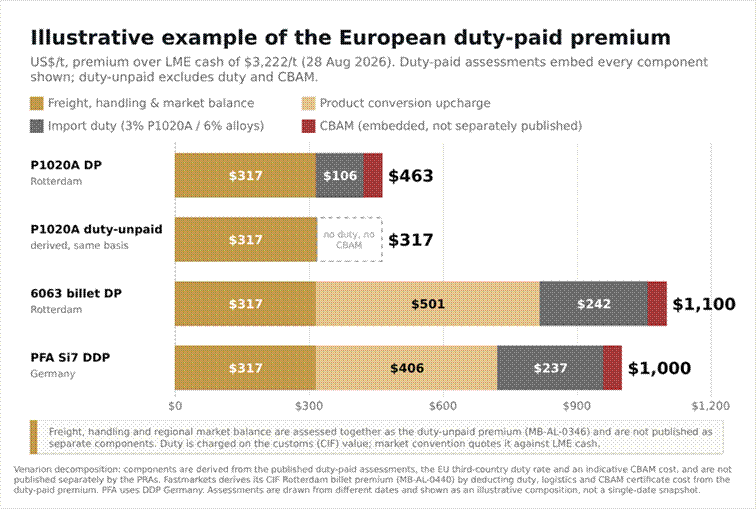
Figure 2 — What is included in the European duty-paid premium. Illustrative decomposition against LME cash of US$3,222/t. The duty-unpaid premium carries the same physical value without duty or CBAM.
Source: Venarion Commodities.
In practice, this has a clear commercial implication. If a commercial contract already references a duty-paid P1020 premium that includes CBAM, adding a separate CBAM charge on top risks counting the same cost twice.
This will become increasingly important in commercial contracts, and buyers and sellers will need to be precise about what their chosen benchmark already includes before adding separate adjustments to their pricing formula.
The impact on price formation is not limited only to imported metal units
At this stage, the discussion becomes more complex. EU-based aluminium smelters do not pay CBAM on aluminium produced within the European Union, but their carbon-cost exposure comes through the EU Emissions Trading System (ETS).
Imported aluminium is different, and CBAM was designed to bring the carbon cost of imported products closer to the carbon constraint European producers are facing. Domestic and imported aluminium units, however, compete in the same physical market, and Europe remains structurally dependent on imported metal to address domestic demand.
Imported metal is therefore not just a marginal consideration. It represents a significant share of the supply required to balance the European market, so the landed cost of imported aluminium also directly impacts the market price of metal available to domestic producers.
If CBAM increases the cost of bringing P1020 into Europe and that additional cost becomes reflected in the duty-paid premium, European smelters can sell their domestically produced metal against a higher regional benchmark even though they have not paid CBAM themselves.
That does not mean the higher premium is a straightforward gain for domestic producers. European smelters continue to carry EU ETS exposure, and the free allocation available to sectors covered by CBAM is being progressively reduced.
CBAM influences the European market price, while the EU ETS determines the carbon cost faced by domestic producers. In practice, both feed into the price of aluminium sold in Europe.
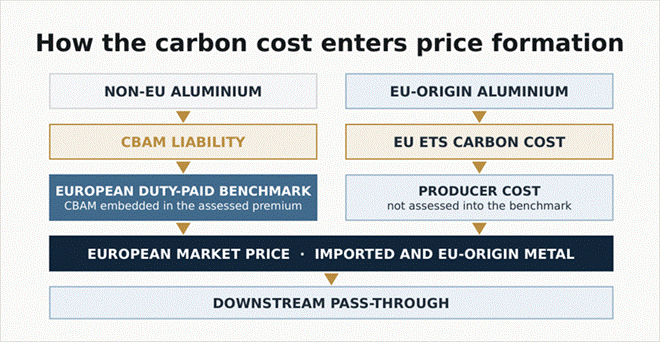
Figure 3 — How the carbon cost enters price formation. CBAM is embedded in the assessed duty-paid benchmark. EU ETS is a producer cost that is not assessed into that benchmark; the two meet in the European market price.
Source: Venarion Commodities.
From P1020 to billet, slab and foundry alloys
The same effect is also visible further downstream. European extrusion billet has its own published premium assessments, separate from the P1020 premium. In 2026, CBAM costs have been incorporated into relevant European duty-paid billet assessment methodologies, including Fastmarkets’ European billet premiums, and Platts’ delivered duty-paid 6060/6063 billet assessments for Germany and Italy. CBAM is therefore already included directly in these billet benchmarks rather than being transmitted solely through the P1020 premium. Commercial billet contracts for physical shipments may still be structured using a regional P1020 premium and a negotiated billet upcharge on top of LME. Where a published duty-paid billet assessment is available and adopted in the market, the treatment of CBAM within that benchmark assessment must be understood to avoid adding the same cost again.
Rolling slab follows a similar commercial logic, although the market transactions are less transparent. Slabs are largely sold under bilateral long-term contracts between smelters, remelters, and rolling mills rather than through a liquid spot market. Even so, the underlying pricing rationale still commonly references the regional P1020 premium, and a negotiated slab upcharge, with additional alloy, dimensions or treatment surcharges where relevant.
Primary foundry alloys (PFA) also follow the primary aluminium pricing structure, with the relevant P1020 transaction price as the metal reference and an additional alloy premium or upcharge. Secondary foundry alloys (SFA) are different because their economics are driven more by scrap, alloying elements, and physical alloy prices and benchmarks. European primary foundry alloys also have their regional price benchmarks. Fastmarkets’ silicon 7 PFA premiums for Germany and Eastern Europe have included CBAM-related costs since January 2026. As with billet, CBAM is included directly in the published PFA premium. Commercial contracts may use different pricing structures, making it important to distinguish between the components of a contractual formula and the scope of the published premium assessment methodology.
The key point is that CBAM does not need to be listed as a separate line item for its effect to move through the value chain. Once it is embedded in the European P1020 duty-paid premium, it can be transmitted into the price of domestically produced value-added and semi-finished aluminium products through the pricing formula itself.
That creates a downstream competitiveness issue
For European semi-finished products manufacturers, the outcome is far more complex than the straightforward assertion that CBAM protects the European aluminium industry by levelling it with carbon-intensive metal.
A rolling mill, extruder, conductor producer or other downstream consumer in Europe may buy aluminium using a pricing formula linked to the European duty-paid P1020 premium. If that premium rises partly because of CBAM, the producer’s metal input cost rises regardless of whether the aluminium it purchases was imported or produced within the EU.
Its competitor elsewhere may be buying metal against a different regional premium that does not contain the same CBAM-related uplift, and that difference becomes particularly visible in export markets.
A European semi-fabricator selling outside the EU may face higher European aluminium input costs but receive no carbon-border protection in the destination export market. Its competitor in Asia, or another geography, may be pricing against a lower regional metal premium.
In that case, CBAM has directly increased the European producer’s raw material cost, impacting its competitiveness in markets into which it exports.
This does not mean that imported semi-finished aluminium automatically gains an advantage inside the EU. CBAM already covers a range of aluminium products, and its downstream scope is also evolving, so the issue is more specific.
The exposure is greatest where European producers compete outside the EU and where carbon-border protection does not extend through the same portion of the downstream value chain as the higher aluminium input cost.
The cost is still limited, but the pricing impact is already visible
The CBAM factor is being phased in gradually, and the initial financial impact in 2026 is still limited compared with what the mechanism will look like later in the decade.
This may make the current effect appear less significant than its longer-term implications suggest. The more important development in 2026 is not the absolute size of the CBAM cost, but the awareness of the transmission mechanism in pricing formulas.
The market now has a mechanism through which CBAM-related costs can move from imported aluminium into the European duty-paid premium, then into domestic P1020 pricing, and further into value-added aluminium and downstream conversion costs.
The amount transmitted through that pathway will change as CBAM scales up, carbon prices move, emissions values become better established, and the market becomes more comfortable pricing the carbon cost. The transmission of cost through pricing mechanisms is already established.
The direct and indirect pricing effects of CBAM
CBAM therefore generates two distinct effects on aluminium metal pricing. The first is straightforward: an importer brings covered aluminium into the EU and incurs a CBAM liability based on embedded emissions and the applicable CBAM factor.
The second effect is less obvious but has a broader reach and wider impact. Once CBAM is reflected in the European duty-paid premium, it can also affect the price of domestic metal and products priced against that benchmark.
The first effect applies directly to imported metal units, but the second effect can influence a significantly larger volume of aluminium in Europe.
That distinction will become increasingly important as CBAM develops from a relatively modest cost in its early years into a much more significant component of European aluminium pricing economics.
For aluminium market participants, the central question now extends beyond the direct cost of importing aluminium into Europe under CBAM. It is also how much of that cost will ultimately be absorbed into the European aluminium price itself, especially in domestically produced metal.


 Voyagerman Technology


