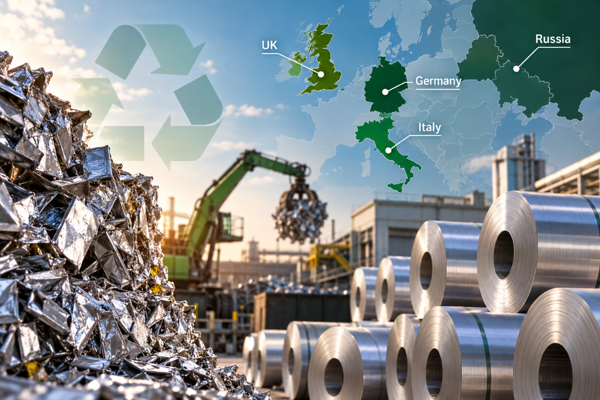
Europe’s recycled aluminium industry is an important component of the global secondary aluminium supply chain, with Germany, Italy and the United Kingdom (UK) representing key national markets. Production across the European region stood at nearly 6 million tonnes in 2023, supported by established scrap recovery systems, industrial recycling capacity and demand for recycled metal. Russia also contributes to the regional landscape through secondary aluminium production units concentrated in several industrial centres. According to AL Circle’s analysis in its report, “ World Recycled ALuminium Market Analysis Industry Forecast ”, the four countries present different market structures, from Germany’s substantial recycling capacity and Italy’s scrap-based production to the UK’s organised...
According to SMM survey statistics, the operating rate of the secondary aluminium alloy industry in September was 35.0 per cent, up 3.1 percentage points M-o-M but down 6.7 percentage points Y-o-Y. Industry production continued its recovery trend, but the overall operating level remained below the same period last year. On the demand side, September marked the traditional peak consumption season, with downstream orders recovering from August. End-use demand from automobiles and other sectors improved marginally, but the peak season effect has yet to fully materialise. According to CAAM data, automobile production in September was 2.99 million units, up 11.4 per cent M-o-M but down 8.7 per cent Y-o-Y. NEV production was 1.814 million units, up 12.2 per cent Y-o-Y. CAAM noted that China's...
Grow with
AL Circle

The International Aluminium Institute (IAI), the global association of aluminium producers, has introduced a new web-based tool at the 14th International Aluminium Recycling Congress in Manchester, UK, that helps the user to know aluminium value chain from bauxite to aluminium scrap, including inter-regional trade flows. The IAI’s mass flow visualisation lets users to operate an animated Sankey diagram that allows seeing the production, consumption and trade of bauxite, alumina, ingots (primary and recycled), semis, final products and scrap across nine regions between 1962 and 2014. Some highlights from the animation shows: In 2004, 15 million tonnes of scrap were available worldwide. In 2014 this scrap availability had increased to 26 million tonnes. North America, historically the...

Spain is home to Europe's largest machinery scrapyard. Some of the industry's biggest aluminium scrap dealers and recyclers also have their facilities located here in the Iberian Peninsula country. According to a recent report, secondary metal production in Spain will grow at an estimated CAGR of 4 per cent over 2013-2018, fuelled by stricter environmental policies and growing demand for the metal. The annual turnover, however, will witness a negative growth of 2 per cent over the forecast period, weighed down by lower domestic as well as global demand. The import of aluminium scrap by Spain clearly shows a year-on-year decline since 2015. {newsStudioGallery} Spain imported a total volume of 205525.20 tonnes of aluminium scrap in 2015, which came down by 7.63 per cent to total at...

South Korea is one of the leading aluminium scrap importer in the world. The country imports aluminium scrap and recycles them for making aluminium alloys. As reported in the latest edition of Non-Ferrous Metals World Mirror by Bureau of International Recycling (BIR), the country’s import of aluminium scrap from Japan surged 56% to 55,000 tons in 2016. {newsStudioGallery} In the year 2014, South Korea imported 8,01,336 tons of aluminium scrap . The cost of import was USD 1.3 billion for the same amount. In the year 2015, the amount increased to 8,67,334 tons and the cost of import stood at USD 3.3 billion . In the year 2016, South Korea is estimated to import 9,45,093 tons of aluminium scrap and the cost of import is estimated to stand at USD 5 billion . We see a consistent rise in...

According to aluminium recycling statistics published by the U.S. Geological Survey, Department of Interior, the U.S. aluminium industry purchased an estimated 792 million pounds of aluminium scrap during November 2016, this records a healthy increase of 14.4% over the November 2015 total of 693 million. USGS estimates that the total recovery of aluminium and aluminium alloys stood at 672 million pounds in November, an increase of 14.8% YOY. The US aluminium industry is concentrating more on secondary recovery to supply to domestic industries after the downturn of the primary aluminium sector. According to the preliminary data, for the period from January to November 2016, the recovery of aluminium from scrap stood at an estimated 7,337 million pounds. This also registers a 6.9% increase...

The Aluminium Packaging Recycling Organisation (Alupro) an association for aluminium packaging producers, reprocessors and fillers in the UK, is sponsoring the Drops Cycling Team during 2017 in order to promote recycling of aluminium packaging that people use at work, at home and on the go. The sponsorship will focus on the Every Can Counts programme aimed at helping people to recycle aluminium drinks cans. The Every Can Counts initiative will be promoted by the Drops Cycling Team during 2017 season at races around the UK, including the Tour de Yorkshire and the Tour Series. Drops Director, Tom Varney says: “We’re delighted to welcome Alupro on board. The Every Can Counts initiative, and recycling in general has many synergies with cycling and we’re excited to explore opportunities of how...

Aluminium scrap supply in major Japanese markets remains tight which seem to be supporting the bullish market conditions over the short term, reports the Bureau of International Recycling (BIR) in its latest edition of Non-Ferrous Metals World Mirror. The country's total aluminium scrap exports surged 14 per cent year-on-year reaching 157,200 tonnes in the first eleven months of 2016. Exports of UBC scrap to South Korea, in the meantime, jumped 56 per cent from that in 2015 to total at 54,500 tonnes during the period under review. The figures are in stark contrast with those of imports. Aluminium scrap inflow in Japan from other countries has shrunk considerably over the last two years. {newsStudioGallery} In 2015, Japan purchased 67,092.23 tonnes of aluminium scrap from the global...

Following the completion of the FIACE project, which highlighted the significant contribution flexible packaging makes to a circular economy and identified opportunities to optimize end of life solutions, it has been announced that the project will continue with a wider scope under the new name of CEFLEX (a Circular Economy for Flexible Packaging). Flexible packaging supports efficient use of resources and waste minimization throughout the lifecycle of the packed product. Not only does flexible packaging help to prevent food waste by offering optimised fit-for-purpose solutions, but it makes a much more efficient use of packaging material than alternative packaging formats with higher recycling rates. This is one of the key findings of the FIACE project, a European initiative, whose aim...

The latest edition of Non-Ferrous Metals World Mirror published by the Bureau of International Recycling (BIR) is out now and available for industry reference, reported Scrap Monster. The highlight of the report remains an almost silent secondary non-ferrous metal market after the Indian government, in order to curb the flow of 'black money' in the economy, decided to demonetize currency of INR500 and INR1000 denominations. The sudden withdrawal of high-value currencies created an acute liquidity crunch which went on to impact heavily on the metal scrap trade where a huge proportion of business dealings are usually made in cash. Aluminium scrap trade, as a result, hit an all-time low in the months of November and December. However, recent reports suggest, market is now returning to...

European Parliament’s ENVI Committee has voted on the amendments to the Circular Economy Package on Tuesday January 24. Gerd Götz, Director General of European Aluminium, has expressed the association’s stand on the outcome of the vote. • Calculation method Today the European Parliament’s ENVI Committee voted in favour of a single point of measurement for recycling targets at input to the final recycling process. European Aluminium strongly supports this new rule. A real comparison of national recycling results will accelerate the transition to a more efficient circular economy. In addition, the new rule will trigger investments to improve the whole recycling value chain, closing the loopholes present in the current methods. This is a strong negotiating position that will push Member...

According to the Aluminum Association reports, new can stock (class) scrap receipts in USA stood at 53.6 million pounds during December 2016. This records a slight decrease from the December 2015 total of 54.0 million pounds. In a month on month comparison, scrap receipts increased six-tenths of one per cent over the November 2016 total of 53.3 million pounds. Preliminary can stock (class) scrap receipts for the full year 2016 totalled at 685.1 million pounds, slightly up over the 2015 total of 681.2 million pounds.

Italy is the second largest aluminium market in Europe just after Germany with consumption amounting to 2 million tonnes per annum. As pointed out by Mr. Fabrizio Ciampoli, CEO of All Metal Services, Italy, in the recently held Aluminium and New Materials roundtable at the Bengal Global Business Summit in Kolkata on January 20, the European nation produces zero primary aluminium but boasts a secondary aluminium production volume of 4.5 million tonnes per annum. Most of the aluminium produced here is used by the domestic aluminium rolled product manufacturers and automotive industry. However, given the increasingly strong demand of these industries, Italy has to import aluminium scrap from the international market as well. {newsStudioGallery} Italy’s aluminium scrap imports have been...

Mexican aluminium industry is characterised by the presence of a large number of secondary aluminium smelters and die-casters which cater to the domestic automotive industry- globally the seventh-largest in production volume. Most of these smelters are fed by aluminium scrap imports from the U.S. Mexican scavengers, popularly known as buscabotes (literally: can seekers) recover aluminium cans in the U.S. and sell them across the border where they are used by the automotive OEMs. {newsStudioGallery} Aluminium scrap comprises one of the key imports of the country which shares a common border with the U.S. The market for recycled aluminium in Mexico shows a strong demand for scrap due to significant differences in prices for the virgin and secondary metal. However, the country also exports a...
Aluminium scrap prices in major North American markets showed no change in movement on ScrapMonster Price Index on January 13, Friday last week. 1100 scrap prices plateaued on the Index over the day. The prices of aluminium 3003 scrap too remained unchanged at US$0.61 per pound. Other scrap products which showed a flat price trend on the Index were 356 Aluminium Wheels, 6063 Extrusions/Fe, and 6063 Extrusions. The prices of aluminium 5052 Scrap and 6061 Extrusions also held steady at US$0.58 per pound and US$0.56 per pound respectively. No deviation in price trend on Index indicates at a steady market situation where demand-supply is showing little variance. The prices of Al/Cu Radiators/Fe, Al/Cu Radiators, Aluminium Radiators and Aluminium Radiators/Fe showed remained flat. Breakage 50%...

2016 has not been a truly encouraging year for scrap aluminium market. Although awareness about aluminium recycling grew manifold among the value chain players, and international bodies made it a point that the smelters, re-melters, and end use product manufacturers complied with the sustainability targets set for 2020, actual scrap aluminium trade met with strong headwinds due to downsizing and closure of operations. China was also seen buying less of the metal scrap from the international exporters as it aggressively sought to boost its internal collection network. So, what is there in store for recycled aluminium in 2017? - Let’s try to have a sneak peek. {newsStudioGallery} Aluminium scrap trade to resume pace but uncertainty remains: At last year’s ISRI Commodities Roundtable, held...

Aluminium scrap import by Indonesia has surged significantly over the last two years as the country is on the verge of becoming an important downstream aluminium product manufacturing hub in south-east Asia, catering mostly to the automotive industry. The country purchased 55,059.5 tonnes of scrap aluminium in 2015, which increased by 28.5 per cent year-over-year to reach 70773.12 tonnes last year. In 2017, till October, Indonesia is estimated to import around 62,159.8 tonnes of aluminium scrap for recycling, up 4.6 per cent from the corresponding period previous year. The import value of scrap aluminium in Indonesia has also increased in tandem with the volume. Last year, the South-east Asian country purchased scrap aluminium worth US$96.8 million, up 33.14 per cent from US$72.7 million...

According to aluminium recycling statistics published by the U.S. Geological Survey and Department of Interior, the U.S. aluminium industry purchased an estimated 795 million pounds of aluminium scrap during October 2016. This is 8.1 per cent more than the October 2015 total of 735 million. USGS estimates that the total aluminium and aluminium alloys recovered from scrap in October 2016 were 672 million pounds, up 8% from the amount recovered in October 2015. According to the preliminary data, during the first ten months of 2016, recovery of aluminium from scrap totalled an estimated 6,665 million pounds, up 6.1 per cent from the same period total of 6,280 million pounds in 2015. U.S. exported about 2,489 million pounds of scrap (not included in the government’s consumption statistics)...

The Rochester Institute of Technology has launched a new initiative under Reducing Embodied-Energy and Decreasing Emissions (REMADE) Institute for recycling, reuse, and remanufacturing of aluminium. The REMADE Institute, worth US$150 million, is financed by the United States federal government, domestic industry, over two dozen major universities, and national labs. According to Magdi Azer, REMADE Institute’s Chief Technology Officer, “Today, if you take some aluminium and you recycle it, what it ends up doing is going into a soda can. That’s called ‘downcycling’. We want to find ways to improve how we process that material, so that we can reuse it again and again and again in airplanes, not just in aluminium cans.” Deborah Thurston, head of the Institute’s Design for Reuse/Disassembly...

Major aluminium scrap commodities prices in India declined on Friday, while aluminium futures prices at Multi Commodity Exchange advanced one percent in line with LME aluminium prices as traders covered their short positions on weekend. The major aluminium scrap commodities on the Scrap Register Price Index fell on Friday. India's major scrap commodities like aluminium rod company, aluminium rod local, aluminium scrap 6063, aluminium scrap taint/tabor, aluminium utensil scrap and aluminium wire scrap traded down on Friday. The most active January aluminium contract on Multi Commodity Exchange gained by one percent to INR116.65 per kilogram on Friday from previous close of INR115.50 per kilogram. The MXC aluminium prices touched an intra-day high of INR116.95 per kilogram and an intra-day...