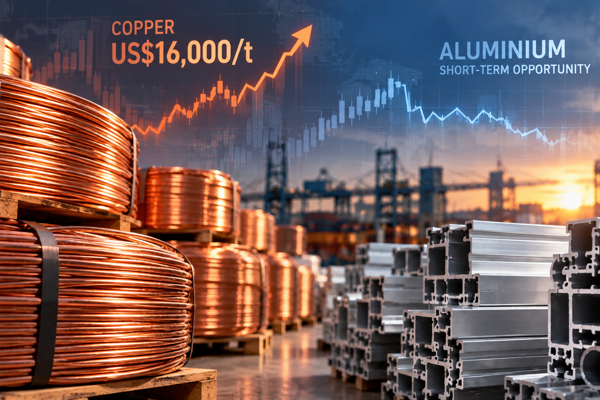
Copper could climb towards USD 16,000 per tonne over the next six to 12 months, while aluminium may offer a shorter-term trading opportunity following its recent correction, according to Navneet Damani, senior group vice-president and head of research for commodities and currency. Speaking on BusinessLine’s Trending Commodity Picks programme, Damani said copper continued to benefit from supply constraints and demand from emerging industries, while aluminium’s price trajectory had been influenced by fluctuations in energy costs and changing supply conditions. Damani said aluminium had climbed from around USD 3,100 to USD 3,600 per tonne earlier in 2026, supported by increases in electricity, crude oil and coal prices. The metal subsequently corrected towards USD 3,300 per tonne, although...
Chinese aluminium producers are planning a major expansion overseas, with at least 15 million tonnes per annum (MTPA) of new primary smelting capacity announced or planned across Southeast Asia, the Middle East, Central Asia and Africa. The expansion could push the global aluminium market into surplus , although tighter scrutiny from Beijing and concerns over project profitability may limit how much capacity is built. Around 2.85 MTPA of the planned capacity is already under construction or being brought into operation. This represents 3.8 per cent of the current global annual smelting capacity of 73.78 million tonnes. The new projects, combined with recovering aluminium output in the Middle East, are expected to change the global supply balance. Morgan Stanley forecast in July that the...
Grow with
AL Circle

According to the Shanghai Metals Market survey, China’s social inventory of aluminium ingots increased by 8,000 tonnes week-on-week and 10,000 tonnes from July 15, reaching 797,000 tonnes on July 18, of which the amount for sale stood at 671,000. Following the restocking mid-week, the current aluminium ingot inventory has reached a new high for H2, up 243,000 tonnes year-on-year. The incessant increase in inventory since early July, due to a production surge in May and June and weak demand due to the ongoing traditional off-season, has been exerting pressure on domestic prices, bringing them below the RMB 20,000 per tonne level. SMM expects the decline in domestic aluminium ingot inventory in July will be limited, likely fluctuating between 750,000 tonnes and 850,000 tonnes. On the other...

According to a Reuters update, some Japanese aluminium buyers have agreed to pay a 45 per cent higher shipment premium than previously agreed for the July-September quarter. In early July, some Japanese aluminium buyers agreed to pay only $118-119 per tonne of premium for the third quarter’s shipments . That was 36 to 37 per cent less than the premium of $185 to $190 per tonne offered by some global producers for Q3. However, in recent negotiations, Japanese buyers have raised their premium offers to $172 per tonne for the September quarter’s shipments, up 16 to 19 per cent from $145-148 per tonne paid in the April-June quarter but down from the initial offers of $175-190 per tonne made by global producers. The increase in Q3 shipment premiums could be attributed to tight supplies in Asia...

Brazil has reclaimed its position as a top ten player in the global aluminium industry, ramping up the production of primary aluminium and raw materials. Once, the country, which used to be the world's sixth largest aluminium producer, lost its momentum for an interim period and ranked 12th in 2022. However, in the subsequent year, Brazil's aluminium industry showed resurgence through advanced strategies and transformative initiatives in operations. Overview and analysis of primary aluminium production From the start of 2023, the Brazilian aluminium industry has been steadfast in raising domestic production with a strong focus on reducing reliance on imported products. The country successfully increased its primary aluminium production by 26 per cent to 1,021.7 thousand tonnes versus...

The aluminium associations of the United States, Europe, Canada, and Japan have approved a new report by the Organisation for Economic Cooperation and Development (OECD) titled "Quantifying the Role of State Enterprises in Industrial Subsidies." Highlights from the report The report highlighted that while state ownership alone is not inherently problematic, substantial evidence indicates that industrial subsidies, such as below-market financing, tend to rise with increased state ownership. Additionally, state enterprises are more likely to receive favourable treatment in competition rules, public procurement practices, and enforced technology transfers. As in previous work, the OECD emphasised that state enterprises are significant recipients of industrial subsidies. However, this report...

The previous trading day, the three-month LME aluminum contract opened at US$2,405.50 per tonne, reached a high of US$2,430 per tonne, a low of US$2,380 per tonne, and eventually closed at US$2,385.50 per tonne, down US$20 per tonne. It is the ninth day and counting, but the LME aluminium benchmark price shows no sign of improvement amid market surplus due to higher production and weaker demand. Over a week, the price experienced a sharp fall of US$93.50 per tonne. On July 18, the LME aluminium cash bid price shrank by US$ 28.50 per tonne, standing at US$2,334 per tonne, and the LME aluminium official settlement price contracted by US$28 per tonne to reach US$2,335 per tonne. The 3-month bid price and 3-month offer price also continued to decline, settling below the US$2,400 per tonne...

In its 25th edition of e-Magazine, AL Circle proudly presents "Advanced Industrial Technologies in the Aluminium Industry" . This milestone edition promises to delve deeper into the cutting-edge innovations and transformative technologies reshaping the aluminium sector globally. The e-Magazine serves as a forum for industry leaders, innovators, and experts to share their insights, strategies, and visions for the future of aluminium technology. From sustainable manufacturing practices to breakthroughs in recycling and smart production methods, each topic in the publication aims to equip professionals with knowledge essential for staying ahead in this dynamic field. For industry professionals seeking to navigate the complexities of modern aluminium technologies, AL Circle's e-Magazine...

In May 2024, upstream aluminium production (primary metal and alumina) scaled up across Europe, driven by higher profitability for producers due to increased aluminium prices. Throughout May, the aluminium benchmark price on the London Metal Exchange rallied by 5.19 per cent, reaching US$2,677 per tonne from US$2,545 per tonne on April 30. Overview of primary aluminium production According to the International Aluminium Institute, primary aluminium production in both Western & Central Europe and Russia & Eastern Europe saw a significant month-on-month increase. While the production in Western & Central Europe saw a hike of 4.42 per cent to 236,000 tonnes, the output in Russia & Central Europe experienced an increase of 3.88 per cent to 348,000 tonnes. On an annual basis, Western & Central...

Spot prices for ADC12 aluminium alloy ingots (non-OEM) in Delhi NCR and Chennai remained steady week-over-week, with only a slight decline, according to BigMint's latest assessment. In the Delhi-NCR region, ADC12 spot prices were recorded at INR 212,000 per tonne ex-Delhi, matching the domestic Tense scrap prices, which settled at INR 180,000 per tonne ex-Delhi. Similarly, ADC12 prices were noted at INR 214,500 per tonne in Chennai on an immediate payment basis, excluding GST. Concurrently, casting scrap prices were INR 181,000 per tonne ex-Chennai. The current spread between Tense and ADC12 spot levels is INR 29,000-30,000 per tonne. Major automaker adjusts ADC12 prices India's leading automobile manufacturer has set the ADC12 August settlement prices at INR 222,000 per tonne, a slight...

According to the US Geological Survey, domestic primary aluminium production in the United States trended down in April 2024, recording a month-on-month drop of 3.51 per cent and a year-on-year decline of 12.7 per cent. Source: USGS The data from USGS indicates that the Y-o-Y drop in full-month output resulted from a dip in daily average production during April 2024, reaching 1,850 tonnes versus 2,100 tonnes in April 2023. However, on a month-on-month basis, the daily output in April mainly remained unchanged compared to 1,840 tonnes. The United States’ full-month primary aluminium production in April stood at 55,000 tonnes, compared to 57,000 tonnes in March 2024 and 63,000 tonnes in April 2023, reinforcing growing reliance on secondary aluminium sourced from scrap for producing end-user...

The previous trading day, LME aluminium opened at US$2,415.5 per tonne, reached a high of US$2,424 per tonne and a low of US$2,397 per tonne, and closed at US$2,405.5 per tonne, down US$10.5 per tonne, a decrease of 0.43 per cent. On Wednesday, July 17, both LME aluminium cash bid price and LME aluminium official settlement price went down by US$5 per tonne or 0.21 per cent and US$14 per tonne or 0.58 per cent to settle at US$2,362.50 per tonne and US$2,363 per tonne. As per the LME price graph, both 3-month bid price and 3-month offer price slumped by US$18 per tonne or 0.73 per cent to clock at US$2,418 per tonne and US$2,418.50 per tonne. December 25 bid price and December 25 offer price slipped by US$15 per tonne or 0.57 per cent to dock at US$2,577 per tonne and US$2,582 per tonne....

Hong Leong Investment Bank (HLIB) reportedly expects Press Metal Aluminium Holdings Bhd’s core earnings to increase by up to 20 per cent Q-o-Q and 60 per cent Y-o-Y in the second quarter of CY2024, led by higher prices of the metal. According to Hong Leong’s projection, the company’s Q2 earnings will range between RM480 million and RM500 million, resulting in the first half’s earnings surging by 51 per cent to RM897-RM917 million. This positive forecast is based on robust prices of global aluminium on LME, especially during the end of May, reaching RMB 2,677 per tonne on May 31, said HLIB, maintaining a “buy” call on Press Metal with an unchanged target price of RM6.51. Supported by the strong aluminium prices, HLIB considers Press Metal’s risk and reward profile favourable and is set to...

The previous trading day, LME aluminium opened at US$2,461 per tonne, reached a high of US$2,462 per tonne and a low of US$2,403 per tonne, and closed at US$2,416 per tonne, down US$44 per tonne, a decrease of 1.79 per cent. As per the reports on Tuesday, aluminium prices dropped to their lowest point in over three month due to concerns about oversupply. On the same day, both LME aluminium cash bid price and LME aluminium official settlement price contracted by US$27 per tonne or 1.12 per cent to settle at US$2,367.50 per tonne and US$2,377 per tonne. 3-month bid price and 3-month offer price slumped by US$31 per tonne or 1.25 per cent and US$31.5 per tonne or 1.27 per cent to clock at US$2,436 per tonne and US$2,436.50 per tonne. December 25 bid price and December 25 offer price also...

On July 16, 2024, Rio Tinto announced its second-quarter production results, indicating growth in its aluminium and bauxite operations. According to Rio's quarterly report, aluminium production in Q2 stood at 824,000 tonnes, experiencing a 1 per cent growth Y-o-Y, owing to stable performance at all its smelters during the period. The steady sequential growth in Q2 aluminium production led to a 3 per cent rise in Rio's total aluminium output in six months, reaching 1.65 million tonnes. In Q2, ended June 30, Rio Tinto announced that its New Zealand Aluminium Smelters (NZAS) secured a 20-year power contract for the Tiwai Point Aluminium Smelter to enable it to continue producing high-purity, low-carbon metal, backed by renewable electricity. This arrangement is expected to further boost Rio...

On July 16, 2024, Emirates Global Aluminium (EGA) marked a significant milestone by completing the design phase for its cutting-edge smelting technology, EX. This innovation represents a leap forward from EGA's DX+ Ultra technology, which is known for its efficiency in the global aluminium sector. The EX-reduction cells, larger than the DX+ Ultra, promise enhanced capabilities with increased amperage and improved current efficiency. This advancement is expected to boost production capacity by up to 22 per cent, underscoring EGA's commitment to pushing the boundaries of aluminium production. Designed with versatility in mind, EX offers two distinct variants: one prioritising productivity and the other aiming to minimise greenhouse gas emissions. This adaptability reassures stakeholders...

On Monday, July 15, LME aluminum opened at US$2,479.50 per tonne, hit a high of US$2,489.50 per tonne, a low of US$2,458 per tonne, and closed at US$2,460 per tonne, down by 1.18 per cent. LME aluminium cash bid price and LME aluminium official settlement price further decreased, marking the sixth consecutive day of fall. While the former descended by US$17.50 per tonne to settle at US$2,403.50 per tonne, the latter shrank by US$18 per tonne to US$2,404 per tonne. On a week-on-week calculation, the LME aluminium benchmark price shed off a substantial amount of US$71.50 per tonne, and on a month-on-month basis, the price suffered a loss of about US$61.50 per tonne, according to the LME graph. The continuous loss in LME aluminium benchmark price is attributed to the growing rise of...

According to data from the National Bureau of Statistics (NBS), in June, China's primary aluminium production soared to its highest level in nearly a decade. The first half of the year (H1) saw a 7 per cent increase as producers boosted output amid rising profits. China, a dominant force in the global aluminium market, has once again demonstrated its leadership. The country, which holds the title of the world's leading aluminium producer, churned out a staggering 3.67 million tonnes of primary aluminium in June. This marked a 6.2 per cent year-on-year surge and set a new record for the highest monthly production since November 2014, according to Reuters data. According to a report by Shanghai Metals Market, last month, China's northern region of Inner Mongolia expanded its capacity, and...

The previous trading day, LME aluminium opened at US$2,481 per tonne, reached a high of US$2,489.5 per tonne, a low of US$2,465 per tonne, and closed at US$2,489.5 per tonne, up US$13 per tonne, an increase of 0.52 per cent. On Friday, July 12, both LME aluminium cash bid price and LME aluminium official settlement price dropped by US$7 per tonne or 0.28 per cent and US$6.5 per tonne or 0.26 per cent. The prices stood at US$2,421 per tonne and US$2,422 per tonne. The LME aluminium benchmark price also witnessed a W-o-W decline of US$73 per tonne or 2.94 per cent from US$2,495.5 per tonne. As per the LME price graph, 3-month bid price and 3-month offer price also slumped by US$7 per tonne or 0.28 per cent and US$6.5 per tonne or 0.26 per cent to dock at US$2,483 per tonne and US$2,484 per...

This week, the upstream aluminium sector took centre stage, featuring numerous significant developments in price front, production, international trade policy, project clearance, and investment. The continuous price fall on the Shanghai Metals Market and London Metal Exchange throughout the week stemming from sluggish demand created sensation in the industry, in addition to an additional 10 per cent tariff announcement by the US President on Chinese aluminium and steel imports via Mexico that took the metal industry by storm. According to SMM, China’s domestic A00 aluminium ingot price shed off RMB 270 per tonne this week, settling at RMB 20,000 per tonne. Although the price recorded intermittent growth on July 9, marking a week-on-week increase of RMB 90 per tonne, it stood lower at the...