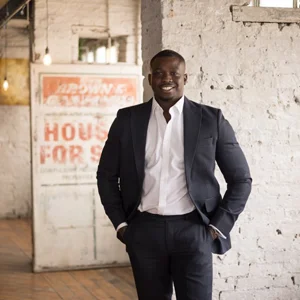
“We plan to offer more secondary aluminium to OEMs and traders in the European market in a bid to increase the total recycled content in machinery, products, and manufacturing,” Raymond Onovwigun, CEO & founder of Romco Group
- Category
- Interview
- Date
- Source
- AlCircle.com
Raymond Onovwigun is the CEO & founder of Romco Group. As a serial entrepreneur, Raymond has successfully built Romco as the fastest-growing green aluminium producer in West Africa. Romco is now a big part of a recycling effort to help build Africa into a powerhouse of sustainability.
Starting with just one small can baler 5 years ago, Raymond’s vision has seen Romco now operate over three continents, producing from over four countries and having an annual turn over of US$29.4 million in 2021.
Romco has over 350 employees and projects to have 500 more within a year. It plans to ship recycled metals from all coasts of the African continent — greatly reducing the need for mining and burning coal to produce aluminium everywhere.
To know his views and opinions on the European aluminium industry, please continue reading the interview.
AlCircle: Being a recycler, do you think increasing the practice of recycling would be advisable to restrain energy costs in Europe as recycling consumes less power?
Raymond Onovwigun: Demand increases prices, as does a shortfall of supply. These two forces are being experienced right now for a range of commodities, especially aluminium. Increasing secondary supply is one of the only available mitigators to increased energy costs and tightening supplies. That said, the answer isn’t simple in the short-term. Solutions need to found abroad in markets that are ready for scaling secondary production.
AlCircle: Having a presence in the United Kingdom, are you facing any hazards in your business due to the ongoing geo-political crisis in Europe?
Raymond Onovwigun: our model is well placed to resist the current turbulence being experienced in the marketplace. We are headquartered in London, with the bulk of our operations in West Africa. As a result, we have experienced relatively less turbulence, other than minor transportation issues over the past few years which have been commonplace across the industry.
AlCircle: Over 90% of aluminium is recycled in the European automotive and building sectors compared with 75% in cans. Do you plan to increase the recycling rate in the latter end-use industry?
Raymond Onovwigun: Our plans are to boost recycling output from the emerging markets and send the castable product to Europe, rather than from just within Europe. In the regions we operate in, mainly the African Continent, it is estimated only 4% of total goods are recycled, and 13% of recyclable goods. We plan to have a direct positive influence on this number over the next five to ten years, benefiting the European market with its ambition to de-carbonise.
AlCircle: How do you plan to ramp up the practice of recycling in Europe this year?
Raymond Onovwigun: We plan to offer more low-carbon secondary aluminium to OEMs and traders in the European market in a bid to decrease the scope 1 and 2 emissions in production and manufacturing — increasing the total recycled content in the EU supply chain. As taxes and prices increase on carbon, including on the emissions inherent in the supplies Europe imports moving forward, we are actively increasing our secondary low-carbon green supply of aluminium to ensure European manufacturers can source low-carbon, high-quality aluminium, sourced sustainably and ethically.
AlCircle: Could you please brief us your investment plans in Europe, if any?
Raymond Onovwigun: We will simply not achieve our climate ambition goals without significant investment in secondary infrastructure. Our investment plans in Europe are to significantly expand our UK recycling enterprise, offering not just more low-carbon aluminium alloys to the European market, but other green non-ferrous metals and recycled rare earths from E-Waste.
AlCircle: How do you plan to contribute to the European Union’s new Circular Economy Action Plan and the EU’s objectives to reduce CO2 emissions with a focus on recycling?
Raymond Onovwigun: Romco will significantly contribute to the European Union’s new Circular Economy Action Plan and the EU’s objectives to reduce CO2 emissions with a focus on recycling by offering low-carbon, green aluminium, to the European OEM market.
One often overlooked aspect of the emissions and energy usage argument is what emissions in the supplies organisations use, as opposed to just counting the emissions in the production process. The EU are recognising this and making moves to price the carbon content of imports. Change is coming, and we are ahead of that change.
Primary aluminium production relies heavily on coal powered energy use, responsible for 3% of the total global energy bill and 2% of human-made carbon emissions. Romco are expanding secondary production of aluminium, reducing the total demand for energy and carbon emissions of the goods by up to 95%, meaning that European organisations can purchase more recycled aluminium that has been produced with 20 times less carbon emissions and energy usage than before. It is also infinitely recyclable, and a textbook example of circular economics.

