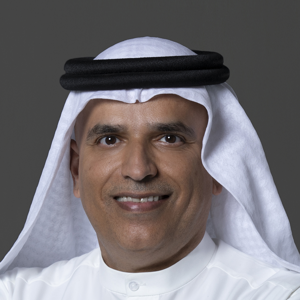
“The immediate outlook for aluminium remains under some pressure due to its close correlation to the health of the global economy,” Abdulnasser Bin Kalban, CEO of Emirates Global Aluminium (EGA)
- Category
- Interview
- Date
- Source
- AlCircle.com
- Edited By
- Abdulnasser Bin Kalban, CEO of Emirates Global Aluminium (EGA)
AlCircle: Could you please briefly tell us about EGA's performance and growth in 2022?
Abdulnasser Bin Kalban: Last year was another extraordinary one for our industry. At EGA, we delivered our best-ever financial results by focusing throughout the year on what we control – the safety of our people, operational excellence, our costs, and our commercial relationships with our long-term global customers.
We achieved production records at every step of our value chain.
Cast metal sales were up seven per cent to 2.72 million tonnes. Some 78% of our sales were value-added products or ‘premium aluminium’.
Hot metal production was recorded at 2.65 million tonnes. During the year, we surpassed 40 million tonnes of hot metal produced since the start-up of Jebel Ali in 1979.
Alumina production at the Al Taweelah alumina refinery was a record 2.43 million tonnes and met 47% of our total alumina needs.
Bauxite exports from Guinea were up 16% to a record 14 million wet metric tonnes.
AlCircle: What is your outlook for the aluminium industry in 2023 and the future in general?
Abdulnasser Bin Kalban: First of all, our performance last year demonstrated our resilience throughout the economic cycle. I am confident that EGA will continue to deliver another competitive performance in 2023 compared to peers in the sector.
The immediate outlook for aluminium remains under some pressure due to its close correlation to the health of the global economy. More broadly, the prospects for EGA and our sector are very strong due to aluminium’s role in decarbonisation economy-wide. EGA will capitalise on this significant opportunity.
AlCircle: In addition to the planned recycling facility and the bauxite residue pilot plant announced last year, what other initiatives has EGA undertaken to promote the circular economy in the UAE?
Abdulnasser Bin Kalban: Aluminium’s infinite recyclability is a key reason our material is essential to the development of a more sustainable society. Secondary metal is clearly a growth area for our industry and for EGA. Last year we announced our plan to build the UAE’s largest aluminium recycling facility. We have made good progress with feasibility studies and should have more to say about this soon.
We are also working with partners in waste management, can-making and beverage production to promote a culture of aluminium recycling in the UAE. Segregating waste is quite advanced in the UAE, but there is still room for consumers to play their part more effectively. Too much aluminium is thrown away and then needs to be found for recycling within the waste management system.
There are also circular economy opportunities in the management of our waste. In 2022, EGA supplied 203,000 tonnes of waste as feedstock to other industries, doubling our volume from 2021 as industries recovered from COVID-19. We have been collaborating with UAE industries for over a decade to find productive uses for by-products from aluminium production, such as spent pot lining.
I am also excited about our work on bauxite residue. Our goal is to find productive uses for this material within the UAE. We have a dedicated team of scientists working on this and have developed some breakthrough solutions. Just one of these is to reuse bauxite residue in soil products. The UAE imports a lot of soil, which is a non-renewable resource. Our game-changing process converts bauxite residue in its entirety in hours into an environmentally-benign, plant-friendly soil. We are working on upscaling this process now.
AlCircle: In 2021, EGA became the first company globally to produce aluminium commercially using solar energy, marketing it under the product name CelestiAL. What are the latest updates and developments on CelestiAL? What other initiatives did you take in 2022 to advance the industry’s decarbonization?
Abdulnasser Bin Kalban: We produced 57 thousand tonnes of CelestiAL solar aluminium last year, an increase from nearly 39 thousand tonnes in 2021. BMW Group is our largest customer. During the year, we announced additional CelestiAL sales agreements with tier-1 suppliers of Mercedes-Benz and Nissan.
Demand for CelestiAL is high, and we could sell much more. We are working on a strategic initiative to divest our natural gas-fired power plants, and instead source the electricity we need from the grid, including an increasing proportion of clean energy. This was allowing us to vastly increase our production of CelestiAL and is a major step in our decarbonisation trajectory.
We recognise that decarbonisation is our essential challenge, and as a major UAE company we are in full support of the UAE’s Net Zero by 2050 Strategic Initiative. My role as CEO is to ensure that EGA is as successful for the next 40 years as it has been for the last four decades.
We have developed a road map to decarbonise by 2050, engaging both internal and external engineers, technologists and economists. We are also active members of the International Aluminium Institute, which has developed greenhouse gas reduction pathways for our industry as a whole, and we have endorsed the Mission Possible Partnerships roadmap for the aluminium sector.

