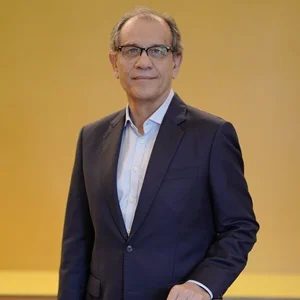
"The Aluminium business from The GCC perspective." Mahmood Dailami, Secretary General of the Gulf Aluminium Council (GAC)
- Category
- Interview
- Date
- Source
- AlCircle.com
AL Circle: The world is likely to surpass a dangerous temperature threshold within the next ten years unless countries transition away from fossil fuels. GCC countries are currently using gas as a source of energy. How do you foresee the situation developing?
Mr. Mahmood Dailami: Looking around, emissions reduction plans by most governments are falling short, and if the situation continues, the world will reach 2.8C degrees by 2100.
We can reverse the trend by reducing the use of fossil fuels and helping developing nations develop their renewable energy facilities and infrastructure.
The European Union is pressing Africa, India, and other countries to stop using Coal and wants the GCC to halt any new oil and gas exploration projects. If they do, these countries will commit economic suicides; if they don't, they will pay Carbon tax such as CBAM.
Meanwhile, the trend in the Western developed countries is the opposite.
The U.S. government approved a new Arctic drilling project expected to produce oil for the next 30 years. Germany has extended the coal-firing plants, and the U.K. gave the go-ahead to the first new coal mine in 30 years and is giving a licence to drill in the North Sea for oil and gas.
These countries that are the biggest polluters can continue or delay taking action because of necessity.
The facts are that fossil fuel currently produces more than 80% of the world's Energy, and Coal makes a third of the world's electricity.
Undoubtedly, the world needs more renewable Energy, but the transition will take much longer than people think.
The production of fossil fuel will be reduced, and it should be, but it will be an illusion if we assume it will be stopped.
The reality is that, we should embrace an energy transition that includes all energy sources.
While we need to increase renewable energy use to achieve the carbon neutrality target by 2050, we need technologies such as carbon capture and other technologies at affordable cost. Above all, we need cooperation and financial assistance for countries that cannot change independently—a proposition that is talked about frequently, but very little has been done so far.
The GCC countries are increasing the use of renewable Energy and working on carbon capture and hydrogen technologies as part and parcel of the transition.
AL Circle: What are the GCC aluminium producers doing on their part?
Mr. Mahmood Dailami: EGA is the first to produce Aluminium using solar Energy from one of the world's largest renewable energy projects. Solar Energy will enable the production of 50,000 tonnes of Aluminium in 2023, with scope for expansion in the future.
EGA would also access clean Energy from nuclear power plants for additional low-carbon aluminium products and explore hydrogen as a fuel and carbon capture, utilisation, and storage solutions.
Meanwhile, the new 600-megawatt power block will lower NOx emissions by 58 per cent, equivalent to removing more than 850,000 cars from the roads.
Additionally, EGA started building 150,000-tonne capacity aluminium post-consumer recycling facilities, and Production ramp-up could begin as early as 2025.
Alba has installed a 6MW solar panels project covering an approximate surface area of 37,000 sq., and it is expanding Power Station 5 by adding 680.9 megawatts (M.W.) Combined Cycle Gas Turbine Power Block that can use up to 30% hydrogen fuel by volume to reach 100% hydrogen fuel in the future.
Ma'aden with Gulf Cryo is to set up a carbon capture plant in the Kingdom. The partnership aims to reduce carbon emissions while providing a clean CO2 source for industrial gas applications in the Kingdom, creating a domestic circular carbon economy.
Also, MA'ADEN AND GLASSPOINT TO DEVELOP THE WORLDS LARGEST SOLAR PROCESS STEAM PLANT AT MA'ADENS ALUMINA REFINERY
The 1,500 MW solar steam facility will reduce carbon emissions by over 600,000 tonnes annually, representing a more than 50 per cent reduction of the carbon footprint in Ma'aden's Alumina refinery.
They are also expanding its recycling facilities.
Ma'aden, in collaboration with partner Zeeco, has launched the Ultra Low NOx Burner Replacement Project. This initiative aims to reduce NOx emissions from existing boilers by 77%, targeting emissions as low as 15 ng/J -
Qatalum and G.E. completed a Power generation upgrade to improve efficiency and reduce emissions.
Sohar Alumnium completed a full review and developed action plans to reduce emissions.
Balexco plans to build solar plant facilities generating around 30% of its total electricity needs.
Garmco completed its US$ 50 million Project by installing three new remelting furnaces to recycle post-consumer Aluminium.
These are examples of practical projects that have been implemented and other projects that are in the pipeline.
AL Circle: what are the technical, political and trade challenges facing the GCC aluminium industry?
Mr. Mahmood Dailami: Technically and operationally, The GCC aluminium Producers are as good as possible. Several internal projects are aiming to upgrade the existing technologies. All the smelters operate at 100 per cent capacity; similarly, the downstreams too.
GGC producers are considered internationally as efficient and reliable sources of aluminium of high quality.
However, as a vital region for the world economy and a significant supplier of oil and Gas and Aluminium, the external environment impacts the region's economy.
After three years of the war in Ukraine, no good outcome exists. Neither side can win, nor can either afford to lose. For the rest, there is always a danger of the conflict escalating. We cannot predict how Russia may react if Ukrainians make a breakthrough on the battlefield.
What would be the implications for the rest of the world?
The war will disrupt global energy, food, fertiliser, and other supplies.
AL Circle: What about the world Trade issues?
Mr. Mahmood Dailami: For the last few decades, a broad international consensus has supported globalisation that has helped countries compete and enter the global market, attract investments, and grow.
Countries were lowering tariffs, removing barriers, harmonising rules, and seeking win-win economic cooperation. The World Trade Organisation (WTO) was functioning as an arbitrator in case of violations of trade regulations.
Now, things have changed. Countries no longer talk about trade as a win-win. They impose restrictions on imports or exports, and the WTO is ineffective. Countries don't trust each other to play by the rules, and we are heading towards a world where protectionism is supreme and trade rules are secondary.
A stable, well-functioning international trading system is vital for the Middle East, Africa and Asia. A decoupling of the world economy will undo what has taken countries decades to achieve.
The breakdown of the global trading system will increase uncertainty, slow growth, and disrupt industries, jobs, and businesses.
In short, we have an unprecedented climate challenge, a hot war in Europe, hostility between two superpowers, and protectionism undermining the foundations of the multilateral trading system.
These four crises will trigger changes, severely disrupting the world.
Alucirle: What would the GCC Aluminium Producers do in such a troubled environment?
Dailami: In the GCC, there is a renewed focus on the need for a sustained effort to mobilise the economy, a readiness to take risks, a passionate vision of the future, and a willingness to make the adjustments required by modernisation.
It will be challenging. After all, we depend on our ability to do business with the world. Our strategy is to increase our efforts to remain open for business and connected to the world and continue as global players with modern infrastructure and effective international hubs.
We are under no illusion and recognise that we must make the right decisions to continue thriving.
We must do things more competently and efficiently. We have to work harder and smarter than before. We must manage the problems and deal with the trade-offs carefully and sensibly.
This means continually upgrading existing capabilities, building new ones, and transforming and restructuring our economy to keep up with technologies and industries.
Our businesses must adapt, transform, develop operating methods, and open new markets to respond to A.I. and other technologies. Our workers need to learn new skills to do the jobs that will be required.
It will be challenging – we will feel tensions and experience disruptions.
All are doable. We are in a region with a young population with big hearts and aspirations.

