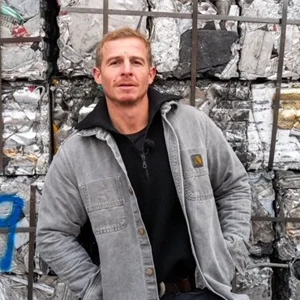
"Respect for the environment embodies the Hu'chu philosophy and my personal story," Daniel Roesner, CEO at Hu'chu GmbH
- Category
- Interview
- Date
- Source
- AlCircle.com
An actor, film producer and environmental entrepreneur, Daniel Roesner is an innovative leader and the CEO of Hu'chu 55, a company known for its sustainable catamaran projects. With a vision rooted deeply in environmental stewardship and cutting-edge technology, Roesner has guided Hu'chu 55 to the forefront of eco-friendly marine transportation. His commitment to sustainability is reflected in the company’s flagship project, the Hu'chu 55 catamaran, designed to minimise environmental impact while maximising efficiency and comfort.
In addition to his role at Hu'chu 55, Roesner is an advocate for sustainable practices across various sectors, often speaking at industry events and contributing to discussions on the future of green technology. His work continues to inspire others in the industry to pursue innovation with a focus on sustainability.
AL Circle: Sir, you are an actor and a visionary film producer. What propelled you to take this leap from the silver screen to the high seas and start Hu'chu?
Daniel Roesner: I still love the silver screen and all the work involved in making movies. But since my early twenties, I spent any free moment I had in our world’s oceans. Saltwater has become my home, the place I miss whenever I am not in it, and It has given me an identity and made me the man I am today. For more than half of my life, I have been the guy with blond surfer hair who always has a bit of salt on his skin. Since early on, I have envisioned combining my love for the sea with making movies and constantly living on the water while contributing to environmental work.
I envisioned a platform where all that could be combined, but I couldn’t imagine doing so with an ordinary fibre composite boat that would not find any place in a recycling chain and leak microplastics and toxins into my beloved ocean while I was on it. That’s what made me dream up the Hu’chu.
AL Circle: What is behind the name - Hu'chu?
Daniel Roesner: Respect for the environment embodies the Hu'chu philosophy and my personal story. It's a term I coined and pays homage to two locations that shaped my fundamental attitude towards life.
'Hu' is the abbreviation for where I grew up, Hunsrueck in Germany. This land has a long and historic tradition of producing natural materials such as wood, flax, linen, and hemp. 'Chu' refers to a spot north of Malibu, California, where I got in touch with the ocean and discovered one of my passions: surfing. This area used to and still should belong to the Chumash Indians, a native tribe that has a strong spiritual bond with their environment, especially the ocean, a connection that resonates in "Hu'chu". The word stands for the land and its natural materials in combination with the ocean. It is also a reminder that a lot of the answers for a truly sustainable future lie in old knowledge and tradition. The respectful combination of past and future, nature and technology, senseful, holistic thinking and manufacturing will make a true impact.
AL Circle: How was your experience working with Speira? What challenges did you face during this process, and how did you overcome them?
Daniel Roesner: I have to say that the collaboration with Speira is absolutely wonderful, and I hope it will continue for many years. The level of commitment, on the one hand, to their existing products and partners, as well as to new products, ideas and innovations, is like no other.
There was a lot of mutual interest in promoting the importance of aluminium in shipbuilding as a truly circular solution compared to any other materials, especially non-recyclable standard fibre composites. The challenge was creating motivation, doing the enormous work, following my vision, and making the Hu’chu catamaran from only scrap metal and no virgin material. There was amazing support from Reinhard Pritzlaff and his whole amazing team to accept the challenge and pull it off. Everybody along the way told me it is impossible to make over 90 per cent mixed scrap-based aluminium without using virgin material. Well, Speira and especially all the wonderful and skilful workers did it, and I am more than thankful, blown away and honoured that my wild dream was turned into reality! Everything is possible; you need a vision, full dedication and people with know-how and motivation who believe in you!
AL Circle: What made you choose aluminium for this project? Is it only the sustainability factor or anything else?
Daniel Roesner: The biggest factor is definitely that once in the form of aluminium, it can endlessly be recycled. With aluminium, we can literally go from scraps to brand-new shining boats, and the scraps we produce during the process can turn into a can or a brand-new boat again. However, there is another big factor that made me choose aluminium for the catamaran. I have always loved the shiny old aeroplanes, cars and airstream Campers from the 60s and 70s. Timeless design in shiny silver, combined with wood and brown leather, has always triggered my excitement. So, to build with this beautiful and timeless material is also a design choice. Lastly, there is the very important aspect of safety at sea. Aluminium is way more impact-resistant than fibre composites, and in the case of a collision with an object, our material will give us the support we need.
AL Circle: How do you see this project influencing others in terms of sustainable living and ocean conservation?
Daniel Roesner: Inspire with fun, curiosity, love and determination instead of the raised finger. I truly hope that others will be inspired to follow the path of truly understanding the impact of boats and life at sea. A lot of my ideas were influenced by fantastic sustainable ingenuity and projects that actually made life in general and at sea much more environmentally friendly. As I will not take no for an answer and will be strict and rigorous about the sustainability and circularity aspects of the catamaran, I am sure people will follow and come up with innovative, sustainable ideas and concepts themselves. The most important thing is that the catamaran will be on the water, sailing the world and spreading the message! No greenwashing, no cutting corners and full honest transparency is the key. Maybe a few more people will understand that all the luxury we see in modern boats is not always what we need, want or should admire. Honest Sustainability, sometimes doing and having a bit less and putting some sweat into things is way more sexy.
AL Circle: Aside from aluminium, what other innovative solutions were implemented to ensure the catamaran is sustainable and ocean-friendly?
Daniel Roesner: To give the catamaran character, use second-life material and parts wherever possible and eliminate as many primary components as possible. Giving material and components a second life is fun, makes sense, and cuts Pollution, energy use, and CO2 emissions.
A bare metal exterior hull. No paints that will leak micro-plastics into the water, no chemicals of any kind on board that will leak into the water. Our commitment to sustainability extends to every aspect of life on board. From toothpaste to cleaning products, everything will be biodegradable. This is not just a choice but a mandatory practice for all guests on board, ensuring that our environmental impact is minimised at every turn.
The boat will utilise seawater to make cold, hot and sparkling drinking water of the highest quality without using plastic bottles on board. The sun, the wind, and hydropower will be utilised for living and working, and they will be partially propelled forward whenever the sails can’t be used. Wind is our most sustainable form of transportation power, it will be used whenever possible. Hull designed for speed.
Organic insulation to minimise the use of energy for heating/cooling. Understanding the importance of harnessing excess energy and reusing it for something else is part of the general philosophy. Muscle power is utilised to minimise the use of power tools or appliances. I don’t need luxury, I don’t need to be pampered, I love true and honest life that is a bit tougher and has grip. The Hu’chu will resemble precisely that. The boat garden will be the green heart of the catamaran, delivering fresh food grown at sea.
AL Circle: How do you envision the future of the aluminium industry in terms of sustainability in the coming years?
Daniel Roesner: I am sure that through higher energy costs, the importance of recycling will be greater than ever. I am envisioning the sole use of renewable energy in the production process. I believe a worldwide high standard of exhaust filtration should be introduced, as it is used in Germany. I hope that excess energy from renewable sources will be used to produce hydrogen to fuel the production and recycling processes. I hope that instead of endlessly producing brand new aluminium, which creates major environmental issues, “mining” already existing material from scraps and trash in the form of recycling will gain importance. I would love to see even more involvement in Aluminium recycling campaigns worldwide to make people understand the true value of this great material. Once people understand what we can do with aluminium and how valuable every beverage can and every piece of scrap is, not a single bit of this material will end up in another landfill or be lost. The aluminium industry can be the front-runner of truly circular products that can endlessly reform! Something a lot of other industries would dream of.
AL Circle: Is it true that the idea of this whole boatbuilding project was the outcome of an experiment with surfboards?
Daniel Roesner: That is absolutely true. I couldn't bear the thought that I, as a surfer, ocean lover, and an advocate for lowering our use of plastics, sit on a stick of petrochemical foam wrapped in toxic fibre resin composites. I needed to change that, build a board made of organic matter while lasting a lifetime. That is how the use of wood, natural fibres, and over 60% bio-based resins transformed the Hu'chu boards. As I see the same issues with boats, just on a bigger scale, I had to find better solutions and, this way, envision the Hu'chu catamaran.
AL Circle: What were some of the biggest challenges you faced in bringing the Hu’chu to life? What has been the most rewarding aspect of this project for you?
Daniel Roesner: Convincingly, people think it’s time to change something from the ground up, be strict on ourselves and take the risk of being the first at something. We still haven’t pulled off the construction of the Hu’chu catamaran. We have the aluminium, we have the plans and an excessive system planning, but the boat still needs to be built.
So far, the biggest challenge has been to find shipyards and partners who would go the extra mile, put a lot of extra work in, and not see the immediate financial return, all for the cause of making a massive sustainability statement. I also get doubt from aluminium boatsbuilders about the weldability, the strength, the corrosion resistance and the behaviour of our recycled aluminium. Our advantage is that all the amazing facts about aluminium are analysed, scientifically checked and certified by the people whose business aluminium is every day. Speira has an enormous team of scientists, engineers, and professionals who have already analysed the material and its molecular structure. All I can say is that there is absolutely no reason for doubt! Otherwise, I wouldn’t trust my or anybody’s life with it! The biggest success is, of course, the production of our super-low CO2 Aluminium!
AL Circle: If you could compare Hu’Chu’s journey to any of the movies you’ve worked on, which one would it be and why?
Daniel Roesner: To be honest, this project is not comparable to anything I have ever done before. The amount of work, passion, dedication, money, frustration, and overwhelming joy that went into it can not be put into words. But it comes from the heart; it is way beyond doing business or just having a bit of fun with something. If everything goes well, if the Hu’chu catamaran gets built like it is planned, then it is the best thing I have ever created.

