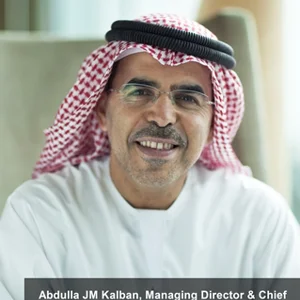
“Our niche focus on premium quality, value-added products places us in a strong position to cater to the projected sustained increase in global demand,” Abdulla J M Kalban (Managing Director & Chief Executive Officer of EGA)
- Category
- Interview
- Date
- Source
- AlCircle.com
AlCircle had the pleasure of meeting the team of Emirates Global Aluminium (“EGA”), one of the top aluminium producers in the world during the Aluminium Middle East 2015 Exhibition in Dubai. Abdulla J M Kalban (Managing Director & Chief Executive Officer of EGA) shared with AlCircle a few significant inputs on the business and the Middle East Aluminium Industry. He had been associated with DUBAL since 1985 leading the transformation of the business from a regional primary aluminium smelter into the world’s 5th largest primary producer. He is also the Chairman of the Gulf Aluminium Council and Chairman of the International Aluminium Institute.
Excerpts from the interview:
AlCircle: Please brief us on the history and objective behind the formation of Emirates Global Aluminium (“EGA”)
Abdulla Kalban: In June 2013, Mubadala Development Corporation of Abu Dhabi and Investment Corporation of Dubai announced the decision to form EGA by combining their respective aluminium industry assets.
EGA’s core operating assets are Dubai Aluminium (“DUBAL”, also known as EGA Jebel Ali) and Emirates Aluminium (“EMAL”, also known as EGA Al Taweelah), whose combined annual production capacity of 2.4 million tonnes per annum (“tpa”) places EGA among the top five primary aluminium producers in the world, by volume. The effective integration of DUBAL and EMAL into EGA meant that the new entity could be built on the legacy of excellence provided by the two businesses.
EGA also owns Guinea Alumina Corporation (“GAC”), a two-phased project commencing with the development of a bauxite mine in West Africa. In addition, EGA has plans for significant local growth and international expansion.
Establishing EGA was the first mega project to bring together the two most powerful emirates in the UAE – Abu Dhabi and Dubai – in a single global business. The strongest argument for the formation of EGA was the opportunity to leverage the synergistic strength in combining the existing assets and going beyond. Prior to the merger, the UAE’s midstream aluminium industry comprised the two separate single-site primary aluminium smelters – namely DUBAL and EMAL. The merger provided the catalyst to transform the businesses into a single, global champion that has immediately created a foundation for further growth.
AlCircle: Tell us in brief about EGA’s investments and projects in the primary and upstream segment.
Abdulla Kalban: In the primary aluminium sector, EGA’s core operating subsidiaries are DUBAL and EMAL:
- DUBAL, where commissioning began in 1979, operates one of the world’s largest single-site primary aluminium smelters. The DUBAL complex, built on a 4.75 square kilometre site in Jebel Ali, Dubai, comprises a 1 million tpa smelter, a 2,350 MW power station, a large carbon plant, extensive casting operations (more than 1.2 million tpa), a water desalination plant, dock and other facilities.
- EMAL, where commissioning began at the end of 2009, is the world’s largest single-site primary aluminium smelter. The EMAL complex, housed on a 6 square kilometre site in Al Taweelah, Abu Dhabi, comprises a 1.3 million tpa smelter, a 3,100 MW power station, a large carbon plant, extensive casting operations (more than 1.8 million tpa), a water desalination plant, dock and other facilities.
The combined DUBAL-EMAL portfolio comprises high quality primary aluminium products in three main categories: high purity and foundry re-melt products (for electronics and aerospace and automotive applications respectively); rolled products (for packaging, lithographic sheets and the automotive industry); and billets for extrusion and forging (for construction, industrial, transportation and automotive purposes). Busbars and anode bars are also made for the electrolytic process used to produce primary aluminium from alumina ore. Over 350 customers are served in at least 68 countries, predominantly in Asia, Europe, the MENA region and the Americas.
In the upstream aluminium sector, EGA has assets in the bauxite mining and alumina refining segments, with associated projects. The most active is Guinea Alumina Corporation (or “GAC”), a wholly EGA-owned mining development company that is currently focused on advancing a bauxite and alumina export project in the Republic of Guinea.
AlCircle: What are the long-term objectives that EGA would like to achieve in the UAE aluminium sector by 2020?
Abdulla Kalban: The five-year plan for EGA has several components, for example:Consolidation of our smelter operations, where good progress is being made in realising synergies.
- Implementing a massive capex plan (US$ 6 billion by 2020), which is designed to strengthen EGA’s position as one of the top five aluminium producers in the world and a global leader in the aluminium industry. The projects planned will reduce cost, improve environmental performance, enhance technologies and more – specific examples being the GAC Project; and various metal brownfield projects. Other opportunities are also under consideration, which could drive our overall capex programme to US$10 billion.
- Ongoing commitment to safety first and always and our target is ‘Zero harm to people and the environment’ (a TRIFR of 3.53 was achieved in 2014).
- Ongoing commitment to protecting the environment where we operate, evidenced by investing in best available technology. Our focus is on raw material optimisation, energy efficiency, emission and effluent control, and waste management. Benchmark performances to date include:
– Fluoride emissions: 0.352 kg/t Al in 2014
– PFC emissions: 0.082 t CO2eq/t Al in 2014
– 100% SPL recycling at Jebel Ali operations since 2012
- Ongoing investment in the social and economic environment in markets where we operate; sponsorship (social license to operate) of high-profile trade and sporting events regionally and internationally
AlCircle: EGA owns Guinea Alumina Corporation (“GAC”), a bauxite and alumina project in the Republic of Guinea. What is the strategy behind setting up this project?
Abdulla Kalban: EGA has stated its strategic intent is to secure raw materials, specifically in alumina and bauxite, as a fundamental requirement for the future security of our business. To produce over 2.5 million tonnes of metal per annum, we will consume about 5 million tonnes of alumina and 12 to 15 million tonnes of bauxite annually. This is the rationale behind our upstream aluminium interests in Guinea.
Guinea is home to about 7.4 billion tonnes of bauxite reserves (equivalent to 27 per cent of the world total). Moreover, Guinean bauxite is amongst the highest quality in the world – particularly in terms of high alumina grade and low silica levels – and is highly sought after by the international market. The GAC project concession is located in the Boké region of north-western Guinea at the heart of the country’s bauxite reserves and comprises a high quality, export grade bauxite deposit of 1.3 billion tonnes. The project will be implemented in two phases, the first involving a greenfield bauxite mine at Sangaredi, in the Boké region, Guinea where production is set to begin in 2017.
AlCircle: As we can see, the Middle East is slowly diversifying towards aluminium from oil and natural gas. Please brief us a little on this transformation.
Abdulla Kalban: Efforts to diversify the economies of the Middle East countries began in the 1970s, driven by two major incentives: (i) to reduce dependence on oil revenues; and (ii) to maximize the opportunities to add value to the oil and natural gas resources. The aluminium industry was identified as offering excellent prospects to achieve both aspirations. The front runner was Alba in Bahrain, followed by DUBAL in the UAE. Over the last six to seven years, the regional primary aluminium sector has expanded substantially through the addition of four new smelters: Sohar in Oman, EMAL in the UAE, Qatalum in Qatar, and Ma’aden in Saudi Arabia.
The six smelters in the GCC region collectively produced over 4.9 million tonnes of primary aluminium in 2014. This is set to rise in in 2015 to about 5.3 million tonnes – equivalent to 10 per cent of total world production.
AlCircle: What is your view on the future of aluminium industry in UAE?
Abdulla Kalban: The UAE aluminium industry has a bright future.
In the primary aluminium sector, EGA is the largest producer in the GCC while the UAE is the fourth largest primary aluminium producing country in the world. Our niche focus on premium quality, value-added products places us in a strong position to cater to the projected sustained increase in global demand (especially for value-added products); as well as to support the growing downstream sector in the UAE.
The downstream aluminium sector is already expanding quite rapidly, driven by local infrastructure development projects as well as increasing demand in international markets. The pro-active development of aluminium clusters – such as the cluster demarcated in Khalifa Industrial Zone Abu Dhabi (“KIZAD”) – will support the accelerated growth of this segment.
AlCircle: Will Middle East aluminium players invest only in the upstream sector and remain necessarily primary exporters or are they planning to invest in the downstream sector?
Abdulla Kalban: EGA’s interests are focused on primary aluminium and upstream projects in bauxite mining and alumina refining – which I will touch on shortly. We do not have downstream interests, but instead are committed to supporting the further development of the downstream aluminium industryin the UAE.
EGA’s commitment in this area is evident in our vision, which refers to our aspiration to build a legacy of excellence for the UAE. We will so by supporting the sustainable growth of the country’s entire aluminium industry. Our commitment is further spelt out in our mission statement, which includes two key statements:
- Delivering high performance aluminium to our customers; and
- Providing support for a broader aluminium cluster.
Our commitment to downstream industry is also listed among our core strategies and priorities, specifically a strategic decision to support the development of the UAE aluminium cluster. This has already borne fruit:
- Since inception, DUBAL and subsequently EMAL have provided 100 per cent of the UAE downstream industry’s primary aluminium requirements. Some 255,000 tonnes was provided to UAE customers in 2014 alone.
- EGA is actively engaged in the aluminium cluster development in KIZAD, where three downstream development projects have already been announced. EMAL is able to supply both cast and liquid metal to customers in KIZAD – the latter facilitated by a Liquid Metal Transfer facility at EMAL and the provision of a dedicated ‘hot metal road’ in the town-planning for KIZAD.
Disclaimer: “The information presented herein is not intended nor implied to be a substitute for professional advice. The views and opinions shared in the interview section of www.alcircle.com are unique to the interviewees and do not necessarily reflect the viewpoint of www.alcircle.com.”

