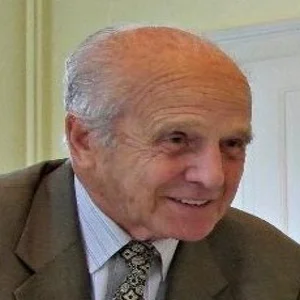
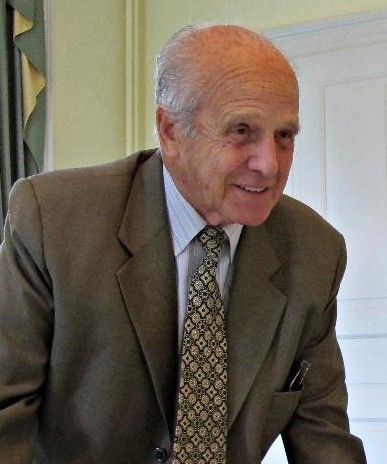
In conversation with Dr. Hans O Bohner, an aluminium industry legend since 1950
- Category
- Interview
- Date
- Source
- AlCircle.com
- Edited By
- Beethika Biswas
Born in Salzburg (Austria) in 1923, Dr Hans O Bohner is a name to reckon with in the global aluminium industry. A chemical engineer and a Ph. D. in Chemistry, his career spans from 1948 to 2014. Starting with Aluminiumwerk, Rorschach, Switzerland, his work with the aluminium sector took him to Canada, Germany, Norway, Iceland, UK, Russia, China, India and many more countries. He worked with some of the biggest names in the aluminium sector like Alcan, ALUSUISSE, Hindalco, Hydro Aluminium, Vedanta, Chinalco, Giulini, etc. He also offered his expertise in aluminium to top aluminium market research organizations like Metal Bulletin / CRU and with metal traders like Trafigura, Alaska Metals and Transworld. AlCircle feels privileged to publish the interview of an industry expert like Dr. Bohner on his birthday.
Here is an excerpt from the interview:
AlCircle: Your association with the aluminium industry goes back to as early as 1950. Please share with us your perspective on the changing scenario of the aluminium industry in last 60 years.
Dr. Bohner: There was no systematic technology in use in the beginning. The operational know-how was in the hands, or more precisely, in the brains of the General Foremen. Their Know-How was much superior to the theoretical knowledge of the engineers fresh from the universities. The thermal balance of the pot, the magnetic optimization of the bus bar configuration, the digital control of the pot voltage and the composition of the melt could not be scientifically calculated.
The notion of “superheat” was not common knowledge and “Superheat” could not be accurately measured until about four to five decades later.
Alumina was (except in North America) highly calcined, so-called “ floury “ which was a good Insulator for the pots allowing lower power consumption but had a low solution speed and not suitable for “ center breaking “and” point feeding”. The need for “sandy” alumina came with the hooding of pots and the so-called “dry absorption” which replaced the wet roof absorption.
Emissions of fluorides and of dust were not considered to be a serious problem and pot hoods were considered a luxury (except in North America and in France). Higher damage to surrounding flora and fauna due to increase of smelter capacity led to public intervention and need for lower limits of gaseous and solid emissions which could only be met by improved hooding design.
Pot life was generally limited to 1000 days. Pot life of over 3000 days could be realized only after the calculation of the thermal balance was carried out, the magnetic optimization was introduced and cathode preheating was optimized.
Last not least the current of the pots was limited to 100 – 120 kA in order to maintain current efficiencies between 85 to 88% at best.
Side breaking was carried out manually or by a pot operator - steered machines which meant high manning. Mechanization and automation were not urgent as wages and salaries were not yet the big cost factor as they are now in developed and even in developing countries.
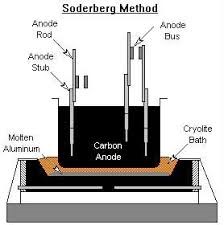
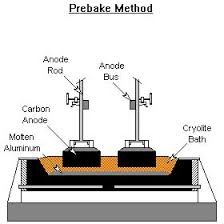
AlCircle: You have seen the primary aluminium smelting industry moving from Söderberg to Prebaked technology? What are the positive changes that you have observed in the smelting process over the years?
Dr. Bohner: The most positive effects were a massive reduction or even an elimination of fatal diseases like lung cancer, stomach and testicles cancers that were frequent among the smelter workers. Along with that, better efficiencies of fluoride and tar emissions led to practical elimination of damages to the surrounding environment.
With the use of technology the power consumption could be reduced by 0.6 to 0.9 MWh per tonne of aluminium due to Lower anode voltage drop.
Unfortunately the operational cost and investment increased substantially because baked anodes cost more than Söderberg paste. It also increases the cost by 10 % or more with the investment for rodding shop, for anode press and anode baking furnaces, or for purchasing from third parties.
AlCircle: What is your input on the frequent pot failure incidents taking place in smelters all over the world?
Dr. Bohner: The three most frequent causes for power failure in smelters are:
- Weak circuit with no reserves or one power supply line only
- Faulty design of power station
- Natural forces ( avalanches, wind forces ) destroy power supply lines
If the power supply stops for more than 3 to 5 hours then the bath freezes completely and the continuation of pot operation becomes impossible. It will then be necessary to remove frozen bath, frozen metal and anodes stuck in the bath. In some cases it becomes necessary to even dig out the cathode and install a new one, a very costly process.
There are some actions which will help to mitigate the loss caused by pot failure:
- Increase alumina cover to the maximum
- Stop all point feeders , all anode changing, all metal tapping
- Kill anode effects as fast as feasible, even kill them manually
- Remove every anode fallen off anode studs ( don’t let them sink into the metal pad )
- Measure stem current in as many pots as possible and remove/lift anodes with high ( + 30 % or more ) stem current
- After 1- 2 hours start pot tapping lowering metal pad level down to 4 -5 cm, filling sows if cast shop cannot take any more metal.
AlCircle: How best do you think can we save energy consumption in the primary smelting industry?
Dr. Bohner: Energy consumption can be reduced by either reducing the pot volt age and/or by increasing the current efficiency. The most efficient way is to incorporate magnetic optimization of the busbar- system purchasing it from a proven technology supplier (who can demonstrate the success). The reduction of the speed of the metal movement leads to reduced bath voltage and to higher (up to 8%) current efficiency.
Another proven way is to reduce the anode effect frequency to maximum one pot per month. At the same time it is possible to measure the” overheat” (bath temperature minus solidification temperature). Overheat should be adjusted to about 2 -3* C reducing or increasing ledges thus improving thermal balance and magnetic condition and side-freeze and freeze on the cathode surface. All these freezes have an undesirable influence on the magnetic optimization/current efficiency.
Additionally one can increase the AlF3 –content of the bath, again with positive influence on current efficiency. Finally one may increase the AlF3-content to 14 -15% in order to obtain a better current efficiency .This however requires frequent bath analysis and may have some risks in operation.
Another solution is to use graphite cathode to lower the resistance of the cathode. This method however has certain drawbacks:
- Increased investment cost
- Higher abrasion of graphite vs. amorphous carbon, possibly lower pot life
- Higher infiltration of sodium into cathode, possibly lower pot life
AlCircle: China at present produces about 54% of the total primary aluminum production in the world. What are your observations on the Chinese aluminium industry?
Dr. Bohner: The Chinese aluminum industry invests more in research than the majority of Western aluminium producers probably due to lower labour cost. They have another advantage that they can rely on a disciplined work force.
Furthermore they use their latest technology for each new Greenfield smelter which usually applies higher amperage pots. Therefore they keep up with the best Western Technology and arrive at a lower investment cost all the time. It seems that the Chinese aluminum capacity is not growing any more or at least, not in the same rate as in the past because they temporarily closed down most of the polluting smelters for about four months in wintertime resulting in a reduction of 15 % or more of its capacity. Additionally they have started to convert some of the “older” smelters to the latest and best technology which has the effect of continuous modernization.
It appears that they intend to reduce the surplus production in order to stabilize the domestic price of primary aluminum.
AlCircle: You have been associated with some of the top names in aluminum market research like Metal Bulletin / CRU and with metal traders like Trafigura, Alaska Metals and Transworld. What is your outlook for the global aluminum industry in the short and medium term?
Dr. Bohner: As outlined above it looks like that China has limited the growth of aluminum output for environmental reasons, price stability, and possibly to avoid exaggerated import-duties by the Western countries.
The aluminum industry is under pressure to eliminate thermal power supply especially in the (Arabic) Gulf area, in Australia, in China and India. Producer countries with plenty of hydro-electric power like Canada, Iceland, Norway and Siberia are in a safe position.
China and in part India could become less under pressure as thermal and nuclear power are still accepted there and new thermal and nuclear stations are still being built, using cleaner and safest possible technologies.
If aluminum from smelters with thermally generated power is slapped by importers with duties, there will be a possibility that some smelters must reduce their output drastically, with the consequence that smelters with hydroelectric power supply or sufficient nuclear power capacities will take up the loss in production.
The USA and Europe will depend more on imports in order to supply their large, efficient and innovative fabrication plants.
AlCircle: Aluminum majors around the world have curtailed primary aluminum capacity to bring down the inventory level and lift up the price of the metal. Recently China is embarking on a capacity reduction drive. Do you think this will balance the global aluminum market that has been oversupplied for years?
Dr. Bohner: In the short/medium term I think that there is a good chance of a more balanced market, but based on my experience in the past 50 to 60 years, such reasonable behavior of the large producers is certainly not going to last. Concerted action of the large producers as has happened in the years up to the 1930’s will not be permitted by antitrust laws and can therefore not be a solution to balance the market.
AlCircle: Which regions other than China according to you will drive the aluminum market in the coming years?
Dr. Bohner: India is rapidly expanding its primary aluminium production capacity by installing modern pot technology mainly from China. India’s economic advantage lies in the fact that they possess modern alumina plants fed by good quality locally mined bauxite mines and are mostly run privately and also abundant coal reserves.
Venezuela has surplus hydro power, good bauxite and modern alumina refineries and could be a serious driver in the primary aluminum market as soon as their impossible political situation could be normalized.
Brazil has both hydro potential and modern alumina refineries in the Amazonas region. Bauxite can be shipped by ocean vessels from Surinam and Guyana bauxite mines. They have a capable engineering force already working for the aluminum smelter.
Chile has no smelters yet but has the advantages of large hydro potential and stable political conditions.
The “Democratic “republic of Congo has plenty of hydro-electric sources, even a power station near the sea, but are not maintained. However a replacement with modern equipment is easy and can be done rapidly (I know the conditions personally well there). Disturbed political situation makes investment difficult there.
Vietnam, Indonesia, have plenty of Bauxite, Coal/Anthracite and quality manpower justifying investment in alumina, aluminium and thermal power to produce aluminium competitively to meet growing international demand.
Disclaimer: “The information presented herein is neither intended nor implied to be a substitute for professional advice. The views and opinions shared in the interview section of www.alcircle.com are unique to the interviewees and do not necessarily reflect the viewpoint of www.alcircle.com."

