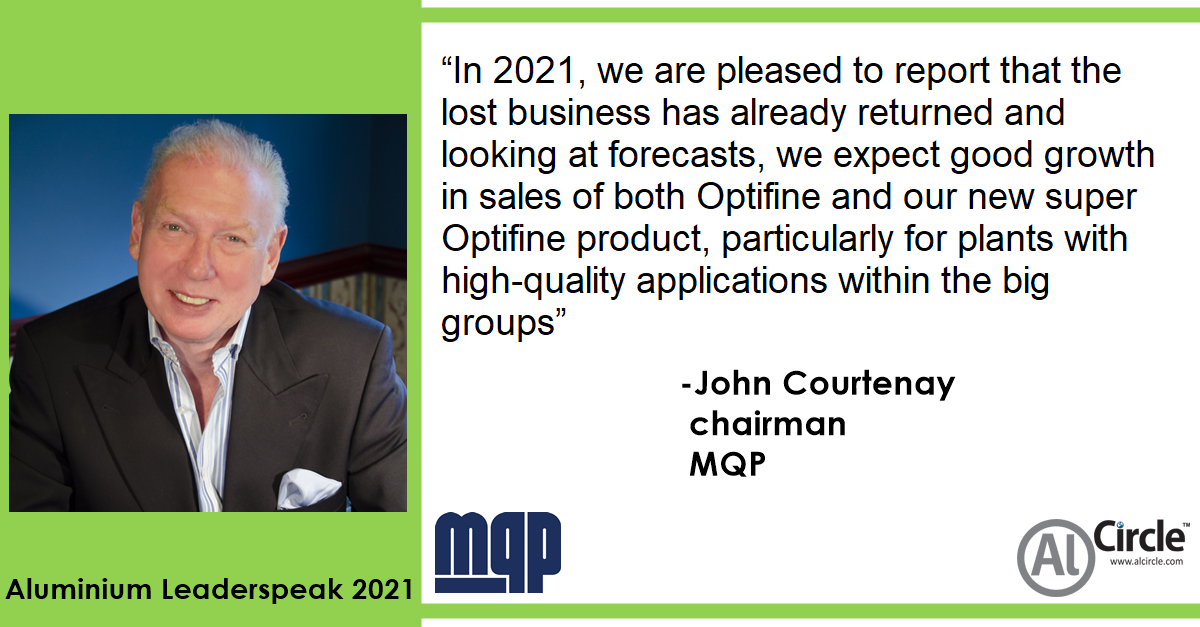
“In 2021, we are pleased to report that the lost business has already returned and looking at forecasts, we expect good growth in sales of both Optifine and our new super Optifine product, particularly for plants with high-quality applications within the big groups”, John Courtenay, chairman, MQP
_1788170597.291_md.webp)
- Category
- Interview
- Date
- Source
- AlCircle.com
John Courtenay is the Chairman of MQP, the leading specialist for the global aluminium industry and producer of high-efficiency grain refiner Optifine.
Studying metallurgy at the University of Aston, John Courtenay started at Foseco International, working his way through ONC, HNC and LIM, before being seconded to Foseco Canada for three years to work on an exciting new product for steel continuous casting plants, going onto hold several International marketing and technical positions before joining Foseco Japan as General Manager of their steel mills division, returning to Foseco International in 1983.
In 1986, he switched from steel to aluminium, starting a long association with aluminium casthouse technology as Director of Technology and marketing of Foseco Aluminium. After the sale of this business to Pyotek, he used his experience to form MQP Limited, which celebrated its 20th anniversary in 2020.
It was an amazing experience for us to get an interview from Mr John Courtenay and here goes his envision for the aluminium industry in 2021:
AlCircle: How do you figure on 2021 for the global aluminium industry after the worldwide economic impact due to the COVID-19 pandemic in 2020?
Mr John Courtenay: Looking at the stock markets, we get an idea of what the future might hold. The Dow Jones industrial average is up by 54% in the same period last year and up 9% in the first quarter of 2021, which is very promising.
And from what we are seeing, our customers are very busy, while our sales have returned to near pre-pandemic levels. So my forecast for the global aluminium industry in 2021 is positive, particularly for the automotive sector.
AlCircle: What new invention is MQP delivering to the aluminium industry in 2021?
Mr John Courtenay: The big deal for 2021 is the launch of our Optifine 5:1 125 TiBAl grain refiner, building on the success of our standard Optifine product, which can already consistently cut addition rates by 70% in a wide range of aluminium alloy compositions, helping eradicate unwanted surface blemishes and defects, and has been used to successfully cast over 16 million tonnes of aluminium since 2010.
Developed on the back of the research we’ve been doing with BCAST at Brunel University London, this new, improved version has a minimum efficiency of 120% and is 35% more powerful than the current Optifine.
The development of a new grain refiner with a minimum of 120% relative efficiency opens up the opportunity to further reduce both the addition rate and particle count compared to standard grain refiners by as much as 85%.
Reducing particles in the melt by 85% is hugely significant and Optifine 5:1 125 will be a game-changer for casthouses working to meet the demand for superior quality aluminium in the high specification segments.
AlCircle: Globally, the popularity of Electric Vehicle (EV) is on the rise, aluminium being the light metal will be on-demand. What is MQP’s role in this segment?
Mr John Courtenay: Many of our customers now incorporate the production of high specification body parts for electric vehicles into their operations, Optifine ensuring that the quality they need to meet manufacturers’ rising expectations is there. Our new, super-powerful version of Optifine will only strengthen this proposition and meet our customers’ needs head-on. This is particularly the case for big plants focussing on producing ABS.
AlCircle: Could you please brief us on the performance of MQP’s in 2020 and how do you project 2021?
Mr John Courtenay: I can say we weathered the storm, but like many companies, we did lose more than three months of sales, which was disappointing. Despite this, however, profits remain strong and we achieved a 12% return on sales for the year. In 2021, we are pleased to report that the lost business has already returned and looking at forecasts, we expect good growth in sales of both Optifine and our new super Optifine product, particularly for plants with high-quality applications within the big groups.
AlCircle: Can you share MQP’s journey and outcome on the major research collaboration with University’s Brunel Centre for Advanced Solidification Technology (BCAST)?
Mr John Courtenay: For the past year, we’ve been working with BCAST on a research project to investigate the relation between particle size distribution, Al3Ti layer formation and grain refiner efficiency. Examination at the atomic level by HR-TEM (High Resolution- Transmission Electron Microscopy) shows that a monoatomic Al3Ti layer forms on the TiB2 particles and this has paved the way for the development of our new Optifine 5:1 125 TiBAl grain refiner, which has 90% of TiB2 particles coated with the Al3Ti layer. This compares to standard grain refiner with only 50% efficiency, having less than 20% of TiB2 particles coated with the layer.”
AlCircle: What will be MQP’s key focus in terms of investment and expansion in 2021?
Mr John Courtenay: Our key focus will be establishing our exciting, new MQP Technology Centre at Brunel University London. It’s already up and running and being driven by our technical manager, Dr Shervin Tabrizi. We are also working with our parent company, STNM, to assist in the completion of the upgrade of their plant in Baoding, China, enabling them to double the production capacity of Optifine and the new 5:1 125 version.”
Alcircle: Which industrial sector, according to you, will drive the growth of aluminium in 2021?
Mr John Courtenay: Figures show that global demand for aluminium will increase by up to 80% by 2050 and, as we’ve mentioned earlier, the industrial sector driving this growth is the one making high-end products, from hoods and doors to full chassis, for electric vehicles.
Battery electric vehicles are expected to achieve more than a quarter of total car sales in about five years and reach up to half of the sales in about ten, with aluminium content expected to grow to 514lbs per vehicle by 2026, up by 12% from 2020 levels.
Through our continued R&D, we expect to play a significant part in this evolution.

