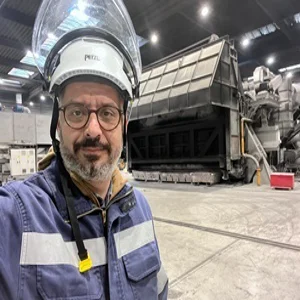
“I believe electric vehicles will drive the aluminium market. The other important point is about the recycling of aluminium. Aluminium recycling will increase in 2024 and continue to grow in the following years,” Dr.Emrah Fahri Ozdogru, Co-owner and General Manager of TRI Metalurji A.Ş
- Category
- Interview
- Date
- Source
- AlCircle.com
Dr. Emrah Fahri Ozdogru is Co-owner and General Manager of TRI METALURJI. He is a metallurgist with a PhD degree. He has 25 years of experience in the aluminium industry as a researcher, engineer, and manager at casthouses, extrusion factories, and rolling companies.
He established TRI Metalurji A.Ş in 2016, and now has seven engineers and one technician working for the firm. He is also co-owner of LIME Billet Cast house with 8 team members. TRI is an engineering company and works based on the project with the following frames: training, technical consultancy, alloy development, material characterisation lab-scale and pilot-scale aluminium casting. TRI is working with 5%0 domestic market needs and 50% with the other countries, mainly from Europe.
AL Circle: Can you provide an overview of TRI Metallurgical Company and its core competencies in the metal industry, particularly in aluminium extrusion processes? What sets TRI METALURJI A.Ş apart regarding technical consultancy and services for the aluminium and steel industries?
Dr Emrah Fahri Ozdogru: TRI METALURJI is the only company focusing on the aluminium extrusion industry with its technical knowledge, highly skilled team members, and well-equipped material characterisation instruments. Our team has extensive experience in aluminium extrusion process. This knowledge allows us to understand the needs of the market. We always scientifically approach the client and show practical solutions. This competence makes us different in the aluminium extrusion industry. When experience and knowledge are combined with research and science, solutions become more meaningful. This makes us differentiate in the market.
AL Circle: In your capacity as an industry expert, how do you foresee the trajectory of the global aluminium industry evolving by the year 2024?
Dr Emrah Fahri Ozdogru: I don't expect significant fluctuations in the market till the last quarter. The sanctions, political crises, and geo-political risks will align with the market. The demand for EVs looks stable, and I also don't expect a big increase in the automotive industry. I believe China will determine the market condition. The demand for EVs is still increasing in China. Looking at the demand in the domestic market in China, the aluminium market will grow, and other countries will try to catch similar demand in their domestic market. Chinese brands in EVs will change the way of life in other countries.
AL Circle: In 2024, which segments within the manufacturing industry do you anticipate to be the primary catalysts for the demand for aluminium? Delving into the forecast specifics, could you identify the sector expected to drive demand for extruded aluminium in 2024?
Dr Emrah Fahri Ozdogru: I believe electric vehicles will drive the aluminium market. The other important point is about the recycling of aluminium. Aluminium recycling will increase in 2024 and continue to grow in the following years. The big player acquired some recycle companies to accelerate the low carbon aluminum business. Recycling business will be the second important topic in 2024. The aluminium extrusion industry is getting requirements from their customers, such as those in construction and automotive, and increasing the recycled content in aluminium material.
AL Circle: Could you elaborate on the specific technical analysis and consultancy services offered by TRI METALURJI A.Ş in the aluminium extrusion process?
Dr Emrah Fahri Ozdogru: We always collect data from the customer’s process. This is the most critical part of technical analysis. If the customer does not have a specific monitoring system, we also launch the system and teach the customer how to collect the data and monitor them. The second step is to analyse the customer’s extruded profiles, which have some defects in our lab. Our team has wide experience in the aluminium extrusion process; therefore, we know the critical points to be touched on during the analysis. We always take pictures of the current condition using materials analysis. Material analysis always tells us about the process condition, which is good or not good.
AL Circle: How does your company approach material characterisation and failure analysis, and what challenges do you commonly address in these areas?
Dr Emrah Fahri Ozdogru: We not only analyse the samples but also visit customers to check the process condition. Then, we combine the results from the sample analysis and process control. For instance, we are doing a Billet Quality Analysis of the cast billet sample. This is a very specific analysis, and we use a specific image analysis program to characterise the billet. We developed some macros and embedded them into the image analysis program to analyse some important features of the billet. The next step is to apply the similar approaches to the extruded profile. May be the final step will be AI for making characterisation of the sample.
We analyse many different defects in billet, profile, and anodised profile. If necessary, we also prepare a book of defects for the customer, but it takes some months as it is specially prepared for the customer.
We not only do aluminium profile or aluminium billet samples but also analyse nitriding, die failure, or any fracture analysis on the extrusion line. This is also another advantage of our company.
AL Circle: Can you share insights into the R&D projects that TRI METALURJI A.Ş is currently involved in or has completed, particularly those related to the casting, melting, and forming of metallic materials? How does your company contribute to advancing technology and innovation in metallurgical processes through its R&D initiatives?
Dr Emrah Fahri Ozdogru: In the last three years, we have completed many different R&D projects, starting from alloy development to setting the extrusion parameters. For instance, ultra-high mechanical properties 6082 aluminium alloy development, which was for the automotive industry needs, and we reached 380MPa tensile strength on the new alloy. The other was about high Zn content 7XXX series aluminium alloy casting and extrusion. High recycle content aluminium alloy development and adaptation to the extrusion process is also one of the projects that we are still working on.
Currently, we are developing some new 6XXX series aluminum alloys with high mechanical properties for forging applications.
Whenever we develop a new alloy or design a new process, we immediately test it in serial production. We have agreements with casthouses and extrusion companies to do this and see the response of the new alloy and process.
AL Circle: In what ways does TRI METALURJI A.Ş provide investment consultancy in metallurgical processes, and what considerations are crucial for clients looking to invest in this sector? Are there specific success stories or case studies where your investment consultancy services have led to notable outcomes for clients?
Dr Emrah Fahri Ozdogru: To date, we have done many investment consultancy businesses with our customers about full extrusion lines or some partial investment projects such as billet heating furnaces or quenching tunnels, and we have been involved in billet casthouse investment projects. We specifically select customers working on specific end products, such as those in the automotive industry or high-level expectations. If the customer is new to the aluminium business, we give some market data and prepare very detailed reports about the investment. The customer should know about some technical details and also market conditions. Therefore, the pre-meeting program is very important for us to show all points to the potential investors. Due to the NDA agreements, we cannot give the customer names, but the customers with whom we did a consultancy business are mainly working for automotive industry purposes profiles, and we are still working with them for new alloy development projects.
AL Circle: Could you highlight the advanced services offered by TRI METALURJI A.Ş in aluminum billet casting and extrusion? What technological advancements or unique methodologies does your company employ in this specific aspect of the aluminum industry?
Dr Emrah Fahri Ozdogru: We present the following services to the customer: consultancy for new investments, technical consultancy for process development, alloy design for their customer’s request, problem-solving, the launch of the monitoring system, and sample analysis from production. We also follow congresses and conferences to follow up on new technological developments.
AL Circle: Can you provide examples of challenges commonly faced in aluminum die casting and how your consultancy services address them?
Dr Emrah Fahri Ozdogru: We don’t work in die-casting consultancy, but in our lab, we analyse many samples from die-casting companies. During the analysis, we contact the customer again and discuss the findings together.
AL Circle: What expertise does TRI METALURJI A.Ş bring to the table in identifying and resolving casting defects in metal processes? Are there specific types of casting defects that your company frequently encounters, and how do you assist clients in mitigating these issues?
Dr Emrah Fahri Ozdogru: We can see two different casting methods on the market: airslip and hot-top. Airslip is a very well-known technique, and if you don't change the casting parameters, especially casting temperature and casting speed and follow the mould maintenance, you will probably not see the problem with the billet product. On the contrary, in the hot-top casting method, the billet's surface always has some issues. The inverse segregation zone is always thick, which is not good for extrusion. As TRI Metalurji, we deeply focus on the hot top casting system and adjust the casting parameters in detail. We solved many problems such as cold folding, surface blister, bleeding out by adjusting the casting parameters, and the most crucial point is to teach the operator how to use the casting table and control the casting parameters. During technical consultancy, we also take the safety clothes and involved in the casting process. We believe that without involvement in the process, you cannot understand the problem and find the solution.
AL Circle: What do you see as the future trends and challenges in the aluminum industry, and how is TRI METALURJI A.Ş preparing to address them?
Dr Emrah Fahri Ozdogru: The aluminium industry has been very silent and stable for the last year. The recycling of aluminium and its application became very popular. Big companies acquired recycling companies to be on the race path. As TRI, we have intensely focused on developing new alloys for the automotive and aerospace industries for the last two years. We also set a pilot scale billet casthouse to make our product faster. We are using this billet casthouse for any new alloy development, for making trials with small amount of billet on the customer extrusion line. Primary or secondary billet casthouses supply any trial billets with a minimum of 50 or 60 tonnes. We can provide 5 to 10 tonnes as a minimum trial amount, bringing cost advantage to the extrusion companies instead of buying 50-60 tonnes of billet.

