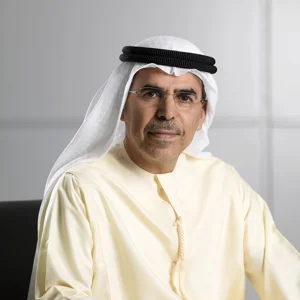
“EGA aspires to be measured amongst the world’s leading metals and mining companies in meeting its environmental and social responsibilities” ~ Md. Abdulla Jassem bin Kalban, Managing Director and Chief Executive Officer of EGA
- Category
- Interview
- Date
- Source
- AlCircle.com
- Edited By
- Beethika Biswas
Emirates Global Aluminium, equally owned by Mubadala Development Company of Abu Dhabi and Investment Corporation of Duabi, is an aluminium conglomerate with interests in bauxite/alumina and primary aluminium smelting. With an annual average production of 2.34 million tonnes, EGA ranks among the five largest aluminium producers in the world. To get more insight into the company’s business activities, its strategies, and forecast, read on the interview of none other than Md. Abdulla Jassem bin Kalban, who has been serving as the Managing Director and Chief Executive Officer of EGA since its formation through the merger of DUBAL and EMAL in 2014.
Md. Kalban had joined the aluminium industry in 1985 and now has 29 years of experience in the sector. Let us see what he has to say about the future of the global aluminium industry and also about the possible business opportunities of EGA.
Q: EGA produced 2.64 million tonnes of primary aluminium in 2018 making it the largest aluminium producer in Gulf. What is your production forecast for 2019?
A: We do not make public forecasts for our performance, but as always in 2019 we will be focused on safe production and delivering value for our business and customers. Last year’s production was a record for EGA, and so was our production of value-added products – which reached 87 per cent of our total production and continued to make us the largest ‘premium aluminium’ producer in the world.
Q: EGA has started production at Al Taweelah alumina refinery on April 10. How is it going to support EGA’s upstream business in the aluminium sector?
A: Al Taweelah alumina refinery and our bauxite mining project in the Republic of Guinea are strategic upstream growth projects for EGA. They deliver new revenue streams and help us secure the natural resources that we need at competitive prices.
Until the start-up of Al Taweelah alumina refinery, EGA was one of the only major aluminium producers without its own alumina assets. Once full ramp-up is achieved, we expect Al Taweelah to meet about 40 per cent of our alumina needs. Since the introduction of API, with the de-linking of alumina prices from the LME aluminium price, investing in alumina production has been shown to be the right strategy.
Most importantly we completed construction safely. The peak construction workforce was 11,542, from 20 countries. Construction took 72 million hours of work, equivalent to one person working for over 25,000 years. Over 280 safety professionals managed onsite safety processes and systems during construction. The rate of recordable safety incidents was far lower than international benchmarks and there were zero fatalities.
Q: EGA has started a new spent pot lining treatment facility recently and it has become the first company in Gulf to receive Aluminium Stewardship Initiative Certification. What are it sustainability strategies for 2019 and ahead?
A: EGA aspires to be measured amongst the world’s leading metals and mining companies in meeting its environmental and social responsibilities.
Spent pot lining is a global challenge for our industry, and we have made very considerable progress in its management. We believe our work in spent pot lining makes us a world leader in the re-use of this waste.
Since 2010 we have worked with UAE cement companies to develop the potential of spent pot lining as an alternative feedstock in cement manufacturing.
Last year we re-used more spent pot lining with cement companies than we produced, reducing stockpiles from previous years.
Our new crusher and pre-processing facility is the latest milestone in this work. It enables us to deliver spent pot lining ready for use by cement companies, rather than relying on third party pre-processors. This reduces the costs, and also the distances spent pot lining has to be transported within the UAE as it is re-used.
Q: Sanction on Rusal has opened up more business opportunities for Gulf Aluminium producers including EGA. Now that the sanctions are lifted, do you think it will create a gap in the business?
A: There have been a number of disruptions in our sector in the last year or so, including sanctions on Rusal but also US tariffs, and disturbances in the alumina market. The return of Rusal metal is impacting some markets, but our strategy is to focus on delivering the value- added products our customers need and on customer and geographical diversification.
Q: With the aluminium price coming down to a lower level in Q1 2019, how do you see your profitability in 2019?
A: We disclose our financial performance annually. However everyone is aware that market conditions are unfavourable in our industry at the moment, and many aluminium producers around the world are challenged. EGA has tier one assets in the lowest quartile of the production cost curve, so we are well-placed. But our focus is to maximise our revenue and carefully manage our costs to weather the current situation as well as possible and be well- prepared for when market conditions improve.
Q: What are your value added strategies for the year 2019?
A: We produce the highest volume of value added products – or ‘premium aluminium’ - of any company. Our goal is to maximise our value-added products production and sales, working closely with our customers around the world. For EGA, maximising value-added products increases the value we create from our each tonne of our aluminium production, contributing directly to our bottom line. EGA’s strength in value-added products comes from the high purity metal we produce using our superior technology, excellent process management, and our investments in our Casthouse.
It also comes from our excellent relationships with our customers. We will continue to work with our customers to develop alloys and specifications that better meet their needs for current applications and find new ones, in industries ranging from automotive and electronics, to aerospace and construction.
Q: What is your outlook for the global aluminium industry in 2019?
A: Globally manufacturing activity has softened in 2019 and we are entering a lower demand period in the cycle. US manufacturing is showing a slowdown, from automotive, to general manufacturing to construction. There are uncertainties created by trade disputes, especially the US-China disputes. In Europe, the manufacturing outlook is weak, and there are uncertainties around Brexit. In Asia the situation looks a little brighter.
The consensus is that we are not entering a prolonged slump, but we are in a difficult period. The expectation is that we will begin to see a recovery this year.
Meantime, many aluminium producers are experiencing difficulties and we expect that to result in reductions in production which will be positive for aluminium prices.
Of course our industry’s present difficulties are also related to raw material prices, especially to alumina: here the increase of API prices has resulted in the erosion of smelting margins, given that API is not anymore correlated with LME prices despite the fact that alumina is primarily used for producing aluminium. We believe that alumina prices linked to LME provide a more equitable and fair pricing mechanism for both refineries and smelters.
For all aluminium companies, difficult market conditions are a challenge and an opportunity. The opportunity side is to further improve the efficiency of our business so we can reap the rewards when the situation gets better, which is inevitable in due course.

