The combination of lightweighting, manufacturability and cost-effectiveness makes the stamped rolled-aluminum approach attractive

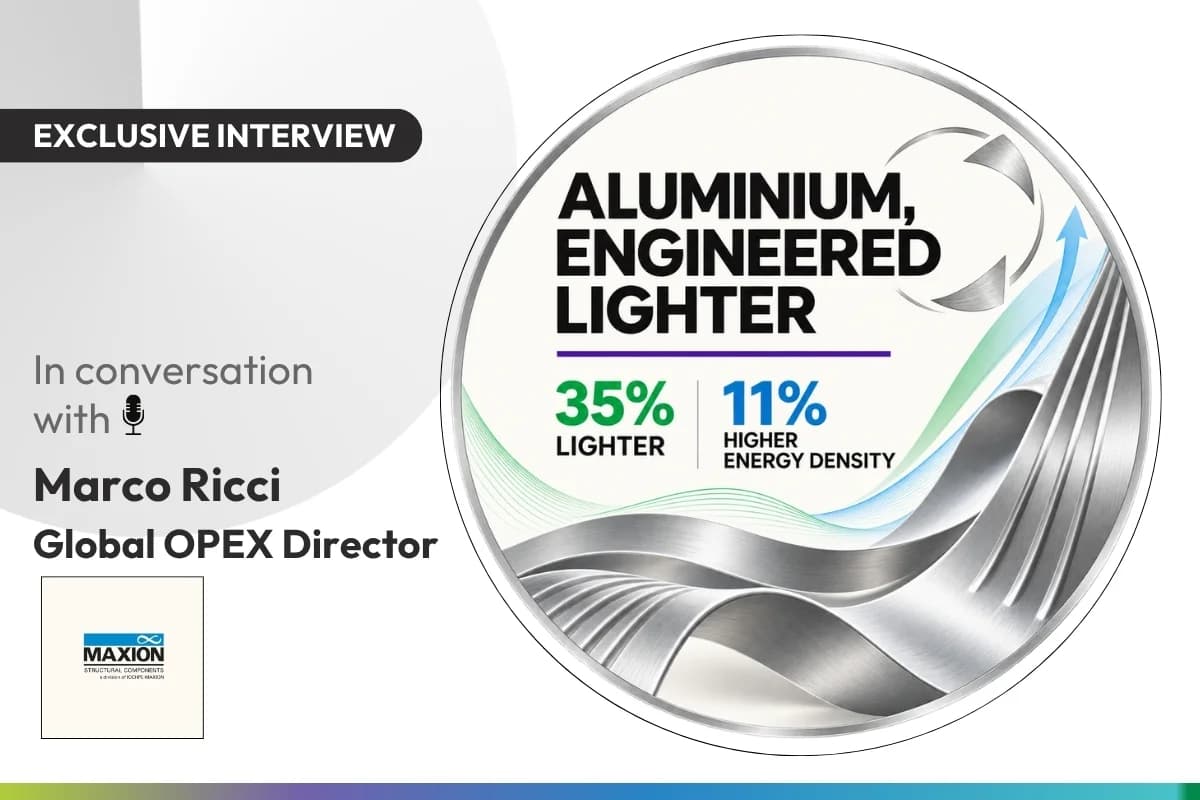
How can aluminium make electric trucks lighter without compromising safety? In this recent conversation, Marco Ricci, Global Innovation, Engineering and Operational Excellence Director at Maxion Structural Components, explained how aluminium is being re-engineered to solve one of electric mobility’s toughest challenges: heavy commercial-vehicle battery systems.
Developed with Novelis, the Maxion InVolt stamped rolled-aluminium housing is approximately 35 per cent lighter than a comparable extruded-aluminium design while delivering around 11 per cent higher energy density. Ricci also highlighted its potential to improve payload, range and operating efficiency while enabling safer, more serviceable and cost-effective high-volume production.
AL Circle: Maxion Structural Components and Novelis have jointly developed the Maxion InVolt battery housing for electric commercial vehicles. What specific industry challenge prompted the development of this solution?
Marco Ricci: The electrification of commercial vehicles has created a significant engineering challenge: batteries are heavy, and their weight directly impacts vehicle payload, operational efficiency, range and total cost of ownership. For trucks and buses, every kilogram allocated to the battery system is a kilogram that cannot be used for cargo or passengers.
The Maxion InVolt project was developed to address this challenge by creating a lighter battery housing solution without compromising structural integrity, safety, durability or manufacturability. The objective was to reduce the overall battery pack weight while improving packaging efficiency and supporting large-scale production requirements for commercial vehicle OEMs. The resulting design achieves approximately 35 per cent lower weight compared with an extruded-aluminum solution designed to the same technical requirements, while also increasing energy density by approximately 11 per cent.
AL Circle: The housing uses stamped rolled aluminium rather than conventional extruded aluminium. What technical and commercial considerations led to this material and manufacturing choice?
Marco Ricci: Our development philosophy was to leverage manufacturing technologies that are already widely adopted and proven within the automotive industry.
From a technical perspective, stamped rolled aluminum allows the creation of highly optimised geometries while maintaining the necessary crashworthiness, stiffness and battery protection performance. It also enables easier access to internal battery components for service and maintenance.
From a commercial perspective, stamping offers significant advantages in scalability and cost competitiveness. The global automotive industry already possesses extensive expertise, tooling know-how and supply-chain infrastructure around sheet-metal stamping. This enables higher-volume production, improved manufacturing efficiency and easier sourcing of replacement components when compared with solutions that rely heavily on large aluminum extrusions.
The combination of lightweighting, manufacturability and cost-effectiveness made the stamped rolled-aluminum approach particularly attractive for commercial-vehicle applications.
AL Circle: You mention aluminium's recyclability results in up to 95 per cent lower emissions. How much of the aluminium used in Maxion InVolt is recycled content? How does this product align with tightening emissions regulations for commercial fleets in markets like North America?
Marco Ricci: The currently available project information references aluminum's ability to be infinitely recycled and notes that recycled aluminum can reduce greenhouse-gas emissions by up to 95 per cent when compared to primary aluminum production. However, the specific recycled-content percentage used in the Maxion InVolt program has not been publicly disclosed.
With regard to regulations, the product aligns with the broader industry trend toward reducing vehicle emissions through lightweighting. For commercial EVs, lowering structural weight contributes to improved vehicle efficiency, extended driving range, reduced energy consumption or increased payload capacity. These benefits support fleet operators and OEMs as they work to meet increasingly stringent regulatory requirements and sustainability targets.
The solution is particularly relevant in North America, where commercial-vehicle electrification is advancing rapidly and OEMs are actively seeking technologies that improve overall vehicle efficiency without sacrificing operational performance.
AL Circle: What specific challenges led you to develop a new aluminium alloy for this application rather than adapting an existing automotive-grade alloy?
Marco Ricci: Commercial-vehicle battery housings create a unique combination of requirements that are not always optimised in conventional automotive alloys. The structure must simultaneously deliver lightweight performance, impact resistance, durability, manufacturability and suitability for large-scale stamping processes.
The development teams from Maxion and Novelis worked on a dedicated alloy solution specifically tailored for this battery-housing application, combining Maxion’s structural and manufacturing expertise with Novelis’ experience in rolled aluminum, alloy development and application engineering. The goal was to achieve the balance between formability during manufacturing and the mechanical performance required throughout the product lifecycle.
While the detailed metallurgical formulation remains proprietary, the new alloy was developed to support the combination of lightweighting, structural performance, energy-density improvements and cost-effective stamped manufacturing that formed the foundation of the Maxion InVolt concept.
AL Circle: North America has been identified as a particularly important market. What regulatory, infrastructure or market developments make the region suitable for this solution? What production capacity, tooling investment and supply-chain partnerships would be required to manufacture Maxion InVolt at commercial scale?
Marco Ricci: North America represents an important market for commercial-vehicle electrification because of increasing investments in electric trucks and buses, growing charging infrastructure, OEM electrification programs and regulatory initiatives focused on emissions reduction. The region is therefore a natural fit for a solution designed specifically to improve electric-commercial-vehicle efficiency and payload capability.
From an industrial standpoint, the technology benefits from leveraging established automotive sheet-metal manufacturing processes. Maxion already possesses the needed assets in North America to scale up production:
- High-volume stamping operations.
- Battery-housing assembly processes.
- Dedicated tooling for large aluminum components.
- Aluminum supply and technical collaboration from Novelis.
- Validation, testing and quality systems aligned with commercial-vehicle requirements.
Because the concept is based on sheet-metal technologies already widely used in automotive manufacturing, the scaling pathway is generally more familiar and potentially more cost-effective than highly specialised manufacturing routes. The specific production-capacity targets and investment figures have not been publicly disclosed.
AL Circle: Could stamped rolled aluminium replace extruded aluminium across a significant share of EV battery housings, or will each manufacturing route continue to serve different vehicle designs and operating requirements?
Marco Ricci: We expect both manufacturing routes to continue playing important roles in the market.
Stamped rolled aluminum demonstrates clear advantages in applications where lightweighting, cost competitiveness, serviceability and high-volume production are primary objectives. For many commercial-vehicle battery-pack architectures, these characteristics make it an extremely compelling solution.
InVolt demonstrates that stamped aluminum can successfully compete in applications traditionally served by extrusions and expand the design options available to vehicle manufacturers.
AL Circle: Could you briefly introduce Maxion Structural Components and tell us about the company’s journey, its core automotive capabilities and how its focus has evolved with the shift towards electric mobility?
Marco Ricci: Maxion Structural Components (MSC) is a global supplier of structural systems and components for commercial vehicles and passenger vehicles. The company has decades of experience in designing and manufacturing complex structural products, including chassis and frame assemblies, cross members, suspension-related structures, and other vehicle components.
Throughout its history, MSC has built strong expertise in metal-forming technologies, structural engineering, manufacturing excellence, and large-scale automotive production.
As the industry evolves toward electrification, MSC has expanded its capabilities beyond traditional vehicle structures into new mobility solutions. This includes battery housings, advanced lightweighting solutions and electrification-focused engineering services. The Maxion InVolt program is a direct example of this evolution, combining MSC’s structural design and manufacturing expertise with Novelis' advanced aluminum expertise, application engineering and recycling capabilities to support the continued growth of electric commercial vehicles.

