“At Rio Tinto, we often say climate change is too big of a problem to go at it alone” Amy Abraham, Vice President Sales Aluminium
- Category
- Interview
- Date
- Source
- AlCircle.com
Amy Abraham is Vice President of Aluminium Sales at Rio Tinto. She is accountable for global sales and account management, book management, trading activities, and sales and operations planning for Rio Tinto’s aluminium business, which includes bauxite, alumina, and aluminium.
Prior to joining Rio Tinto, Amy worked with World Fuel Services as the senior vice president of strategy and chief marketing officer. Reporting to the Chief Executive, Amy was accountable for leading and influencing global, enterprise-wide transformational change across a team of 1500+ market-facing sales and marketing professionals and delivering material, sustainable and profitable growth. She also had a long career at BP, where she worked in senior leadership roles across the US and UK, including Chief of Staff to the Group Chief Executive, Vice President of Marketing and Communications and US Retail Transformation Leader.
Amy has a Bachelor’s degree in arts (BA) in Economics from Duke University and a Master’s degree in Business Administration (MBA) from Indiana University (Kelley School of Business).
AL Circle: What trends are you seeing in the industry today, and how is Rio Tinto planning to respond to them?
Amy Abraham: We have been seeing several consistent trends across the industry for some time now that have helped to shape our strategy.
First, we are seeing a lot of demand for low-carbon products to support the net-zero transition due to a decisive shift in society’s intentions towards the energy transition and dedicated sustainability goals, from governments to businesses to consumers. As a result, we have been, for a long time, investing in developing production methods that generate less greenhouse gas emissions, as well as materials and solutions to support the global transition towards net zero and continue to do so.
With a large-scale, fully integrated business, we currently produce some of the highest quality, lowest carbon aluminium in the world.
Majority of our aluminium is produced with renewable energy, including the use of 7 wholly-owned hydropower plants that generate most of the electricity we use in our Canadian facilities.
In 2016, we launched RenewAL™, the industry’s first certified low-carbon aluminium and in 2018, we became the first company to receive certification from the Aluminium Stewardship Initiative (ASI) for the production of responsible aluminium. We are currently also working with partners to develop ELYSIS™, a smelting technology which produces no direct greenhouse gases, and expanding our AP60 smelting technology, which is amongst the most efficient and lowest carbon technology currently available on a commercial scale. Through our Matalco joint venture that was completed late last year, we now also offer a sizable portfolio of recycled aluminium products, complementing our current suite of low carbon, high-quality primary aluminium and, in the future, primary aluminium produced with ELYSIS™ technology. All these allow us to offer customers a fuller suite of low-carbon products.
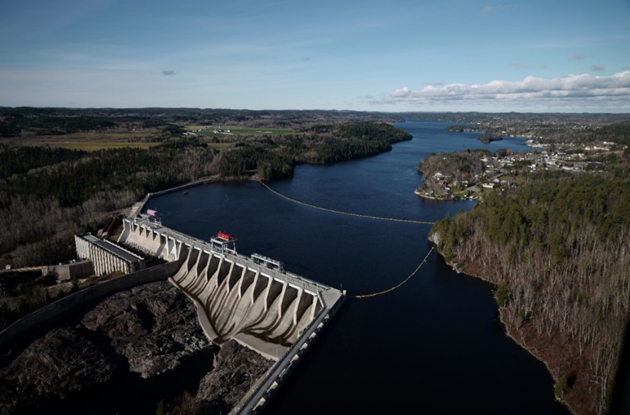
We produce some of the highest quality, lowest carbon footprint aluminium in the world using hydropower.
Second, the increase in government regulations, commodity market and supply chain disruptions, and consumers’ growing desire to live more sustainably are some of the shifts nudging the world towards more transparent supply chains. To fulfil this demand, we have START, our blockchain technology platform that provides our customers with key metrics, such as greenhouse gas emissions, safety, and diversity figures, around our materials’ production.
Finally, we have noticed an increase in establishing partnerships across the integrated supply chain. This stems from a need for secure and responsible supply chains for important raw materials like aluminium. We are well positioned to support this trend, as we have assets located in politically stable regions, providing supply security for our customers and their supply chains. For example, last year, we announced a Memorandum of Understanding (MoU) with BMW Group to identify and pursue opportunities to lower the carbon footprint of BMW’s North American aluminium supply chain. We also signed an agreement with Marubeni last year to secure a sustainable and reliable supply of Rio Tinto’s responsible aluminium products to Japanese downstream manufacturers.
AL Circle: Decarbonisation is high on everybody’s radar. Could you elaborate on Rio Tinto’s decarbonisation strategy?
Amy Abraham: We have put climate change and the low-carbon transition at the heart of our company strategy, and we have set goals to reduce our scope 1 and 2 emissions by 50% by 2030 and to reach net zero by 2050. We are taking a multi-faceted approach to decarbonising our aluminium business.
Firstly, we are working to repower our Pacific Aluminium operations and decarbonise our alumina processes in Queensland. This year, we signed two long-term power purchase agreements (PPA). These combined 2.2GW of renewable PPAs have the potential to lower carbon emissions by about 5 million tonnes per year and could generate the equivalent of 10% of Queensland’s current power demand. Of course, the work does not end there, and we continue to engage with potential partners to assess other proposals that can help us further our decarbonisation objectives. We are also working with Sumitomo and the Australian Renewable Energy Agency to research using clean hydrogen to replace natural gas in the calcination process of alumina refining at Yarwun.
Secondly, we are developing products and technologies to help our customers decarbonise. This includes our work on ELYSIS™, which now focuses on scaling up for larger commercial-size cells. We have also leveraged blockchain technology to create our START digital platform. The START label provides up to 14 ESG metrics of the aluminium produced and its provenance so that our customers and end-users have greater visibility into the production process and where the products were made.
Finally, we are growing our materials production to enable the energy transition, including our investments in primary and recycled aluminium. We have continued to invest in our primary low carbon output at our Alma smelter for the production of higher-value low carbon billets. Our AP60 smelting technology1 is currently amongst the most efficient and lowest carbon technology available commercially, so we are investing in the AP60 aluminium smelter to replace older and less efficient production from our Arvida smelter. In doing so, we will reduce greenhouse gas emissions by 50% while meeting the increasing demand for low-carbon aluminium. In addition, we have ventured into the recycled aluminium market through our Matalco joint venture in North America, expanding our value-added product portfolio.
1 The AP60 technology generates approximately 1.6 tonnes of CO₂e per tonne of aluminium produced, compared to approximately 3.2 tonnes of CO₂e per tonne of aluminium for the Arvida smelter’s current technology.
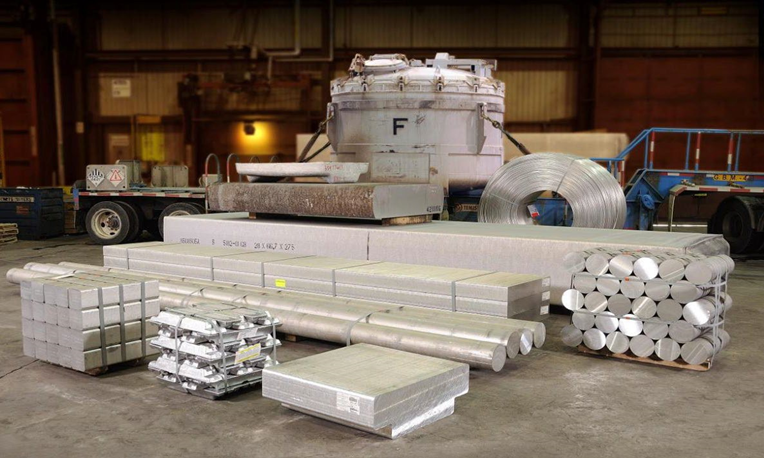
Rio Tinto produces a wide range of low carbon aluminium products.
AL Circle: Recycling is increasingly gaining traction in the industry. What has been/are Rio Tinto’s activities in the recycling space?
Amy Abraham: Recycling presents unique growth and commercial opportunities, especially for a company like ours, which now has downstream processing capabilities within our Matalco joint venture. We have the unique opportunity to meet our customers’ diverse needs by providing both primary products and recycled products with reduced footprints.
In recent years, we have explored different strategies to bring more recycled content to the market. These include introducing a closed-loop recycling solution in Shawinigan and investing in a new recycling facility in Arvida to incorporate recycled post-consumer aluminium into aluminium alloys in the future.
However, the one I’m most excited about is our Matalco joint venture because it allows us to unlock recycled aluminium at a much faster pace than we can ever achieve on our own. Our joint venture with Giampaolo Group allows us to manufacture and market recycled aluminium products at scale. This will immediately add approximately 45% capacity to Rio Tinto’s North American aluminium marketing portfolio and almost double our portfolio of value-added products, allowing us to meet demand at a much faster rate. As a result, we are now in a uniquely advantageous position among our competitors in the US, as we will be able to offer our customers a fuller suite of low-carbon products for their needs.
AL Circle: Last year, Rio Tinto announced its entry into the recycling business. What is in it for Rio Tinto?
Amy Abraham: There are many reasons why entering the recycling business makes sense for us. The first is being able to meet the needs of the market. For a while now, we’ve been experiencing an increasing demand for recycled content in our aluminium products. In fact, we expect demand for recycled aluminium to increase by more than 70% from 2022 to 2032 in the United States. Hence, Matalco will play an important role in helping us to fulfil the demand for recycled products, for not just our customers, but their customers over the next few years.
The Matalco joint venture expands our value-added product portfolio while allowing us to offer circular recycling solutions. A sizable portfolio of recycled aluminium products complements our current suite of low-carbon, high-quality Canadian primary aluminium and, in the future, primary aluminium produced with the ELYSIS™ carbon-free smelting technology. This expanded product portfolio also allows us to offer the greatest customer optionality in North America.
This joint venture also gives us access at scale to recycled aluminium into our portfolio, in a much faster time than in comparison to establishing greenfield production facilities and our own supply chains.
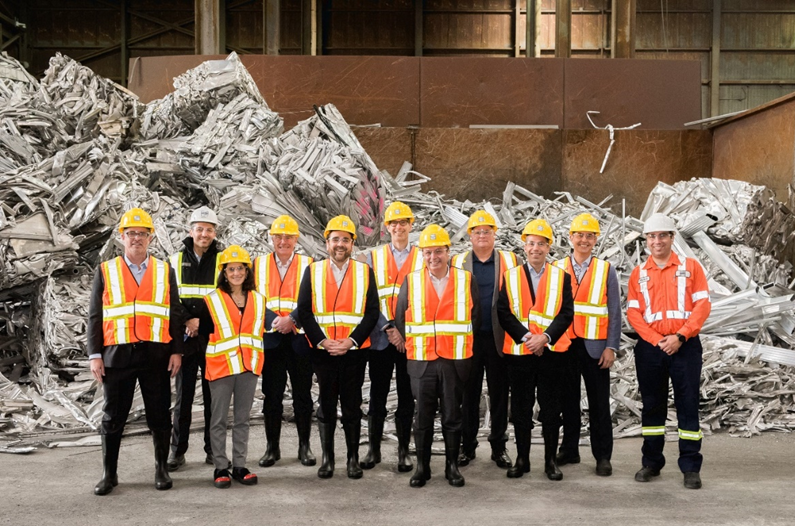
Rio Tinto and Giampaolo Group Inc (Giampaolo Group) formed the Matalco recycling joint venture in 2023.
AL Circle: For decarbonisation to gain traction, what are some drivers that need to be in place or challenges you foresee we need to overcome?
Amy Abraham: At Rio Tinto, we often say climate change is too big of a problem to go at it alone. There will be challenges that we will need to overcome. For instance, some of the technology we need to get to net zero by 2050 doesn’t exist today, so we need to contribute, support and partner to make it a reality. That’s why we’re focused heavily on R&D. We have established the Office of the Chief Scientist, increased our target spend to $400m a year, and have committed $150 million to create a Centre for Future Materials, led by Imperial College London to find innovative ways to provide the materials the world needs for the energy transition.
In addition, higher carbon prices, green premiums and other government incentives are needed to drive the production and consumption of low-carbon metals and minerals.
It is clear we can’t decarbonise on our own. We are optimistic that we will be able to move towards a better future by creating partnerships with governments, suppliers, customers, universities, communities, and even other mining and metals companies to help find solutions.
The good news is we are already collaborating. Last year, we agreed to partner with Prysmian Group on the sustainable supply of materials for the energy transition to ensure we help meet the increased demand for power generation from renewables in the US. We are also combining forces to leverage our technologies, research and development capabilities, and technical expertise to develop multi-material solutions supporting North America’s growing electrification demand.

