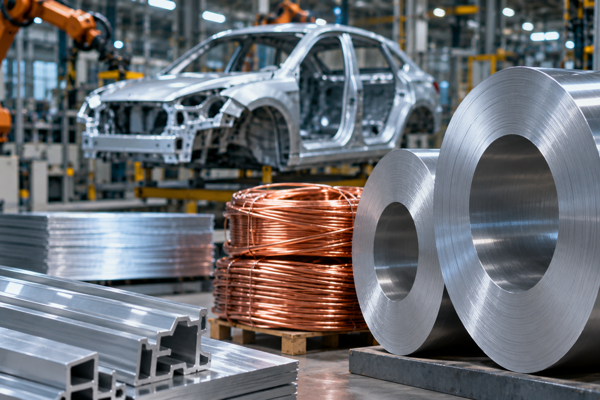
Rising aluminium prices are adding to manufacturing cost pressures at Hyundai Motor and Kia, as the prolonged Middle East conflict continues to disrupt supply chains and push up raw material expenses. Aluminium prices have reportedly increased by 26 per cent year on year, while higher copper and plastic costs are also weighing on the South Korean automakers' profitability. According to the companies' quarterly reports released on November 20, prices of key automotive raw materials have risen significantly compared with the previous year. Copper recorded the sharpest increase, climbing 35 per cent from USD 9,945 per tonne to USD 13,434 per tonne. Plastic prices rose 26 per cent, from USD 866 per tonne to USD 1,090 per tonne, while aluminium increased 26 per cent from its reported...
The US aluminum scrap market is showing signs of cooling as falling Midwest premium expectations and weaker primary aluminum prices put pressure on used beverage can (UBC) scrap values. The latest decline highlights how closely recycled aluminum pricing in the United States is tied to regional trade premiums, rather than movements on the London Metal Exchange (LME) alone. The LME's US UBC scrap contract, which settles against a mill-grade delivered price index, closed at $2,635.63 per metric ton on November 18, marking a daily decline of 0.66%. The downward movement reflects growing pressure across the US aluminum pricing structure, with both the underlying metal benchmark and regional premium losing momentum. US UBC scrap prices retreat as November weakness builds The latest movement...
Grow with
AL Circle

The growing importance of the UAE's primary aluminium industry in the global market has once again been highlighted, thanks to the joint presence of Dubai Aluminium Company Limited ("DUBAL") and Emirates Aluminium Company Limited ("EMAL"), at 26th International Aluminium Conference, organised and hosted by Metal Bulletin in Paris, France, from 7 to 9 September 2011 ("MBI 2011"). The combined production volume of the two companies, forecast at 1.8 million metric tonnes in 2011, represents 4.1 per cent of the estimated 43.8 million metric tonnes of annual global production; and 51 per cent of the 3.5 million metric tonnes produced in the greater Gulf region (itself equivalent to 7 per cent of global production in 2011).
Aluminium stocks held at three major Japanese ports came to 241,200 tonnes at the end of August, up 37,700 tonnes or 18.5 percent from a month earlier, trading house Marubeni Corp said on Monday.
Technology will advance the growth in aluminum smelting capacity, with key innovation coming from producers, an executive at engineering and project management consultancy Hatch said Friday. Martin Desmeules, a global director of Hatch's aluminum division, told a Metal Bulletin conference in Paris that there are a "good number" of technology providers in the market. "Core reduction technology development will continue to be driven by producers," he said. "Technologies are evolving towards higher amperage and greater efficiency," he added. But "breakthrough" technologies are not expected to hit the market soon, he said. It can take up to 65 months to build a greenfield smelter from scratch, including the various studies required,he noted.

Global demand for aluminum rolled products will rise by over 11 million metric tons to 30 millions tons by 2020, a senior executive at Novelis said Friday. Tadeu Nardocci, president of Novelis Europe, told a Metal Bulletin conference in Paris that demand will reach 25 million tons by 2015, driven by "global megatrends." Asia will account for around half of the global aluminum rolled products market in the next five years, at over 12 million tons. These megatrends include population growth, a spreading distribution of wealth, tighter availability of essential resources like water and energy and a desire for a better environmental footprint, he said, and are underpinned by solid growth in key sectors like transportation, canstock and consumer electronics.

Lawmakers in Guinea, the world’s biggest exporter of bauxite, adopted a new mining code that will give the West African nation a 35 percent stake in commodity companies. “The code gives a correction to the old one for Guinea’s interests,” Mines Minister Lamine Fofana told reporters after the policy was approved by members of the National Transitional Council, the country’s legislative body. Investors will have to show feasibility studies before mining concessions are granted, Fofana said in the capital, Conakry, today. “Permit holders must work in transparency,” he said. Guinea, whose President Alpha Conde pledged mining-sector reforms as part of his election campaign last year, holds as much as half of the world’s bauxite reserves, according to the U.S. State Department. Customs duties...

BHP Billiton is spending money hand over fist expanding its global production capacity. But the big spending stops when it comes to an alumina project in Guinea where the company and its Canadian and Middle Eastern partners have all but stopped work on a $US5.2 billion ($A4.9 billion) alumina project, despite having already spent more than $US700 million on preparatory works. The division was the runt of the litter in BHP's record-breaking June-year profit of $US21.6 billion. Underlying earnings before interest and tax from the division was a paltry $US266 million, down by $US140 million on the previous year. The contribution was the smallest of any division and was despite the benefit of higher alumina/aluminium prices. The division has been plagued by power issues at its aluminium...
Insufficient power supply has forced state-run National Aluminium Co Ltd (NALCO) to cut its daily aluminium output by about 6 per cent, a senior company official said on Saturday. The disruption caused by a scarcity of coal however will not affect the company's quarterly or yearly output target although the production may decline slightly by around 2,100-2,400 tonnes for a month, said A.K. Sharma, director (Production). Sharma said the shortfall will be subsequently made up by enhanced productions after receipt of coal. "We are going ahead with bulk imports of coals in few days. We have also requested ministry of coal to help us" he said. MCL chief A.N. Sahay told Reuters earlier this month a near week-long strike by contract labourers, a lethal outbreak of dengue and continuous rains...
Novelis, the world’s largest producer of rolled aluminum, today announced the opening of a new office in the Shanghai World Financial Center to expand the company’s presence in Asia. To lead the company’s business development in China, Novelis has appointed James Liu as Managing Director, Novelis China, and Director, Sales and Marketing, Automotive Asia. Liu will lead Novelis’ expansion plans in China in alignment with the company’s long term growth strategy for Asia. In his sales and marketing role, Liu will drive the execution of major automotive growth opportunities for Novelis in China and Korea. “Aluminum has been growing at a much faster pace than other comparable materials,” said Philip Martens, President and CEO of Novelis.”As global urbanization and income continues to accelerate...
Former Minister Damodar Rout criticized the recent industrial policy of state government during his speech on Saturday.He attended the seminar organized by Ganjam district unit of the Orissa union of journalists (OUJ). Mr. Rout said unrestricted establishment of Iron,steel and Alumina industries would be detrimental to the interests of the state in the long run .Four Alumina projects are proposed in the state. Such a large number of industries would put negative pressure on non-renewable mineral resources as well as be a great impact upon environment of the state. Further he criticized the state government for promoting large number of thermal power plants in Orissa which will rob away coal resources of the state and destroy the balance of the environment while power generated by them...
Mr Prabhas Pande former additional director general of Geological Survey of India said that stating that minerals are precious natural resources for any country. The minerals are nonrenewable in nature and limited in quantity. Mr Pande said that "Indians have been familiar with minerals since Harappan days. In India, the per capita consumption of most of the minerals like copper, lead, zinc aluminum and related products is one the lowest in the world. The demand for various metals and minerals will grow four to five times in the next 15 years against the backdrop of globally dwindling and increasingly scarce resources. He said that “Minerals should be looked as potential for income rather than threat. These are vital raw materials for infrastructure, capital goods and basic industries....
Gulf News reported that Aluminum Bahrain will focus on modernizing its older production facilities if and when it has approved an expansion and bedded that down. Mr Laurent Schmitt CEO of Alba said that the expansion which would add a new sixth smelter potline would see first metal produced in 2015 and increase production by 400,000 tonnes. The smelter currently produces 870,000 tonnes a year. Mr Schmitt said that a pre feasibility study into energy and smelting technology will be completed by year end and the company aims to launch a bankable feasibility study in early 2012 for completion and then the potential green light to go ahead by the end of next year. He said that this is already a nice step ahead and we want to focus our attention on this for the next 5 years. Beyond that we'll...
Base metals, with the exception of tin, slid last week at LME in London as deepening concerns about Europe's debt crisis and sluggish global growth pushed investors out of growth sensitive metals. A new economic stimulus proposal of USD 447 billion package of tax cuts and spending designed to boost the flagging US economy and cut unemployment in US did not overcome the worries among the investors that Europe's debt crisis is worsening. LME rates - Cash buyer for Aluminium slid by 1% last week.
Chinese aluminum producers have a weak voice in pricing aluminum oxide, an official of a Chinese aluminum smelting company said on Thursday. Wang Xiaodong, general manager of Henan Shenhuo Aluminium Co.Ltd, said it is because alumina refineries are usually large in scale. While attending an aluminum industrial conference in Paris, Wang said the cost for aluminum production was increasing sharply because of the rise in the price of raw materials such as aluminum oxide. He added that since early 2011, the price of aluminum oxide had increased by 18%.

Aluminum scrap imported by Guangdong may decrease and the amount is limited. It is because restrictions on imported aluminum scrap tend to be stricter and examination intensity on domestic consignees are being tightened. The primary condition for importing aluminum scrap is to have verification from the domestic consignee. Besides, green certificate and approval form AQSIQ are also required. However, Guangdong managed loosely with consignee verifications in the past. Many companies import aluminum scrap through third-party intelligence companies. Recently, relevant departments in Guangdong have strengthened the scrutiny towards imported aluminum scrap. It prevents some companies from importing aluminum scrap in large quantities.
800 thousand tons/year of alumina project of Wenshan Aluminum Co., Ltd started in May, 2008, with the close attention of leadership and active involvement of branch office.Now the company has finished the construction of spare storage, finished products filter plant, raw material grinding mill, aluminum hydroxide warehouse, and crude ore bin.
Most active SHFE 1111 aluminum contract opened slightly higher at RMB 17,455/mt on September 9th, and narrowly fluctuated in the morning session due to a lack of upward momentum on remaining high inflation pressure as reflected by August CPI data. The contract fluctuated upward to an intraday high of RMB 17,500/mt in the afternoon after long capital took up the dominant position and forced shorts to exit. Finally closed price was RMB 17,485/mt, up RMB 60/mt or 0.34% from previous trading day. SHFE aluminum led other base metals to gain in the morning, and was the only metal that reported gains on all contracts. Transactions of the most active contract dropped further to near 20,000 lots. Considering output cuts in some aluminum producers in South China, SMM expects most active SHFE...
Spot aluminum market in South China was extremely quiet today, the last trading day before China’s Mid-Autumn Festival starts. Only a few purchases were seen as downstream buyers purchased as needed with fewer orders. SHFE aluminum consolidated after a higher opening today, which pushed spot aluminum prices in South China a little bit higher. Market transactions, however, were quite sparse.
Traded prices of spot aluminum in Shanghai were between RMB 17,850-17,890/mt on September 9th, with premiums of RMB 0-40/mt over SHFE current-month aluminum prices. Low-iron aluminum was traded between RMB 17,890-17,930/mt. Traded prices of spot aluminum in Wuxi were between RMB 17,830-17,870/mt. SHFE aluminum not only led other base metals to gain, but also pushed spot aluminum prices slightly higher. Position building was not seen before the coming Mid-Autumn Festival, and goods movements were mainly seen among middlemen. Market sentiment was slightly active.