“For Aluminium Melting & Holding Process, there are two types of basic heat source used throughout the world,” Prakash Maladkar, Managing Director of AFECO
- Category
- Interview
- Date
- Source
- AlCircle.com
Mr. Prakash Maladkar is a visionary technocrat and Managing Director at AFECO HEATING SYSTEMS. The company ventured in the field of Industrial Heat Treatment Furnace and Oven manufacturing in the year 1989. With limited resources, his unwavering determination led the organization to excel in Industrial Heat Treatment Furnace and Oven manufacturing. Through sheer will and commitment, AFECO earned industry acclaim, marked by a stream of repeat orders from valued customers.
AL Circle: Can you please enlighten us on AFECO’s Heating Systems? What heating source do you use in your Melting and Holding & Heat Treatment Furnaces?
Prakash Maladkar: “AFECO” Heating systems is a recognized Furnace Manufacturing Brand in the globe since 1995 and has successfully installed various melting, holding and heat treatment furnaces more than 1500 nos., as per customers demand.
“AFECO” is a full-service industry leader in machine design, quality workmanship, and innovative ideas. It has been providing superior service and support to manufacturers and O.E.M. builders for over 25 years.
At AFECO” Industries, we strive to provide our customers with superior assistance in robotics, machine design, and electrical engineering among a suite of other engineering and manufacturing services. Robotics has drastically increased productivity, efficiency, and speed across the aluminium value chain, right from aluminium billet casting process to heat treatment.
“AFECO” has leveraged the power and capacity of robotics to improve automation. Robotics and industrial robots have positively altered the way in which products are changed through qualities of superior precision and consistency.
Further, robotics can help to improve the morale within industrial environment as people are not always in order to complete mundane and hazardous tasks. Because they can work tirelessly and quickly, using industrial robots to reduce company overhead can stimulate an increase in company profits.
For Aluminium Melting & Holding Process, there are two types of basic heat source used throughout the world. For Aluminium Melting Process, fossil fuel like gas, HSD, and coal is used, and for Billet Homogenizing Heat Treatment process, electric or gas is a main source.
AL Circle: What are the key features and applications of your Billet Homogenizing Furnace?
Prakash Maladkar: In the production sequence of aluminium smelting/melting, the homogenizing furnace is the final heat treatment process before delivery and further processing of the aluminium logs or billets in an extrusion plant. Basically, two different plant variants, whether operate continuously or discontinuously, have become established in the market.
Both types fulfill the metallurgical requirements with sufficient accuracy. When making a choice, the heating equipment and heating concept are not decisively important. Unless the space available is a factor, the flexibility required by the user is the essential deciding criterion: frequent changes of format, alloy and temperature encourage the use of the discontinuous design, but if the role of flexibility in the production sequence is subordinate, the advantages of the continuous variant can be put to good use. As a complete supplier of both the variants, AFECO HEATING SYSTEMS is a competent and dependable partner for its customers when selecting the most economic variant and determining its size.
AL Circle: What unique impact does a homogenizing furnace have on billets compared to other heat treatment processes used for billet production?
Prakash Maladkar: Furnace structure and energy transfer in both designs the basic structure and the heat transfer mechanisms are the same: in an insulated steel housing channels of heat-resistant steel are formed, which enclose the aluminium logs. Hot gas fans and the heating systems are built into these internal housings. Directed towards the aluminium logs, the internal housings have special nozzle systems adapted to the geometry of the charge.
AFECO MAKE BILLET HOMOGENIZING FURNACE GAS FIRED TYPE
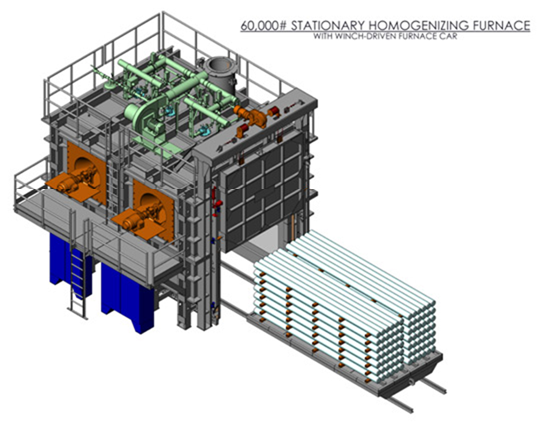
The furnace atmosphere is circulated continuously by hot gas fans of radial or axial design, so that the energy flow introduced by the heating devices is first given up to the circulating atmosphere by forced convection. The nozzle system blows onto the charge and, as a result, the energy flow is transferred to the charge to by far the greatest extent by forced convection (85%) and by heat radiation (15%) from the furnace atmosphere.
In the discontinuous (batch) design, the cooling section is made as a separate chamber, while in a continuous version it is a fixed part of the unit. In each case, the structure and consequently also the heat transfer mechanisms correspond to those in the heated portion of the plant.
As the cooling medium, as a rule ambient air is drawn in and after flowing through the charge just once, discharged again to the outside. Depending on the alloy, the cooling rates require range between 150 and 550 K/h and these are sufficient for the great majority of requirements; substantially higher cooling rates.
AL Circle: Are all your furnaces equipped with digital technologies and solutions? If yes, please brief us on the technologies you use.
Prakash Maladkar: ALL AFECO furnaces are equipped with modern Digital control systems, which are compatible for Industry V 4.0. “AFECO” offers the following Engineering
Services:
- CONCEPT DESIGN for Automation and Processes Controlling
- Heating Systems MACHINE DESIGN
- MECHANICAL DETAILING
- ELECTRICAL CONTROLS DESIGN, for Machines and Total Heating Systems
- ELECTRICAL CONTROL PANELS DESIGN AND LAYOUT
- ELECTRICAL CONDUIT AND CABLE SCHEDULES
- PLC PROGRAMMING
- EQUIPMENT INSTALLATION ENGINEERING, (Mechanical, Electrical, and Piping)
- AIR AND HYDRAULIC PIPING SCHEMATICS
- MACHINE PIPING ARRANGEMENTS WITH B/M
- MACHINE WIRING ARRANGEMENTS WITH B/M
- PROJECT MANAGEMENT
AL Circle: What advantageous features do your furnaces have compared to others? How have they benefitted your customers?
Prakash Maladkar: AFECO offers world class technology at an Indian price.
- We specialise in Computer Aided Design, utilizing AutoCAD™ (2d and 3d) and SolidWorks™ (3d Parametric Solid Modeling) software.
- “AFECO” has a talented staff capable to provide solutions for your most difficult applications.
- “AFECO” can provide you with a complete documentation package, including mechanical arrangements with bills of material, mechanical details, electrical schematics, and installation arrangements.
Major benefits of continuous or batch type homogenizing furnace:
- Perfectly uniform metallurgical property of the billet due to precise and reproducible temperature regime during heating, holding and cooling.
- Lowest Labour Cost - As opposed to a batch furnace which requires one or two operators per shift (building of log stacks, transporting of the batches, removal), operating labour for a continuous homogenizing plant is practically nil.
- Logs, stripped from the casting pit are entered at the Log Laydown Station. After homogenizing, heat-treated logs automatically arrive at the billet saw. Plant operation, including heat-treatment and cooling as well as all integrated log handling operations, is fully automatic. No operator is required.
- Best Log Straightness - Perfect straightness of logs is an important issue whenever a hot shear is used at the extrusion press. A continuous furnace bends logs into straight ones, effectively reducing the reject rate.
- Low Downtime & Maintenance - Plant availability is 99%! As opposed to a batch type furnace, which is typically subjected to periodic temperature change cycles, the continuous-furnace practically operates on a set temperature level in continuous operation, which means much reduced thermal strain and wear on the equipment.
AL Circle: What measures have you taken to curb greenhouse gas emissions from the heat treatment process?
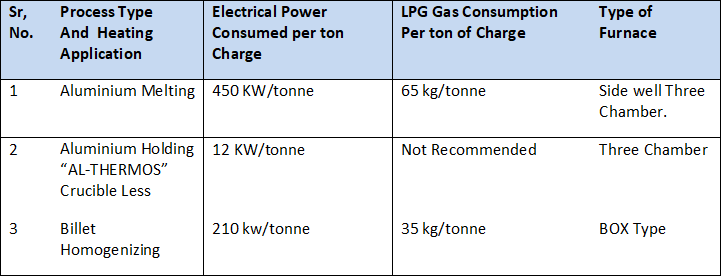
Prakash Maladkar: AFECO is always taking care to protect the environment while designing the equipment and selecting the heat source. An electric heated continuous furnace consumes around 210 kWh of electric energy per tonne of aluminium. A gas-heated furnace of same size with recuperative burners requires 230kWh of natural gas and 35 KWh of electric energy for producing each tonne of aluminium. Specific electric power consumption is considerably lower than that of a batch type furnace.
Carbon emission is a sincere concern that is largely being addressed worldwide by companies and individuals. The aluminium industry is no exception in contributing its share of efforts to combat the issue. Producers, suppliers, and patrons across the value chain have been experimenting heavily to lower their ecological carbon footprint for years. Sustainability and zero-carbon emission is now the focal point of all innovations and ventures undertaken by the global aluminium value chain.
To explore them and delve deep into the industry's journey towards sustainability, AFECO is coming up with a new technology for aluminium melting and holding, titled AL-THERMOS & BILLET HOMOGENIZING PROCESS EQUIPMENT Manufacturing. The aim is to reduce carbon emission during green aluminium casting component production.
AL Circle: What is the average energy consumption of heat treatment in your furnaces? Is it possible to reduce it further?
Prakash Maladkar: For different applications in aluminium Industries, power consumptions are indicative as below and all above AFECO FURNACES are bound to deliver the performance accordingly.
AL Circle: What is the durability of your furnaces? How often do they require servicing?
“AFECO-designed furnaces perform trouble free for more than 10 years of service life. We also have performance references more than 10 years of age.

