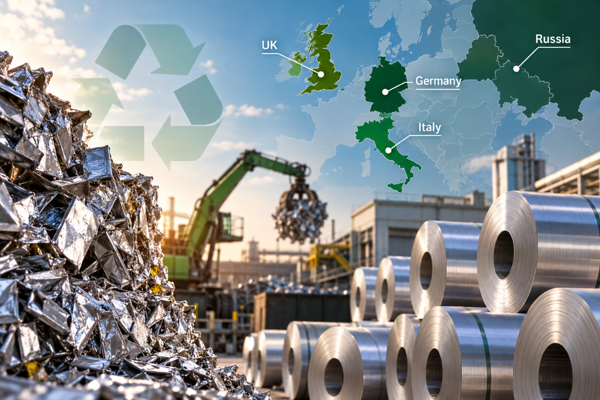
Europe’s recycled aluminium industry is an important component of the global secondary aluminium supply chain, with Germany, Italy and the United Kingdom (UK) representing key national markets. Production across the European region stood at nearly 6 million tonnes in 2023, supported by established scrap recovery systems, industrial recycling capacity and demand for recycled metal. Russia also contributes to the regional landscape through secondary aluminium production units concentrated in several industrial centres. According to AL Circle’s analysis in its report, “ World Recycled ALuminium Market Analysis Industry Forecast ”, the four countries present different market structures, from Germany’s substantial recycling capacity and Italy’s scrap-based production to the UK’s organised...
According to SMM survey statistics, the operating rate of the secondary aluminium alloy industry in September was 35.0 per cent, up 3.1 percentage points M-o-M but down 6.7 percentage points Y-o-Y. Industry production continued its recovery trend, but the overall operating level remained below the same period last year. On the demand side, September marked the traditional peak consumption season, with downstream orders recovering from August. End-use demand from automobiles and other sectors improved marginally, but the peak season effect has yet to fully materialise. According to CAAM data, automobile production in September was 2.99 million units, up 11.4 per cent M-o-M but down 8.7 per cent Y-o-Y. NEV production was 1.814 million units, up 12.2 per cent Y-o-Y. CAAM noted that China's...
Grow with
AL Circle

The recycling rate for aluminium drinks cans continues to increase year on year, hitting 72% in 2017 (up from 70% in 2016), whilst the national recycling rate for all aluminium packaging reached 51% (up from 50% in 2016). According to packaging waste recovery data, recently released by the Environment Agency, aluminium packaging easily achieved its 2017 business target. There was a 4% increase in the number of PRNS raised in 2017 (94,092 tonnes) vs 2016 (90,095 tonnes). Ultimately, the PRN numbers show that over 8,000 tonnes of aluminium PRNs were raised but not issued. As in previous years, there is evidence that some reprocessors/exporters chose not to become accredited or decided not to raise the maximum number of PRNs that they could have done, due to the resulting low PRN prices....

Saudi Arabia’s export of aluminium scrap has been on an uptrend from past several years. The country emerged as the major market for scrap metal recycling. Aluminium scrap represents 6.1 per cent of the total exports of Saudi Arabia. Most of the aluminium scraps generated in Saudi Arabia are from consumers, industries, and demolition sites across the country. The country exports considerable amount of aluminium scrap to India. India alone imported 123365 tonnes of aluminium scrap from Saudi Arabia in 2017, according to recent statistics. Other major countries where Saudi Arabia exports its aluminium scraps include Brazil, UAE, Pakistan, Greece and Belgium among others. As per global export-import data, Saudi Arabia is estimated to export 102685 tonnes of aluminium scrap in the half of...

According to a recently published report by AlCircle on Aluminium Dross Processing , the aluminium industry comprising primary, recycled and downstream sectors generated approximately 3 million tonnes of dross in 2017. Near 50% of the total dross generated still finds its way to land fill. The Asia Pacific region accounts for about 56% of the total dross generation followed by Europe and North America at 21% and 14% respectively. Keeping pace with aluminium usage the dross generation across the aluminium value chain is expected to grow at around 4 to 5% per annum in the coming years. The recovery of aluminium metal from dross is economically profitable and is essential from the environment perspective. Aluminum producers face increasing pressure from regulatory authorities to eliminate...

On April 2, the Ministry of Commerce of the People’s Republic of China issued a announcing that the 25 per cent tariff on aluminium scrap imported from the United States would take effect immediately. China immediately imposed tariffs on all 128 products, citing public comments expressing support for the measures. On March 23 Chinese Ministry of Commerce issued a notice soliciting public opinions and invited comments to be submitted by March 31. The ministry said, during the comment period, a large number of people expressed their support for measures and product lists. And the tariffs were implemented only after evaluating the feedback. Ministry of Commerce states, “In view of the lack of agreement between the parties, on March 29, China notified the WTO of the suspension of the...

As a retaliatory move to the US tariffs on imported aluminium and steel, China has revived its aluminium scrap policy and imposed 25 per cent tariffs on imported aluminium scraps. This has already created mayhem among the countries who export aluminium scraps to China, including the United Kingdom. The British Metals Recycling Association (BMRA) warns that this situation is affecting the aluminium scraps prices in the UK. President Donal Trump’s decision to impose tariffs on China’s aluminium and steel imports in an attempt to protect American smelters has engendered fear of a trade war between the two countries, which in the long run may not spare the UK. The BMRA said that the continuing lack of clarity over the US and China’s tariffs issues and the latter’s recent decision to...

As a retaliatory move against the US aluminium and steel imports tariffs, China has taken the US aluminium scrap industry on storm and created mayhem by officially slapping a blanket of 25 per cent tariff on aluminium scraps imported from the Unites States, effective on and from Monday April 2, 2018. This tariff is applied to products under Harmonized Tariff Code 7602.00, which refers to aluminium waste and scrap. China, being the largest aluminium scrap importer from the US, with total import standing at 958,584 tonnes in 2017, up 19 per cent from 812,661 tonnes in the prior year, is now facing a steep price hike of US-sourced metals. Accordding to Shanghai Metal Market (SMM), this may continue, as domestic aluminium scrap prices would remain high in the short term because of the tight...

The cross-European drinks can recycling awareness programme Every Can Counts has been diligently promoting aluminium can recycling in collaboration with major events around Europe. Next they will be present in the Amstel Gold Race on 13 April in Valkenburg, the Netherlands to promote ‘Recycle Race’ activity with cycling fans while cheering the cyclists. Every Can Counts team engaged with hundreds of visitors at its booth during the Tour of Flanders in Oudenaarde, Belgium. They let the spectators combine their cycling and recycling skills in ‘The Recycle Race’, an interactive game using pedal power to move drinks cans around a recycling loop track, with the opportunity to win prizes. The game promotes the message that used beverage cans could be recycled and transformed into a new can or...

According to aluminium recycling statistics published by the U.S. Geological Survey, Department of Interior; the U.S. aluminium industry purchased an estimated 318,875 tonnes of aluminium scrap during January 2018, up from the December 2017 total of 315,280 tonnes while down 2.8 per cent from the January 2017 total. Total aluminium and aluminium alloys recovered from scrap in January 2018 was 292,000 tonnes, 4% more than the revised amount in December 2017, slightly less than the revised amount in January 2017, but unchanged from the amount in January 2016. Of this, 168,000 tonne of aluminium was recovered from new scrap and 125,000 tonne was recovered from old scrap. In total for 2017, preliminary data indicate that recovery of aluminium from scrap totalled an estimated 3.6 million...

Aluminium scrap imports by China, the world’s biggest aluminium producer, dropped YoY through the first two months of 2018 as the secondary aluminium production took a back sit due to environmental restrictions during winter heating season. As per recent export-import data released by General Customs, the figures dropped by 29 per cent year-on-year reaching 119,737 tonnes in February. The monthly import volume, however, was also lower than in January when aluminium scrap imports totalled 190,000 tonnes. Our data shows aluminium scarp import is expected to remain flat in 2018. However, the trend indicates a lower scrap import in 2018. China imported 309,698 tonnes of aluminium scrap during January-February period, down about 9 per cent from the same period of previous year. Import has been...

Malaysians will soon be the first to earn gold by recycling their plastic bottles and aluminium cans. Southeast Asian fintech firm HelloGold and Malaysia’s reverse-vending machine (RVM) company KLEAN are implementing a recycling scheme that offers Malaysians 0.00059 grams of investment-grade gold for each recycled plastic bottle and each aluminium can. Anyone can start earning gold by first downloading the HelloGold app from the Google Play Store or Apple Store and registering for an account. KLEAN CEO Nick Boden, said, “Plastic waste is increasing around the world, yet recycling rates remain low. Through this partnership, we aim to encourage greater recycling by showing Malaysians the potential wealth and money that lies around our communities, in our landfills and floats in our oceans.”...

China has started retaliating against the tariffs imposed by the U.S. on Chinese steel and aluminium products. The China’s Ministry of Commerce has proposed to levy a 25% tariff on aluminium scrap imports from the US in order to offset the losses brought by the newly announced US tariffs. 30% of China’s aluminium scrap imports come from the US and the extra tariff may increase procurement costs for Chinese secondary aluminium plants. SMM believes it is too early to make a conclusion on the after effect. The average price of imported Zorba scrap stood at US$1600 per tonne today. The prices stood at US$1550 per tonne in the beginning of March and it saw a jump on March 12. While primary ingot prices are dropping, imported scrap prices are on the rise leading to an increase in the price of...

The Goods and Services Tax (GST), even after being introduced eight months ago, is still stirring a storm among businessmen from all industries, including aluminium. A high rate of the tax, with no provision for refund, has been persistently threatening to demote the aluminium recycling industry, a majority of which are MSMEs, reported by the representatives on Saturday. “The aluminium recycling industry, which is represented by around 5,000 Micro Small and Medium Enterprises, is severely affected by the accumulation of GST due to over-valuation of imports of aluminium scrap by the Customs,” said Mahendra Shah, president of the All India Non-Ferrous Metal Exim Association, an official body of aluminium recycling industry that depends largely on imported metal scrap. Mr. Shah further...

Emirates Global Aluminium, the largest industrial company in the United Arab Emirates outside oil and gas, today announced that it recycled over 96 thousand tonnes of waste in 2017, up from over 77 thousand tonnes in 2016. Today is the first Global Recycling Day, which is being marked worldwide to encourage the economic re-use of waste. The volume waste EGA recycled in 2017 increased as the company reduced stockpiles from previous years having found economically-viable solutions. Salman Abdulla, EGA’s Executive Vice President of Health, Safety, Security, Environment, Quality and Business Transformation, said: “At EGA our long term aspiration is that everything we produce can ultimately be a product with an economic use. We just have to work with other industries to find those uses....

The demand for secondary aluminium is increasing significantly due to the growing requirements of lighter vehicles. The demand for this product will continue to grow in the coming years. Italy exports substantial amount of aluminium scrap every year. Looking at the previous year, the country’s aluminium scrap exports were higher than what they were in 2016. Italy is estimated to witness a decline in exports of aluminium scrap this year. The top destinations of Italy aluminium scrap exports are Germany, Romania, China, Turkey, India, Hungary, Spain, South Korea, Slovenia, France, Austria and Albania. China, who is also one of the top buyers of its products, imported 182 tonnes of aluminium scrap in January 2018. According to recent estimates, in the year 2016, Italy exported 90993 tonnes...

Recycled aluminium alloy producers from across the United States formed the Aluminum Recyclers Council (ARC) in January 2018, a press release from the newly formed organization confirms. The Council was formed in order to have a unified voice for these key industry participants in dramatically changing industrial and market scenario. The mission of ARC is to promote and defend the domestic aluminium recycling industry and establish a business excellence program. The organizatin will focus on operational efficiency, environmental leadership and worker safety. “Too often, our industry is left without a voice in legislation and regulation impacting our businesses and the lives of all our employees,” said Luke Palen, President of Spectro Alloys Corporation, and elected as the first Chairman...

According to aluminium recycling statistics published by the U.S. Geological Survey, Department of Interior, the U.S. aluminium industry purchased an estimated 315,280 tonnes of aluminium scrap during December 2017, essentially unchanged from the December 2016 total. USGS estimates that recovery of aluminium and aluminium alloys totalled 282,000 tonnes , slightly less than that in November 2017 and December 2016, but 8% more than in December 2015. In total for 2017, preliminary data indicate that aluminium recovered from purchased scrap in the United States was about 3.7 million tons, of which about 57% came from new (manufacturing) scrap and 43% from old scrap (discarded aluminium products). Total recovery from scrap in 2017 was slightly more than that in 2016 and 8% more than that in...

Aluminium scrap imports by China, the world’s biggest aluminium producer, kept surging through the first month of 2018 as the country continues to step up its secondary aluminium production alongside smelter close-downs to check pollution. The figures spiralled up by 11 per cent year-on-year reaching 190,000 tonnes in January. The monthly import volume, however, was lower than in December when aluminium scrap imports totalled 202,374 tonnes. China imported 2.17 million tonnes of aluminium scrap during the 12-months period ending December 3, 2017, up 13.26 per cent from the previous year. The US remained the top aluminium scrap exporter to China followed by Hong Kong, Australia, Thailand, Malaysia, and the UK. Aluminium scrap exports to China by these countries in 2017 were: Source:...

Emirates Environmental Group (EEG) which has been playing a significant role in creating environmental and sustainability awareness among local citizens and groups has collected 4,000kg of aluminium cans for recycling. The organisation has set a target of 28,000kg of can collection for 2018. Emirates Environmental Group (EEG) has rallied the nation for its 22nd cycle of the Can Collection Day. The event has brought together more than 115 entities from across the emirates to participate in the event. The combined effort of various hotels, families, academic institutions and corporations has collected 4,000kg of aluminium cans for recycling. The recycling campaign has grown due to the growing awareness of recycling practices, its importance and the interest and dedication of the local...