A brief interview with Maurizio Sala, President Foundry Ecocer and President of Amafond, Italian Foundry Suppliers’ Association
- Category
- Interview
- Date
- Source
- AlCircleNews
- Edited By
- Heena Iqbal
The EU3 triad of France, Germany and Italy is one of the European Union’s economic pillars. The EU3 triad demonstrates technological and financial development axes and, even after the exit of the UK from Europe, it still contributes 50% of the total budget of Europe’s 26 states. In the exchange between the European Union and India, the metallurgical sector is crucial as it allows for the exchange of enabling technologies, regulated by programs such as Industry 4.0 and Horizon 2020. The new research programs in the metal sector are mainly dedicated to aluminium and its alloys.
A comment regarding the Euro-Italian exchange with India comes from the President Foundry Ecocer and Amafond, Maurizio Sala who in recent years has conducted the Indo-Italian Metal Hub missions, - the journeys to explore the aluminium resources in India. The aluminium itinerary was lead in collaboration with AAI (Aluminium Association of India), METEF, IIMH, FACE, Assomet and Assofond.
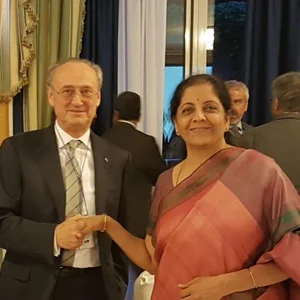
Indian Finance Minister Nirmala Sitharaman recently presented the State Budget. Previously Mr Sala, in the role of President of Amafond, has met with Mrs. Sitharaman, and discussed the future of metallurgy between the two countries. The meeting will soon be repeated during the next 2020 Italian diplomatic mission to India.
AlCircle: What do you think of India's 2020 budget?
Maurizio Sala: One of the cornerstones of India's budget involves taking action to attract investment. Despite being the fifth industrial power in the world, it must approach institutional investors such as the IMF, WB, EIB and sovereign wealth funds. Here the role of EU-based metallurgy stands out. The number of the aluminium firms involved in this frame is huge. The Indian groups are very active in Italy in the non-ferrous sector, such as Vedanta, Hindalco, and Endurance. And not only in the direction to provide row materials for the production of automotive, but also in the perspective on acquire valid technologies for a larger market.
However, the metallurgy exchange with India concerns Italy in particular, but in the opposite direction, as 3 of the 4 largest Italian steel plants have been acquired by Indian groups. These are the Ilva plant in Taranto, the Ex-Lucchini plant in Piombino and the Magona d’Italia plant, which belong respectively to Arcelor Mittal, JSW, and Liberty Group
AlCircle: So, it’s Indo-Italian steel then?
Maurizio Sala: It is certain that the production of steel in an industrial country like Italy is of great importance, the Taranto plant in particular has an extraordinary importance for the local and national economy and employment. Not only does it have 11,000 direct employees, there are also the subcontractors and ancillary workers which brings that total up to 26,000. The situation with Ilva is a bit of a test case for our industrial and political system.
The relaunch of the Lucchini plant in Piombino, now known as JSW Italy, offers an important opportunity to show that it could become—as happened with Pomigliano and FCA—a excellent manufacturer and a foundation for the relaunch of that part of the steel sector dedicated to transport. When he arrived at the end of January, Sajjan Jindal, head of JSW, was offered a genuine metals and transport engineering laboratory.
AlCircle: Ms. Sitharaman, inaugurated India’s fiscal year with the statement ‘We wish to open up vistas for a vibrant and dynamic economy with a gentle breeze of new technology. This vibrant India shall be a caring society which shall attend to its weak, the old and the vulnerable among its citizens.’
Maurizio Sala: Of course. It is a positive outlook. Narendra Modi's primary aim in India is to combine its industrial growth with an economy of solidarity. Certainly Minister Sitharaman, who has a highly political role in the government and who has replaced a prestigious economist like Arun Jatley, has declared herself ready for major openings on the international stage and wants to involve Europeans in industrial exchange initiatives.
AlCircle: What effect will the Coronavirus have on the Italian interface with the two Asian giants?
Maurizio Sala: It will certainly no longer be the same. The Coronavirus disaster has severely affected the globalism of modern China and the political leadership of Xi Jinping itself. Paradoxically, as the western pole of Asia, currently India has turned out to be much less vulnerable than China. India's disaster recovery has proven to work well in climatic and even health contingencies. India manages to maintain a balance between its rural areas and the most advanced economy where impressive innovations in the automotive and transport sectors indicate precisely the important role played by engineering and metals.
AlCircle: So, what does this mean from the Amafond perspective?
Maurizio Sala: The main growth in the Indo-italian Metal hub is related to the various format of aluminium industry. In India the numbers of applications and the technology skills was clearly visible in the past edition of INCAL in Bhubaneswar 2019. Thanks to the action of dr. Mishra and dr. Satpathy, INCAL 2019 had a spectacular diffusion in the critical sectors involved: primary, secondary, extrusion, diecasting, recycling of scraps.
In the 2020 Budget there are strong measures to encourage the production and sale of Indian Primary Aluminium abroad by the large groups—Vedanta, Hindalco, Nalco and Balco—and to reduce Indian dependence on secondary production and in general production from other countries’ scrap metals. There are incentives to reduce the cost of fuel for steel production: this concerns above all Tata Steel, SAIL, JSW, JSPL, and Arcelor Mittal.
AlCircle: How do you interpret the 2020 Indian Budget in the automotive sector and how does it compare to Italy?
Maurizio Sala: India is the world's fifth largest automotive manufacturer and the world's leading motorcycle manufacturer. Two sectors closely related to each other and operating mainly in the manufacturing centers of Pune and Chennai. Many Italian companies are active with plants in the Pune area, near Mumbai, including FCA, Piaggio, Brembo, Danieli, OMR, Streparava, Dall’Orto, Bettinelli, Camozzi, and others. On the other hand, 10 years ago European car production was 27% of the global total, while today it has fallen by 7 points. For Italy, the most recent industrial production data shows a significant slowdown in the domestic automotive sector, from -11.4% in the fourth quarter of 2018 to -9.5% in the first quarter of 2019, to -9.7% in the second quarter, and the same obviously applies to the parts and accessories production industry.
It's important to remember that the automotive sector in our country includes around 6000 companies, many of them SMEs, with about 160,000 direct employees, which increases to 250,000 when you consider related industrial activities. In India, this global supply-chain involves 8,000,000 employees. Automotive represents about 7% of total employees in the entire Italian manufacturing sector and 5.6% of Italian GDP, we are talking about a production value of 93 billion euros, of which 24 billion is exports.
AlCircle: And what will India and Italy do in this context?
Maurizio Sala: Their economies are not so hawkish, but if we focus on the metallurgy of ferrous/non-ferrous metals, Italy will be able to greatly increase exchange in this sector following the end of this two-year decline. But our automotive export, which currently has volumes similar to that of India, cannot be compared to a sector that produces 30,000,000 vehicles (included 2wheels) and exports almost 5,000,000 (included 1000.000 automobiles) of them every year and which will shortly reach production volumes with a value of up to 300 billion euros over the next five years.
AlCircle: What emerged for aluminium network in the recent Amafond general assembly in November?
Maurizio Sala: According to Amafond and Assofond—Italy’s two largest business aluminium associations, for Foundry Suppliers and Foundries respectively—the major drive for the industry bounce back will be the expected recovery of automotive industry production by mid-2020. High confidence is particularly focused on a recovery in the major German car manufacturers market, whose remarkable drop in production over the last year has so strongly affected the business performance of the Italian non-ferrous industry—the second largest in Europe.
AlCircle: What are the important upcoming events for the Italian sector?
Maurizio Sala: First of all, the Italian System mission to Delhi and Bangalore led by Ambassador Vincenzo de Luca, recently installed in the New Delhi Embassy. Then there are two major industry events that involve our countries, Metef and MECSPE in Bologna and INCAL in Bhubaneswar, in Eastern India. Both will be taking place in the first quarter of 2021.

