您想继续阅读英文文章还
是切换到中文?
是切换到中文?

THINK ALUMINIUM THINK AL CIRCLE

Estonia, a country in Northern Europe, formerly part of the Soviet Union, borders the Baltic Sea and the Gulf of Finland. Including more than 1,500 islands, its diverse terrain spans rocky beaches, old-growth forest and many lakes.
The economy of Estonia is an advanced economy and the country is a member of the European Union and the Eurozone. Estonia's economy is heavily influenced by developments in the Finnish and Swedish economies. The major industries of the nation are engineering, electronics, wood and articles of wood, textiles, information technology, and telecommunications.
{alcircleadd}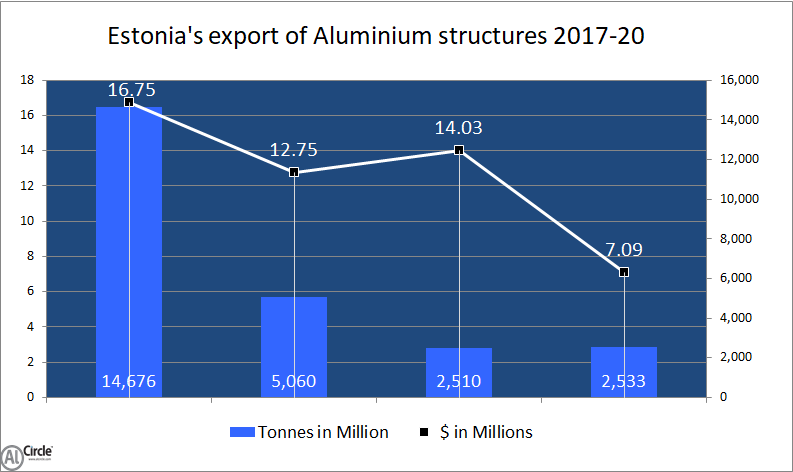
The Northern European nation’s export of aluminium structures has been marked with a step fall during 2017-19, as the total volume of export and revenue income during the period remained at 22,246 tonnes and $43.53 million. The export projection for 2020 has been recorded at 2533 tonnes and revenue generation to drop at $7.09 million.
Estonia’s export of aluminium structures in 2017 has been recorded as the highest in the four years, as the volume stood at 14,676 tonnes and the income remained strong at $16.75 million, whereas in 2018 the export saw a steep drop by 65.52%, as the volume stood at 5060 tonnes, although the income remained at $12.75 million.

The export in 2019 was recorded at 2510 tonnes, de-growth by 50.39% and the revenue generation stood at $14.03 million. The estimated for export for 2020 has been analysed at 2533 tonnes.
Estonia’s export partner for aluminium structures: Austria, Bahamas, Canada, Denmark, Finland, Iceland, Germany, Latvia, Netherlands, Norway, Sweden, UK, etc.
Responses





_0_0.png/500/0)